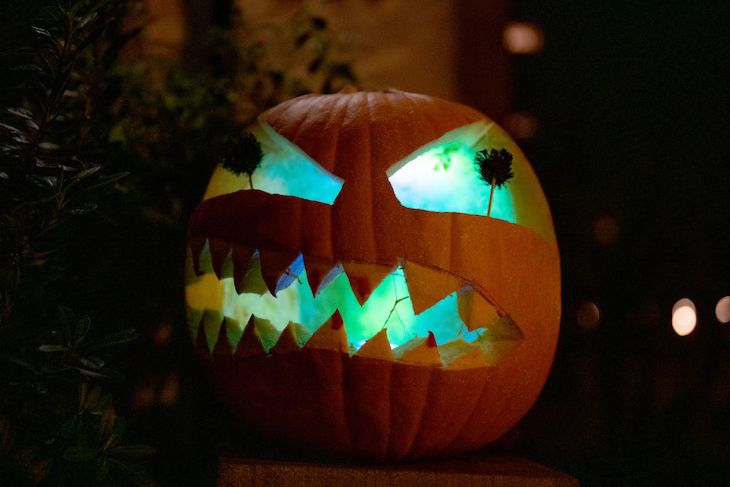
Three years into my medical career, I worked with a doctor called Darren. Darren was excellent. Calm, sensible, highly intelligent and extremely experienced. Friendly and supportive, he was sober in demeanour and scrupulously polite. So it was refreshingly out of character for him to attempt a shortcut through the geriatric ward on the night of the mess Halloween party, when dressed as the Grim Reaper.
That Halloween is chiefly about sweets for little kids, and costumes and sweets for teenagers, doesn’t entirely efface its origins
“Perfectly natural to think about death, to be befuddled and anxious and even terrified of it,” wrote Joseph Epstein, “but it would be a mistake to let it spoil your day.”
To say we’re heeding this advice at Halloween – easing our dread by mocking our own mortality – goes too far. For grumpy adults like me the night is a sorry spectacle of Americanisation, until we remember that it was Irish and Scots emigrants who carried guising and turnip lanterns across the Atlantic, and what we’re suffering from is repatriation.
For kids it’s about sweets and fun and more sweets. Fortunately, sour as I am, I can still remember the fun of being a child. Tonight there’s a carved pumpkin outside my door, and a bowl of sweets waiting inside for the village trick-or-treaters who, unlike in my day, never trick, and are always polite. Nobody, least of all me, takes seriously my suggestion that we trick them ourselves by offering callers a choice from a platter of fruit.
We do take death seriously, which means it makes for good jokes. Epstein told of an avid golfer returning late to a furious wife, and winning her sympathy by explaining that, on the third hole, their friend Irving had a massive heart attack and dropped down dead.
“How awful,” she exclaims. “You don’t know the half of it,” her shocked husband replies. “For fifteen holes! Hit the ball, drag Irving; hit the ball, drag Irving.”

That Halloween is chiefly about sweets for little kids, and costumes and sweets for teenagers, doesn’t entirely efface its origins. Festivals for the dead are common, often as the nights draw in, and our Halloween customs may blend the Christian and Roman and Celtic. Dressing up as death and playing with our fears may come second to Haribo, but it’s still in the mix.
Decades ago I returned from a friend’s stag-do in Madrid with a reproduction of Goya’s The Third of May. An illuminated man holds his arms aloft while facing the firing squad, alongside the corpses of his comrades and the cowering figures of those also about to die. His arms suggest the crucifixion, but I always felt that his stance declares his triumph. In his final moments, death does not diminish him.
Sometimes defiance needn’t be heroic. A handful of Haribo will do. “You are a philosopher, Dr. Johnson,” an old friend of his said, encountering him after many years. “I have tried too in my time to be a philosopher; but, I don’t know how, cheerfulness was always breaking in.”
Whether this lesson has been adequately learned by a man who returned from a stag weekend with a death-soaked Goya is a good question. I also brought back his Saturn Devouring His Son and another of a terrified cat, but alongside them I carried La Maja Vestida. Even melancholy fools notice beautiful women.
Odd, our modern desire to die in our sleep, to be unconscious of the final great experience of our lives. Most deaths I see are gradual, age and frailty creeping in as insidiously as dusk. A late friend, born in 1922, said he wanted to die neither too slowly nor too quickly, because he wanted to see what it was like. I have been awed by a woman who refused morphine as her lungs filled with fluid, determined not to risk dying with her consciousness impaired.
Asked one Saturday to check on a priest, a World War Two veteran, I popped my head round the door. “AM I DYING?” he bellowed. I’d never met him, but said his weekday team had told me he was. He nodded approvingly. “WHAT NEWS OF THE ANGLICAN COMMUNION?” he boomed on the Sunday. I was at a loss, but enjoyed his company. On Monday he died.
Kids aren’t reflecting on mortality when they dress as vampires or, as my fifteen-year-old daughter did, as David Bowie. They’re getting on with life, and embracing an excuse to dress up and have fun – and, as I discovered after a recent party, mildly alcoholic premixed cocktails. We don’t need to think about death in order to demonstrate our refusal to let it govern and spoil our lives.
Pessimists say mortality continues to run at a hundred per cent. “Not while I walk the wards!” this doctor replies. But one day I may not, for age has sharp teeth. Have I mentioned my left knee is now not so good?
I don’t remember much of that Halloween mess party, the hours long since lost, but I remember Darren. The nurses locked him out of the ward, quite reasonably. With his black hood over his face and his scythe in his hand he stood outside in the darkness and knocked at the ward windows. And then went to the party.



Comments