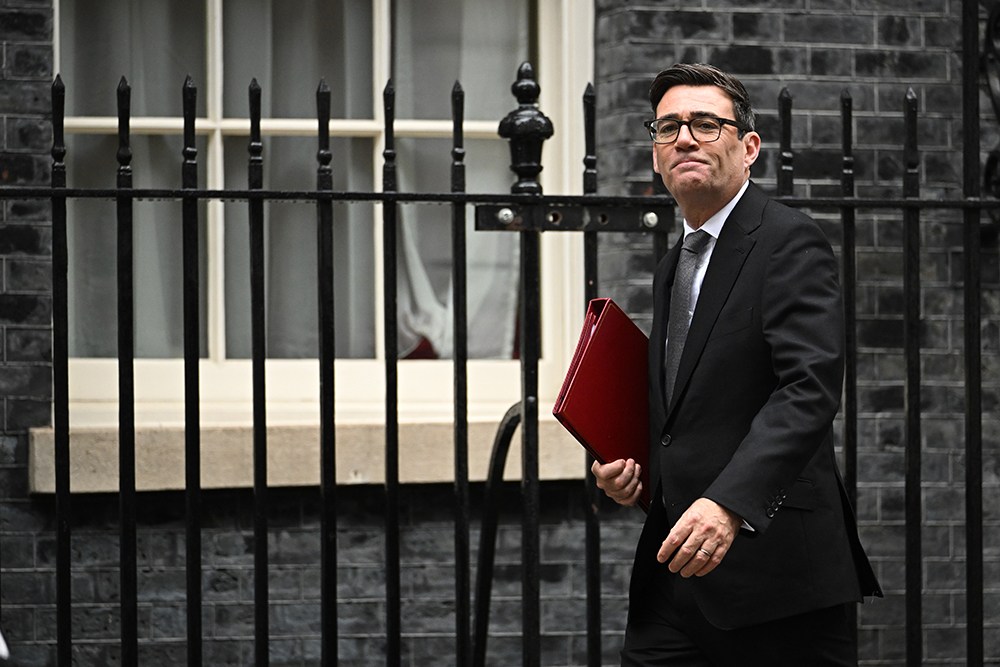
Andy Burnham says in a couple of interviews that he wants an ‘honest discussion’ about free movement, and then Downing Street indicates that perhaps he doesn’t. Many interpret this as poor ‘message discipline’. I don’t think so. The key to Mr Burnham’s behaviour is to remember two things. The first is that, even after 100 days in office, he still wants to be as different as possible from Sir Keir Starmer. That means he must be seen at all times to welcome open discussion, talking like a human being not a robot. The second is that he wants to keep open the possibility of calling a general election next year. The ‘breathing space’ he says the country needs is really what his party needs. His talk about free movement is intended to signal to Lib Dem/soft Tory/southern middle-class Labour voters that he feels their pain about Brexit. Downing Street’s semi-rebuttal is intended to reassure Red Wall, Reform-adjacent, northern working-class Labour voters. The Prime Minister’s loose talk and Downing’s Street’s appearance of reining it in are tactically complementary. This week’s Budget operates on the same principle, if principle is the right word.
As I walked across Smith Square on the eve of the Budget, I noticed a sleek chauffeur-driven car circling slowly. Its number-plate was 27 EU. Perhaps it was hoping to pick up a rudderless country.

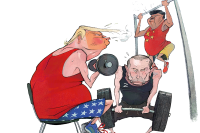
The worsening grimness in Ukraine is starting talk of a settlement once again. Steve Witkoff thinks this is best done by recognising Vladimir Putin as ‘a great humanitarian’. Saner voices, led by Matthew Parris in the Times, seek some better formula for peace. Matthew attacks the ‘not-an-incher’ camp and calls for ‘steadfastness in the pursuit not of absolute victory but a dispassionate acknowledgment of what is and is not within our grasp’. That sounds right, but it does not cite any evidence that Putin would respond in good faith. Since his softening is not ‘within our grasp’, that puts all the pressure on Ukraine to make the concessions. Matthew is right that some Ukrainians have ‘a half-furtive willingness to think about a deal’. But how can they possibly make one with nothing secure on offer in return? Why should they? The ‘reasonable’ westerners in this situation are making the same mistake as they made in the 1930s of thinking that their adversary wants something that could be partially accommodated. Now, as then, the dictator is unappeasable. He has to be stopped, not soothed.
Seventy years ago this week, I was in the process of being born. Because there were complications, my mother had to lie still in a hospital bed in Hastings for two or three weeks before I arrived. At the time, my father was writing leaders for the News Chronicle, struggling down from London on that infamous railway line whenever he could seize a few hours. He was extremely busy because two acute crises were dominating the news – the Middle East (Suez) and Russian aggression (the Soviet invasion of Hungary). Is it deeply depressing that versions of the same themes dominate our news right now, or is it somehow comforting that we have been here before and survived?
The three Caribbean countries which the King is visiting all owe their existence as modern states to Britain. They also all suffered through slavery from British rule, though Britain was the first colonial power to sustain its abolition. The same existential point applies to the Commonwealth, whose conference in Antigua the King will address. The Commonwealth secretary-general, Shirley Botchwey, wants reparations, but works in tremendously privileged comfort from Marlborough House, literally a stone’s throw from the King’s residence. Britain’s history with these countries has been like a marriage – for better and for worse. Reparations, like alimony, would be a symptom of divorce.
Jimmy Lai, the most famous dissident and oldest of the 1,200 political prisoners in Hong Kong, will be 79 on 8 December. He will spend the day alone in Stanley Prison, on an otherwise empty floor in a cell with no natural light, where he has been held for almost all of his nearly six-year captivity. Despite being a British citizen, he is denied all consular access. His latest sentence, for collusion and sedition, delivered in February this year, is for 20 years, but that day will almost certainly not come because Mr Lai suffers from diabetes, a heart condition, high blood pressure, failing eyesight and hearing, for all of which he receives inadequate medical treatment. A devout Catholic, he has been permitted the sacraments on only a handful of occasions. His courage is approaching the status of martyrdom. A West Country reader writes with an excellent suggestion which would show solidarity with Mr Lai without making any political statement which could provoke rage from Beijing. Send him a birthday card, he says. The instructions are precise. The address is LAI Chee-Ying [his Chinese name], Top floor, Stanley Prison, 99 Tung Tau Wan Road, Stanley, Hong Kong SAR. Prison regulations require that the sender’s address be on the card and the envelope. Only general greetings are allowed; no politics. Two first-class stamps and an Air Mail sticker will cover the cost. To allow enough time, cards should be posted before 20 November. Imagining the prisoner’s pleasure at receiving cards, the reader quotes Auden’s much-loved ‘Night Mail’: ‘And none will hear the postman’s knock,/ Without a quickening of the heart/ For who can bear to feel himself forgotten?’ Please do send.
There is something in ‘Night Mail’ that had not struck me before. Its drama is heightened by the phrase ‘crossing the [Scottish] border’, because it sounds potentially at odds with a unionist message – a universal service across the kingdom. I think this is what is meant by the phrase ‘creative tension’.




Comments