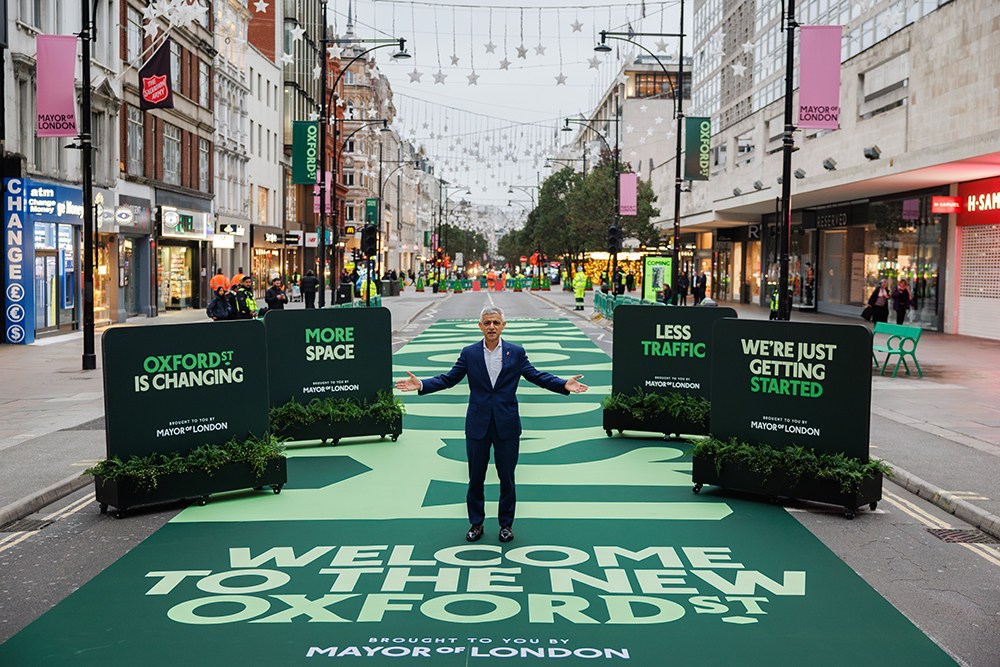
I tried to think positive about the pedestrianisation of Oxford Street, I really did. But on Monday evening, Christmas lights still unlit, it was a dark and dismal canyon. Disappointed crowds shuffled westwards from Oxford Circus, passing boarded-up hulks that were once House of Fraser and Debenhams department stores. Shops called Foot Locker, Garage and Under Armour offered no compensating glamour.
A £150 million budget has so far bought phallic bollards and some street furniture emblazoned ‘Mayor of London’, this being the pet project of Lord (Sadiq) Khan, despite resistance from Westminster council. Montages of the completed scheme show trees down the middle – but no fountains, bandstands or tented cafés. It’s a big space that seems to lack a big concept. Or does it?
An architect friend’s remark that Oxford Street is ‘a shopping experience from the past’ made me wonder whether Khan, in the Burnhamite mood of yearning for pre-Thatcher Britain, aims to turn this faded boulevard into a 1970s theme park. All it needs are ‘Closing Down’ banners, militant pickets blocking Bond Street station and a sculptural pile of uncollected binbags.
Dire state
Will pre-Christmas shoppers divert from Oxford Street to press their noses against nearby estate agents’ windows? The dire state of the capital’s property market attracts media attention mostly at the luxury end, but it’s a catastrophe from top to bottom, especially in the new-build sector, with immeasurably adverse impacts on commercial activity, labour mobility and community life.
In 2022’s post-Covid bounce, more than 20,000 new homes were sold in London. In the first half of 2026, the number (according to the Molior Consultancy) was 5,606. In a conurbation that theoretically needs 88,000 new units per year, a fraction of that target is being built but many remain unsold. At the lower end, sales of older flats are stymied by post-Grenfell cladding issues, while first-time buyers are rarer than the newts whose wellbeing often halts bulldozers. In the mid-market, buy-to-let lost much of its rationale when values stopped rising and has been killed by the Renters’ Rights Act. At the top, sales above £5 million have fallen 80 per cent as the wealthy stampede for the exit.

Is there any policy initiative that would offer a London home for everyone, high or low, who might add to the city’s vitality? Or do we have to wait for Joseph Schumpeter’s ‘perennial gale of creative destruction’ to bring supply and demand into balance, whatever the collateral damage? Radical reform of stamp duty, planning and building regulations would be an obvious start, as would electing a mayor who genuinely wants to make his city more liveable and prosperous. A multimillion-pound Oxford Street vanity project will make no difference at all.
Hang on to democracy
The electric car maker Tesla peaked as a hot stock last December. Its zenith as a design pioneer arguably came much earlier, with the launch of the Model S in 2012, and it has since left many promises unfulfilled. Now its chief executive and 20 per cent shareholder Elon Musk has diverted from interfering in Ukraine and the US midterm elections to propose a merger of Tesla with his rocket venture, SpaceX. He plans to maintain personal control of this $3.5 trillion market-listed monster through a special class of shares carrying ten times the votes of those held by ordinary investors.
Musk is a visionary entrepreneur but a public menace, and his Tesla-SpaceX power grab illustrates the growing anti-democraticmindset of his ilk of US tech billionaires. Meta founder Mark Zuckerberg wants to create non-voting shares (of which he would sell his own allocation to pay his Californian wealth tax bill) that won’t dilute the 60 per cent control he exercises through existing ‘super-voting’ shares, despite only 13 per cent economic ownership. And the cloud-computing giant Oracle, 40 per cent owned by Larry Ellison, is likely to adopt a rule which would prevent small shareholders putting proposals to a vote at annual meetings.
This rough-riding over wider investor interests is a Trumpist trend that may meet its reckoning if markets crash. Over here, ‘dual share’ structures weighted towards founders and their families went out of fashion several decades ago – but recent rule changes have made them possible again, with the aim of encouraging hotter listings on the London Stock Exchange. Few have come forward, however, because valuations in London are still too low. And watching America, we might conclude we’d rather cleave to the democracy we treasure, whether in politics or share-owning.
French prep
Am I prepping? Defiantly not, at least for the time being. But if doomster voices succeed in persuading me that civilisation is on the verge of collapse, I’ll head for my rural Dordogne hideaway – by bicycle if necessary – in the belief that the survivalist lifestyle will be softer there, even as anarchy and arson overwhelm French cities.
I shall stock up locally on large jars of duck cassoulet and €17 magnums of Vin de Domme Perigord Noir, both robust enough to last until the Second Coming. And if there’s still intermittent broadband and a vestige of a stock market, I shall pause from cabbage-planting to scan for undervalued French shares. The CAC 40 index of leading stocks has dipped only 10 per cent during the recent turmoil, an indication that corporate France is in considerably better health than its debt-crippled government. Online tipsters aplenty can help you explore this theme, but my own eye falls on the luxury brands sector, where world-class names such as LVMH, Hermès and Kering (owner of Gucci and Yves Saint Laurent) have fallen hard this year. Based on traditional craftsmanship rather than out-of-control AI, selling beautiful things to lift our mood as scare stories recede, they’re surely good for long-term revival.





Comments