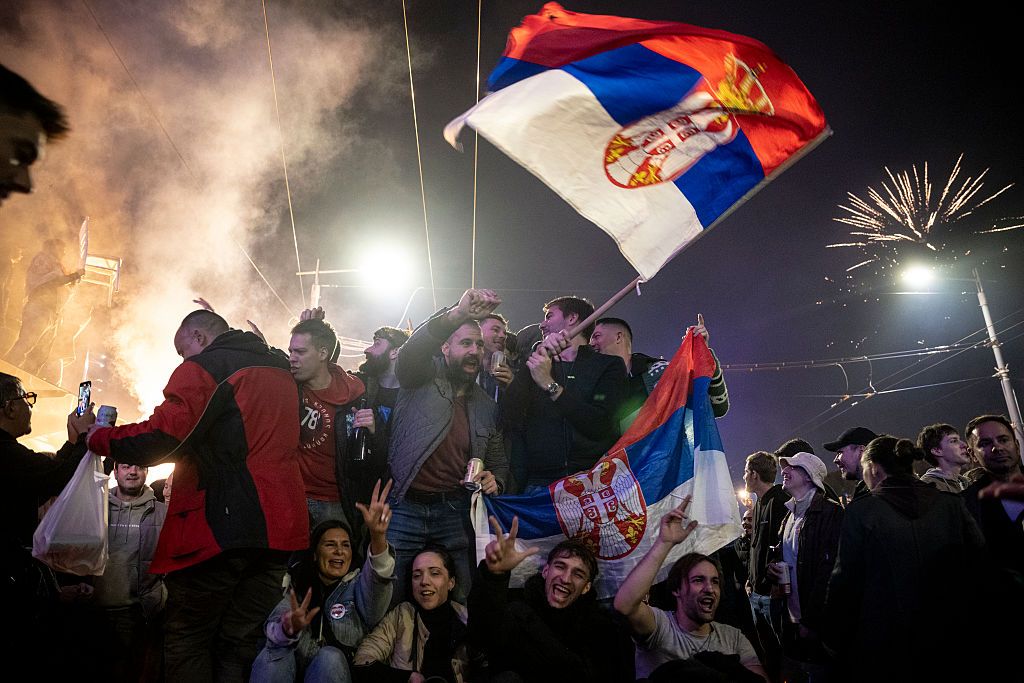
Serbs have been partying on the streets for two days after a leaderless student movement dethroned Aleksandar Vucic in a parliamentary election, ending 14 years of rule by his Serbian Progressive party (SNS).
A movement without a leader or detailed manifesto has defeated a government with more money, media access and organisation
Few pundits expected the students to win, let alone by such a large margin. Yet within 90 minutes of polling stations closing on Sunday night, Vucic had conceded defeat. The SNS, which has dominated Serbian politics since 2012, was out of power.
Vucic’s composed announcement suggested he had anticipated defeat and wanted an orderly transfer of power. The gendarmerie, deployed throughout the day, stood down. Groups of men in black who had earlier marched through the streets disappeared as revellers set fire to a pro-government camp outside parliament, known as Caciland.
Preliminary results from the election commission gave the Student List 52.65 per cent of the vote, against 39.22 per cent for Vucic’s United Serbia. No other non-minority party cleared the 3 per cent threshold to enter parliament. Turnout reached nearly 69 per cent, its highest level since 1992.
The result is a political earthquake. A movement without a leader or detailed manifesto has defeated a government with more money, media access and organisation. Many Serbs, myself included, expected the SNS to scrape a victory. We underestimated the appetite for change and the infectious energy of the students’ campaign.
The movement began after the roof of a newly renovated train station in Novi Sad collapsed in November 2024, killing 16 people. Just months earlier, Vucic had hailed the station as a symbol of Serbia’s progress. Mass protests followed, demanding resignations and the release of classified contracts related to the station’s reconstruction.
Student organisers blockaded universities and organised demonstrations for months, drawing hundreds of thousands onto the streets of Belgrade, Novi Sad and Nis. Their demands eventually expanded to include early elections.
Vucic finally gave in, resigning as president in the hope of returning as prime minister. The election became a referendum on his rule and 14 years of SNS government.
The students’ campaign combined grassroots organising with social media savvy. They travelled by bike and on foot to small towns and villages, meeting older voters who might normally vote SNS, which had promised election handouts and pension rises. Online videos captured grandmothers kissing the students as they marched past.
The campaign bridged a generation gap. Serbs who might otherwise have little in common with the students shared their frustration with corruption and a system that rewarded political loyalty with jobs and promotions. Many were inspired by young people who chose to fight for their country rather than emigrate, as so many talented Serbs do. Social media helped the movement reach voters despite the hostile coverage on national television.
Years of scandals and the entrenchment of the country’s political elite fuelled the desire for change. So did the high cost of living and failing public services, with hospitals lacking basic supplies like soap and toilet paper. After 14 years in power, first as prime minister and then as president, Vucic became synonymous with the country’s problems.
Now comes the harder part. The Student List has won a mandate to govern, but its lack of a leader or clear policy programme could make forming a government difficult. Its MPs include doctors, academics, engineers, artists, farmers and sportsmen. Few have any political experience.
Ilija Srdanovic, a cardiologist from Novi Sad whose name topped the Student List, has resisted taking on a conventional leadership role. It is unclear who will become prime minister, how ministers will be chosen, and who will be nominated for president come elections in December.
There are signs that the euphoria could give way to lawlessness. As Belgrade partied on the streets for a second night, some angry men decided to smash the windows of the notorious tabloid Informer and storm its offices live on television. Vucic took to social media to call for calm, as did the country’s newly elected MPs.
Police later came out in force to protect media outlets associated with the old regime, while citizens danced outside public broadcaster RTS. RTV, its sister organisation in Vojvodina, began its evening broadcast by apologising for its hostile coverage of the opposition and its failure to hold the government to account.
Reforming the media will be one of the students’ priorities, alongside overhauling a judiciary widely seen as lacking independence. They want jobs to depend on merit and public appointments to stop rewarding political loyalty. But they have offered little detail on how they will deliver, manage the public finances or handle international relations.
The first tests will come quickly. Serbia’s only oil refinery faces another shutdown if the US does not extend a sanctions waiver for Russian-owned oil company NIS. A proposed sale of the Russian stake to Hungary’s MOL could resolve the impasse, but depends on Moscow agreeing to sell. Any disruption to supplies could drive up fuel prices and inflation.
Then there is Expo 2027, the international exhibition due to open in Belgrade next May, which the outgoing government staked considerable sums on delivering. Opposition figures have called for investigations into Expo contracts, while some have suggested cancelling the event. The new government must ensure it goes ahead if it wants to reassure investors that Serbia remains a predictable place to do business.
There is a risk that investigations into officials and businesspeople linked to the old regime could become entangled with political score-settling. Lustration may satisfy a public hungry for accountability, but a purge could undermine investor confidence and distract from policymaking.
Beyond these immediate pressures lie harder questions about Serbia’s foreign policy, its stalled EU accession process, its energy ties with Russia and its refusal to recognise Kosovo. The EU expects Belgrade to normalise relations with its former province as part of the path to membership.
A movement united by opposition to the old government and a desire for fairer institutions must now agree on policies over which its MPs may vehemently disagree.





Comments