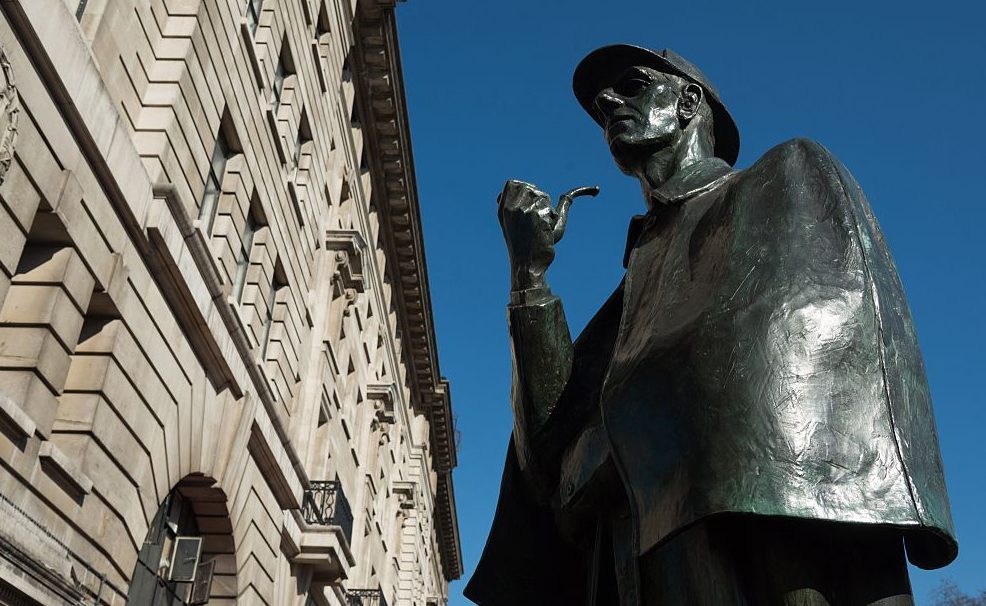
Sir Arthur Conan Doyle was, at the end of his life, a committed Spiritualist, and so knew all about authors writing posthumously from the Other Side. But he might still have been taken aback by Sherlock, a book of short stories which has a profile of the great man on the cover in his distinctive deerstalker and meerschaum. Closer inspection shows it to be ‘authorised by the Conan Doyle Estate’ rather than authored by A. Conan Doyle, but the reader’s first response is, goodness, is there more Sherlock out there?
It’s a bid by the literary estates of the authors to squeeze more from their authors once the original copyright expires
At second glance, you see: ‘Ten New Stories, Ten Incredible Writers; the Game is Afoot…Again’. With a sinking heart, you note the inevitable ‘With an introduction by Stephen Fry’, which is a brisk trot through the terrain, with winsome references to his own work. Inside, the stories are by assorted ventriloquists, from Kate Mosse to Anthony Horowitz, most trying hard on the period detail but missing the mark on the indefinable element of tone, like most historical fiction. The one successful story, by Janice Hallett, set in the Baker Street Underground police department, is based on the actual Scotland Yard programme for collating details about a crime with the acronym H.O.L.M.E.S., established in the 1980s.
It’s not just Conan Doyle. Agatha Christie has been resurrected from the grave umpteen times, courtesy of the Agatha Christie estate, with her name lent to various stories featuring her creations: Poirot in the case of Sophie Hannah, and most recently, Miss Marple in the case of Lucy Foley. Look, Agatha Christie wrote 66 works of detective fiction… enough to keep anyone going. In the case of Sophie Hannah, the reader might easily be misled by the books with Agatha Christie’s distinctive signature prominently at the top of the cover, with that of the actual author in much smaller type below.

Then there’s Bond, whose body has been snatched by umpteen writers, from Sebastian Faulks to Anthony Horowitz. The first ghoster of Bond was Kingsley Amis, who was commissioned by Glidrose Productions, the Fleming literary estate, to tidy up The Man with the Golden Gun. Glidrose didn’t accept the amended version, but the estate did commission him to write a follow-up, Colonel Sun. Fleming’s widow, Ann, vetoed any further novels.
It didn’t stop the appearance of a succession of other authors inhabiting Bond’s carapace, with varying degrees of plausibility. Granted, the films, which took on a life of their own, took more liberties with the character, but the authors did their bit to flesh out the brand and Bond’s original chilling persona. Blame Sebastian Faulks for making the continuation concept respectable. The nadir must surely be Charlie Higson’s On His Majesty’s Secret Service (2023), in which Bond is a progressive, centrist individual who battles the evils of right-wing populism. His latest, King Zero, is out now, but at least Higson’s name is prominently on the cover; the ‘James Bond novel’ line is in smaller type.
Some continuation stories are well done. Nick Harkaway has just published The Taper Man, a successor to Karla’s Choice, featuring his father John le Carré’s creation, George Smiley, which I’ve just started and am enjoying (though I was startled to find that Smiley and his colleagues wore wedding rings in the Sixties; I fancy not).
Now, it may be the case that children inherit their parents’ genius, but it’s a different matter when they take over their actual creations. If it were that easy, The Exploits of Sherlock Holmes by Arthur Conan Doyle’s son, Adrian, with John Dickson Carr, would be as good as his father’s pieces (and at least it had an authentic period confidence). The trouble with almost all continuation fiction that seeks to channel an earlier time is that it may get the Bakelite phones and the teacups right, but it ends up importing the contemporary mindset in some form or other, quite often through the author’s preoccupation with sexism and gender equality.
Children’s books are especially susceptible to the body-snatching habit. The most brazen appropriation of an author’s brand I’ve come across is the new How the Grinch Stole Christmas (According to Max). The cover channels the style of the original Grinch (who appears on the side). At the bottom is ‘Dr Seuss’. In smaller type on the cover, we find ‘Based on How the Grinch Stole Christmas!’ You have to turn to the title page to find that the author is, in fact, Alistair Heim, and that the book is illustrated by Aristides Ruiz, whose illustrations channel quite astonishingly the style of the original drawings.
That itself is a sequel to the 2023 How the Grinch Lost Christmas by the same author and illustrator, which must come as a surprise to readers who mourned Dr Seuss in 1991. While Dr Seuss may have died, Dr. Seuss Enterprises lives on to authorise these new creations. There’s lots more out there; Margret and H. A. Rey’s Curious George, the charming adventures of a curious monkey, had a prolific, dismal afterlife following its creators’ deaths.
The A. A. Milne estate is celebrating the 100th anniversary of Winnie-the-Pooh (and, less happily, the expiration of the UK copyright on Pooh in the New Year) with the publication of A Little Boy and His Bear by Jane Riordan, which she describes as her way of making sure that Pooh’s promise to Christopher Robin that he would never, ever forget him would come true. It’s a charming thought, and there’s a valiant attempt to capture the spirit of the original, but it’s painfully not the original. It reminds us how big a mistake it is to out-whimsy Pooh, as in ‘At Night I like to sleep a lot / But there are some who seem to not’, etc.
And although the copyright on Ernest Shepard’s drawings doesn’t expire until 2047, Andrew Grey’s illustrations do look strikingly similar.
Now, the problem with all these things is that, with rare exceptions, the sequels and continuations diminish the brand. They are almost always less good than the original, usually way less good. Most often, it’s a bid by the literary estates of the authors to squeeze more from their authors once the original copyright expires, but they diminish the thing they exploit. Too bad that an author’s creation should die with him or her, but you know what? It’s better that way.





Comments