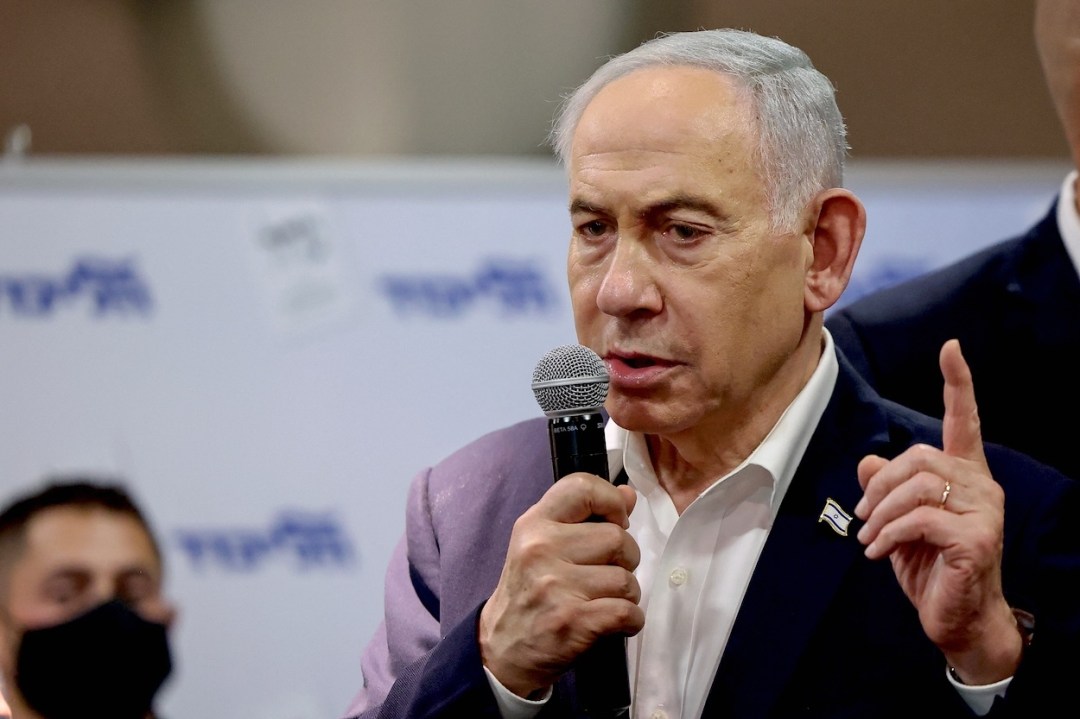
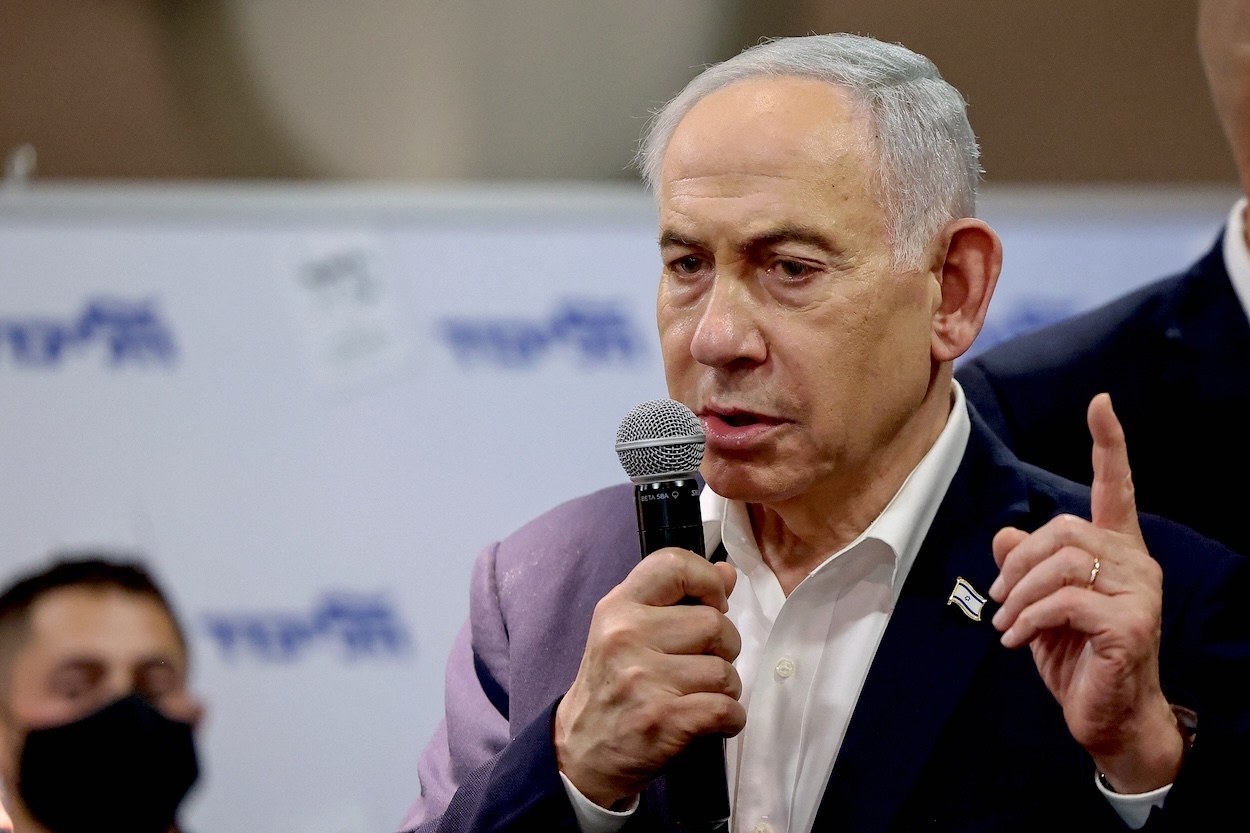
Next Tuesday, Israel holds elections for the first time since the appalling attacks of October 7, 2023. After such a sadistic onslaught, which happened on Benjamin Netanyahu’s watch, many pundits predicted his political days were numbered (though it’s worth noting that neither Roosevelt nor George W. Bush were expected to resign after Pearl Harbor and 9/11 respectively – indeed both were subsequently re-elected.)

But Israel is tiny, and in per-capita terms, the loss of life on October 7 was 12 times worse than 9/11 was for the US; 89 times worse than the Bataclan massacre in Paris, 140 times worse than 7/7 in London. And the horror in Israel went far beyond the numbers of deaths: it included rapes, mutilations and torture, the murder of babies and Holocaust survivors, and thousands of rockets fired at Israeli civilians from all directions.
Hamas’s hostage-taking alone was, per capita, 110 times the rate of America’s 1979 Iran hostage crisis, an event which still traumatizes America today. Israel’s kidnapped citizens were not adult diplomats like the US hostages, or journalists who had entered a warzone like ISIS’s hostages. They included young children without their parents, elderly women, a disabled teenager. They were held not above ground like the US hostages, but starved and raped in underground tunnels, some without seeing daylight for over two years. Others were hidden, chained up in UN-run hospitals.
Understandably, many Israelis held Netanyahu responsible for the security failure. Even before October 7, they felt Netanyahu had probably outlived his political usefulness. He has now been prime minister for 19 of the last 30 years, heading six separate governments. Unlike the US or French presidential system which sets term limits, Israel has a parliamentary system based on proportional representation. So, while politicians and parties might tire of their leaders, prime ministers can go on for as long as voters want them. Arguably, Margaret Thatcher and Tony Blair might well have been elected for a fourth or fifth term had it not been for opposition from within their own parties.
Netanyahu is currently running neck and neck in the polls with his main challenger, Gadi Eisenkot, a former army chief of staff from a working-class Moroccan-Jewish background. Many Israelis regard Eisenkot as having personal integrity, and are sympathetic to a man whose son and two nephews were killed in Gaza.
But others say he lacks the political, diplomatic and economic experience required to hold a complex coalition together at home and win over allies abroad. He speaks poor English and also lacks Netanyahu’s eloquence in Hebrew. Nevertheless, Eisenkot may end up as Israel’s next prime minister if he can forge agreements with six opposition parties. But three other scenarios would see Netanyahu remain in office: first, if right-wing parties that back him win a majority; second, if neither leader is able to form a government and Netanyahu invites Eisenkot to join a broad centrist coalition (which many Israelis favor), one in which small religious parties no longer have undue influence; and third, if in the absence of any agreement, Israel holds fresh elections a few months later with Netanyahu staying on as caretaker prime minister.
Netanyahu is undoubtedly divisive. Within Israel, he has become something of a hate figure, not just on the Israeli left, but among political rivals. Former prime ministers Ehud Olmert and Ehud Barak, outplayed by Netanyahu, are now largely irrelevant in politics. This hasn’t stopped them seizing any opportunity to denigrate him in international media. Netanyahu supporters put this down to bitterness and jealousy.
But Netanyahu is also a hate figure for many outside Israel. While some charges may be justified – he has allowed the conflict in the West Bank to fester, for example – others are not.
Many Jews and others feel Netanyahu has become the “Jew in world politics” – the whipping boy responsible for all the world’s ills, far beyond anything he has actually done.
The anti-Netanyahu hysteria on social media or at rallies in western capitals can grow so intense that on occasion it even calls to mind the “Two Minutes Hate” in George Orwell’s Nineteen Eighty-Four, in which the Party whips up a frenzy of hate towards the fictional Emmanuel Goldstein as a useful escape valve – with one (Jewish) individual being held responsible for all the problems in the world.
What, then, explains Netanyahu’s continuing appeal?
Even some supporters of Israel feel the need to single out Netanyahu for opprobrium every time they defend the country, implying that there would somehow be “peace in our time” if it wasn’t for Bibi. They seem unaware that, despite many deep divisions across Israeli society, there is a near consensus on issues of national security. Neither Eisenkot nor Israel’s left-leaning Labour party (now named the Democrats), nor even Israeli-Arab parties are calling for Israel prematurely to withdraw from Gaza or the West Bank, at least not until Palestinian leaders show a genuine interest in finding a durable peace deal.
What, then, explains Netanyahu’s continuing appeal?
Firstly, and often lost in the whirlwind of media reporting about the war, is Israel’s remarkable economic performance – usually the deciding factor in any national election.
Netanyahu’s earlier administrations are widely credited with liberating Israel’s economy from socialist stagnation to become one of the world’s most dynamic and innovative countries. The IMF now puts Israel’s GDP per head at $69,800, above Germany ($65,300), Britain ($61,000) and France ($51,200).
According to the new IMF report released this month, Israel is currently the fastest growing developed economy, at 4.5 percent a year, above Denmark (3.7 percent), the US (2.3 percent), the UK and Germany (both 1.3 percent) and France (a miserable 0.4 percent). Since the outbreak of war, Israel’s main stock market index, the TASE, has soared a staggering and unprecedented nine-fold.
Then there is the renewed sense of security in Israel. Netanyahu’s successful prosecution of a multi-fronted war that many experts thought was near impossible has helped mitigate a sense of his responsibility for October 7. Often defying the advice of his own military, not to mention intense pressure from the Biden administration to “show restraint,” he has decisively pushed back Hamas, Hezbollah and Iran, as well as helped topple the murderous Assad regime in Syria. The shelling of Israel’s northern towns and villages has subsided. Israelis have emerged from their underground shelters and feel safer.
Netanyahu also boasts significant diplomatic achievements. While the peace efforts of 14 previous prime ministers have resulted in just two treaties – with Egypt and Jordan – Netanyahu has achieved four (with the UAE, Bahrain, Morocco and Sudan). Relations with the UAE and Morocco have even grown stronger during the Gaza war.
Netanyahu has also managed to establish contacts with Arab regimes such as Syria and Lebanon that still do not have formal ties with Israel. Latest polls show that a majority of Lebanese are thankful to Netanyahu for having degraded Hezbollah and express a desire for Lebanon to make peace with Israel. Many Syrians welcomed Netanyahu’s weakening of the Assad regime, while millions of ordinary Iranians admire Netanyahu’s decisiveness in striking their hated regime.
Although Israel’s international image, especially among western leftists and Islamists has undoubtedly deteriorated, there has been an upsurge in support from conservative leaning countries. Netanyahu has greatly enhanced Israel’s ties with India, Argentina, Azerbaijan, the Czech Republic and Greece, to name a few. Uganda, now a close ally, recently unveiled a statue at Entebbe airport honoring Netanyahu’s brother Yoni who was killed while leading the famous 1976 rescue of 103 Jewish hostages.
Colombia this month became the tenth country to move its embassy from Tel Aviv to Israel’s capital, Jerusalem. Others, such as EU member Slovenia, have announced that they will follow soon. Depending on upcoming election results in Brazil and Spain, relations there may improve again.
Most importantly, Netanyahu has demonstrated unprecedented closeness to the US. With eight visits to the White House since President Trump’s January 2025 inauguration – as well as a record-breaking four invites to address an admiring Congress over the years – Israeli voters might be forgiven for feeling that with Netanyahu, for better or worse, they are in capable hands. Contrast this with the precious few minutes afforded to Britain’s Andy Burnham on the UN General Assembly sidelines, before he addressed an almost empty UN Chamber. Even the UK ambassador in Washington, Sir Christian Turner, admitted privately that it was Israel, not the UK, that had the true “special relationship.”
Donald Trump, for one, would welcome Netanyahu remaining in power, as he made clear in his endorsement last Sunday, referring to him as “a great warrior prime minister and an even greater partner for peace,” and “the kind of partner America needs.”
While, like any successful leader, Netanyahu has some serious flaws and has made enemies along the way, many of the charges against him both at home and abroad haven’t borne fruit. To his supporters, they seem vindictive and have only served to bolster his popularity.
Even some of Netanyahu’s political opponents privately admit that the charges are largely baseless or trivial
For example, Netanyahu’s corruption trial which has dragged on for seven years is widely seen as an attempt by Israel’s leftist media and judicial establishment to drive him from office. To many Israelis, it seems unconscionable that a wartime prime minister should be forced to sit for hours, three times a week, on an uncomfortable court bench in a case that appears to be going nowhere. Recently, the judges reportedly called on the state prosecution to drop the charges because the initial claims now seem incorrect. Even some of his political opponents privately admit that the charges are largely baseless or trivial. If their intention was somehow to label Netanyahu as “corrupt” in order to diminish his public standing, the tactic appears to have failed.
A similar story might be told regarding the International Court of Justice’s genocide accusation. The ICJ Judge Julia Sebutinde from Uganda, for example, has criticized South Africa’s case, arguing that it was political, designed to harass and pressure Netanyahu. Most Israelis agree. To cite but one counter-argument: would Israel have arranged, in September and October 2024, a mass polio vaccination campaign for all Gaza’s 559,000 under ten-year olds, distributed at great risk by IDF soldiers in the midst of the war, if their intention was genocide?
Even Hamas’s own data shows that a large proportion of Palestinians killed have been armed combatants not civilians. As with his domestic problems, many Israeli voters have responded to international attacks by rallying around him.
Much of the world may have found their perfect bogeyman. But many Israelis see an indomitable figure of historic proportions who can still keep them safe and bring prosperity despite October 7 – perhaps enough to once again return Israel’s longest-serving prime minister to office.






Comments