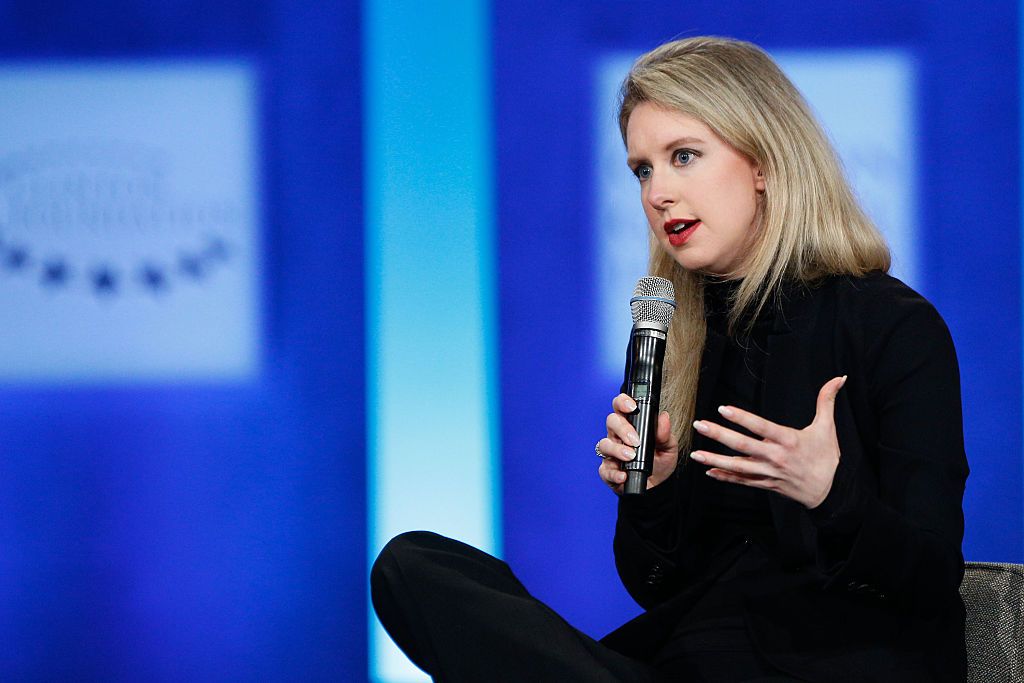
Silicon Valley rewards founders who talk about tomorrow’s technology as if it’s already here. A founder tells investors that a machine runs a blood test today. When the claim falls apart, the founder explains that it was only a promise about the things the machine would accomplish one day. Some investors learn the difference later, from their lawyers.
Nathan Fielder and Lance Oppenheim’s new documentary, You Can See Everything, catches a founder offering that explanation on camera. Its subject is Elizabeth Holmes. For a while, Silicon Valley rewarded her lavishly. She wore a black turtleneck like Steve Jobs and posed for photographers holding up a vial of blood no bigger than a fingertip. Her company, Theranos, said the routine blood tests doctors order, such as cholesterol checks, needed only a few drops from a finger prick, and that it already offered more than 200 of them.
Silicon Valley has a slogan: fake it till you make it
Investors valued the company at $9 billion. Inc. magazine put her on its cover as “The Next Steve Jobs”. But in 2015 the Wall Street Journal reported that most of its tests actually ran on other companies’ machines. Theranos collapsed. In 2022 a jury convicted her of defrauding its investors. She was sentenced to more than 11 years and is in a federal prison camp in Texas.
In the weeks before she reported to prison in 2023, Holmes and her partner, Billy Evans, let Fielder, a deadpan comedian, film their life in a rented house near San Diego. In the film, Evans describes his plans for a new diagnostics venture, in which lasers would scan blood, urine or saliva and artificial intelligence would read the results.
Fielder arrives with questions of his own. He plays Holmes a recording of her 2014 interview with Fortune, in which she says Theranos has “a single device that can perform any test” and calls it “a big deal.” When he questions the claim, she insists: “That was our invention.”

What follows is a long, uncomfortable negotiation over the word “can.” The machine, Holmes explains, could run any test “assuming you have the chemistries,” meaning a chemical recipe for each test. By her own account, those recipes still had to be developed, one test at a time.
When Fielder suggests the claim was therefore theoretical, she agrees: “Yeah, because this is a platform that can run those things.” When Fielder asks why she didn’t add a word to make the distinction clear, she says: “I feel like now I’m living in a parallel universe.”
Silicon Valley has a slogan for the habit: fake it till you make it. The slogan works only when the investors in the room know which tense the founder is using – present or future. Theranos’ investors somehow believed she was speaking in the present tense.
The jury’s word for Holmes’s actions was fraud. An engineer on Evans’s new venture, who never worked at Theranos, offers Fielder a gentler explanation: “Theranos is one failure on a path, and there will be more.” Then he cites a precedent: “Entrepreneurs, even the best of them, you know, Elon Musk, make claims that are not true at any given point in time, right?” According to him, a false claim is simply a claim that hasn’t come true yet.
Holmes had settled on her precedent long before: Steve Jobs. A framed photo of him hung in her office. She did not need to make the comparison herself. Channing Robertson, a Stanford engineering professor on her board, told Fortune he “could have just as well been looking into the eyes of a Steve Jobs or a Bill Gates.”
One man on the Theranos board had actually worked for Steve Jobs. Avie Tevanian ran software for Jobs at NeXT, the company Jobs founded after Apple pushed him out, and followed him back to Apple, where he led the team that built the software for the Mac. He joined the Theranos board in 2006 and asked many questions.
“All these promises, none of them have happened,” he later told ABC News. When he took his concerns to the chairman, Don Lucas, Lucas asked him to resign. “Don honestly believed that she was the next Steve Jobs,” Tevanian said. “And believe me, I worked for Steve Jobs. I saw some crazy things. But Elizabeth took it to a new level.”
Tevanian resigned in 2007. Six years later, Theranos began testing the blood of ordinary customers in Walgreens pharmacies. But a customer reading a cholesterol result wants an accurate number, not a promise about the great future accomplishments of a machine.




Comments