
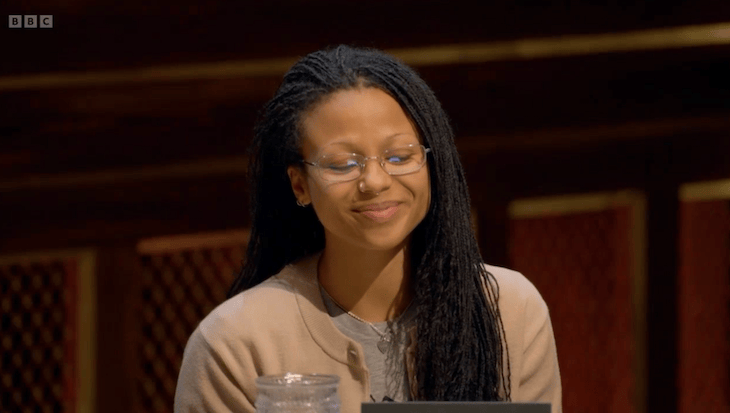
When Industry actress Myha’la was kicked off Celebrity Traitors this week, she did not appear to take her exit very graciously. Responding to a comment on her Instagram branding the BBC’s show as ‘racist’ Myha’la said:
‘I sealed my own fate! And that early in the game there is VERY little to grasp on to, and I gave them … a lot.
‘I do agree that unconscious racial and cultural bias exists in this game where my authenticity or honesty or the ways in which I choose to express myself look suspicious to people who are unfamiliar with people like me.
‘I had this fear coming into the game, as I am a BIG fan and also clocked right away how prevalent this is in this game. And I came in knowing I’d be the only American (apart from Honorary British National Treasure Jerry Hall).
‘I’m not saying it’s right, I’m not saying racism doesn’t exist, but I do have to defend my dear friends on this show who in no way consciously put bias on me because of my race.’
Despite being 30 per cent of contestants, non-white players make up nine of the first eighteen departures (50 per cent)
The headlines about Myha’la’s comments have had rather less nuance than her actual statement (which could be condensed to: ‘racism is a problem in the show but I was also not very good’).
‘Celebrity Traitors star Myha’la blames racial bias for banishment’ booms the Times. A government minister has even been called upon to weigh in, with Josh MacAlister telling LBC that while he had been watching it he had not noticed any bias (no doubt admitting to having never seen it would be a sackable offence in Andy Burnham’s Britain).

Myha’la did give a big wink to Richard E. Grant, who outed himself as a Traitor on the first episode of the series. So, as she says, she’s not the best test case for unconscious bias in the show. But a close examination of data from the show as a whole does part-way support her claim that non-white people underperform on the show – early on, at least – relative to white players.
Looking at data from the four civilian two celebrity series (for the latter, a full season one, and season two so far) we have a dataset of 130 players, 39 of whom are non-white, meaning 30 per cent of players have been non-white (the UK population was around 17 per cent non-white in the 2021/22 censuses).
Despite being 30 per cent of contestants, non-white players make up nine of the first eighteen departures (50 per cent). Again at the ‘round table’ we see eight of the first 18 banishments, at which point players are working from first impressions, have been non-white people. The traitors themselves are also likely to skew non-white in their first ‘murders’, with half of victims at this stage being non-white.
This discriminatory effect, interestingly, fades as the series progresses. Across all 63 banishments we see that non-white players make up a third of banishments, only just above their proportion of the cast. For ‘murder’ victims their share is 31 per cent.
It could be the case that the producers get fewer non-white applicants, meaning that producers are fishing in a smaller pool for the contestants who are the best at lying or appearing innocent. Or perhaps the producers have certain levers they can pull (twists, overriding murders, nudges) which steer the show to a more diverse final.
Or, more innocently, it could be that any ‘unconscious bias’ from the first impressions fades as contestants get to know each other as the show goes on.
Interestingly we see that there is almost no difference between the level of bias between celebrities and regular contestants, though the former might be expected to be more sensitive to accusations of racism. Certainly the BBC, which has been so strenuous in its efforts to diversify staff that it now pays white men 13.2 per cent less (median, lowest pay band), is ideologically averse to putting forward bias contestants. And yet this problem persists.



Comments