There are few countries in the world with relations as close as Turkey and Azerbaijan. The two countries hail from the same Turkic ethnic roots, their languages are more or less mutually intelligible, and military cooperation has been strong – particularly in Nagorno-Karabakh against the Armenians. There’s even a phrase, “one nation, two states,” commonly echoed by both sides.
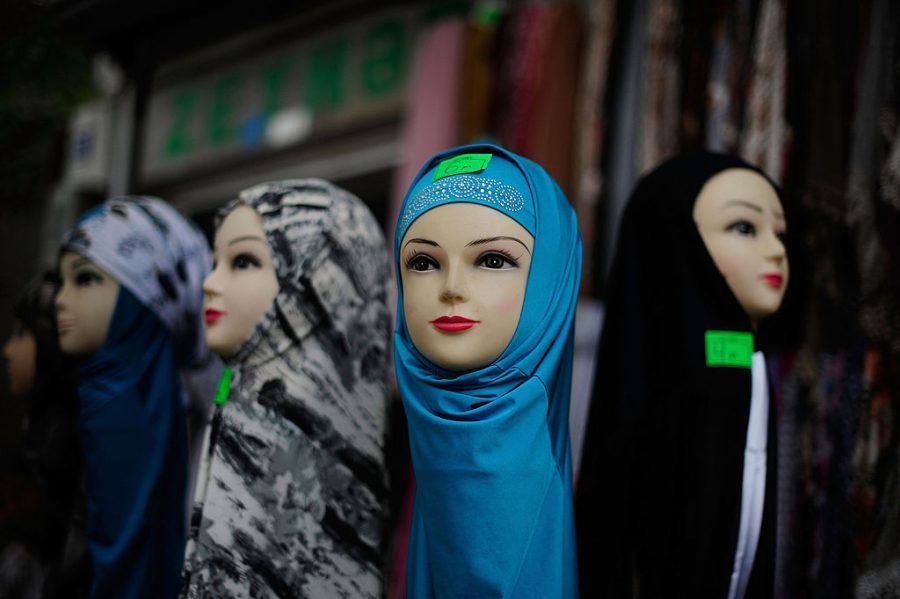
Yet, a rift is now brewing between the two brotherly Muslim countries – over hijabs. Last month, the Azerbaijani government imposed restrictions in schools that “do not correspond to the principle of secular general education,” effectively banning headscarves worn by schoolgirls. In recent days, as the authorities started to enforce the ban, videos have flooded social media showing young girls in headscarves being barred from entering public schools.
Azerbaijani students have flocked to the streets in a rare moment of dissent. These have been the largest protests in years in a country that President Ilham Aliyev has ruled with an iron fist since 2003. Dozens have been arrested, including a few young pupils who allegedly tried to set a school on fire.
Headscarves were once banned in all public institutions in Turkey
Some of the strongest backlash to the ban has come from Turkey, Azerbaijan’s closest ally. President Tayyip Erdogan used his address at the UN General Assembly last month to condemn restrictions on the hijab. His chief advisor, Oktay Saral, then doubled down, saying: “The obstruction of veiled students’ right to education in Azerbaijan is unacceptable!”
“Leaving a student who covers her head out of religious conviction at the school gate – what conscience, what sense of justice could allow that?” the advisor went on. “The headscarf is not an obstacle, it is a requirement of faith! The right to education cannot be sacrificed to any ideological imposition!”

Other politicians and journalists from Turkey’s ruling Justice and Development party (AKP) jumped on the bandwagon and have launched fierce verbal and written attacks against the hijab ban. It is an issue of particular importance to the AKP. Headscarves were once banned in all public institutions in Turkey as well.
The Islamist movement the AKP grew out of fought bitterly against the ban in the 1990s and early 2000s. It was the AKP that eventually lifted the ban after coming to power. The struggle for the right to wear headscarves anywhere became a central element in the party’s origin myth. To this day, their politicians regularly post archive videos from decades ago of veiled students getting manhandled by police and claim that this is the Turkey the opposition wants.
The Turkish criticism has not been well received in Baku. “Everyone should know their place, they should not interfere in our affairs, stick their noses into our way of life, or tell us what to do,” President Aliyev said in a speech at the start of the month. “Everyone should mind their own nation and state.”
Turkey was not specifically mentioned, but the subject of the rebuke was clear. The Azerbaijani president then went on, stressing his country’s self-reliance and highlighting, among other things, that they have paid for all the weapons they acquired (i.e. Azerbaijan doesn’t owe Turkey anything).
Just this week, Azerbaijani state television issued this statement: “The state will block any attempt to inject Arab-Persian values into our national identity. We have our own national values. Azerbaijan is a Muslim but secular state.”
This sentiment is also common in Turkey. But it is shared among a segment of society that has been very much confined to the opposition for the past two decades. Staunch, sometimes heavy-handed secularism was the status quo of the ruling class and parties until they got swept away by President Erdogan’s movement in the early 2000s.
The only other issue the two nations have found themselves at odds over in recent years has been relations with Israel. Turkey has effectively cut all diplomatic ties with Israel following October 7, 2023 and has been exchanging increasingly vicious threats with Benjamin Netanyahu’s government. Azerbaijan, on the other hand, has maintained good relations with the Israelis, continuing to purchase weapons and sell oil.
Good relations between the Azeris and Israelis caused considerable annoyance in Turkey, yet the government decided to (and was able to) contain it. Direct and sharp criticism was limited to the fringes of the ruling party and a few zealous columnists. Azerbaijan carries on supplying Israel with around a third of its oil, and Turkey allows it to flow through its pipelines, quietly collecting the transit and tariff fees.
Oddly, the two countries’ differing approaches to Israel never resulted in such a pronounced confrontation as the hijab ban did. A seemingly much smaller issue has managed to ruffle more feathers between the two brotherly nations. But even if it has caused the nastiest spat between them in years, the damage is hardly likely to be irreparable.




Comments