
We have to start with the ritualistic part of any consideration of an apparent attempted terrorist attack. We do not know the whole story behind the arrest of five men on terrorist charges near RAF Fairford in Gloucestershire on Sunday morning. Anyone old enough to have played Chinese whispers as a child knows how quickly information can become distorted or mangled. The ubiquity of social media has potentiated this a thousandfold. So we ought to be cautious.
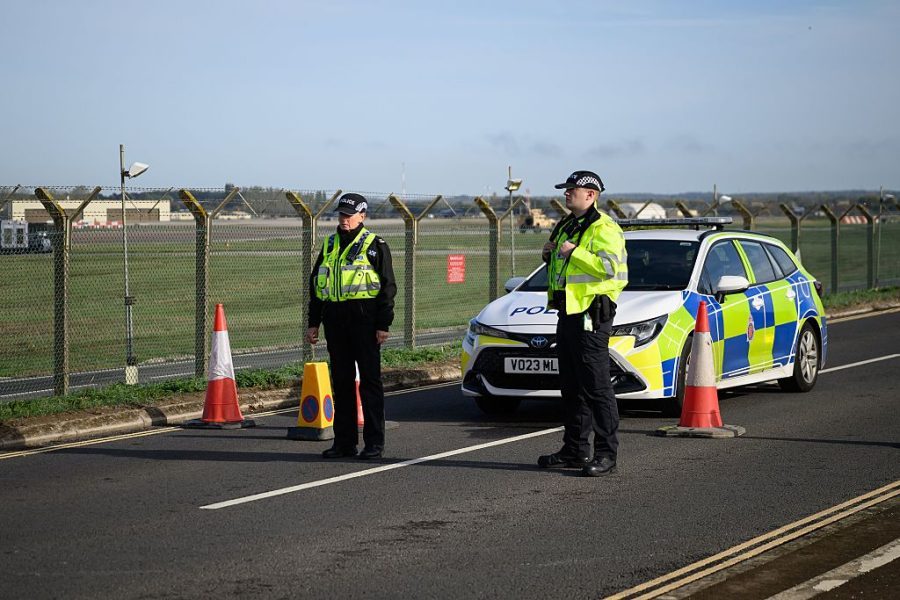
This is what we do know. At 12.45 a.m. on Sunday, Gloucestershire constabulary received a call concerning ‘three suspicious vehicles’ moving in the direction of RAF Fairford, a Ministry of Defence facility operated by the US Air Force. Five men were subsequently arrested near Whelford, two miles south-east of the base, and a bomb disposal team was deployed to the area.
The suspects were initially detained under the Explosives Act 1875 but then arrested under section 5 of the Terrorism Act 2006 relating to the preparation of terrorist acts. This allows them to be held for 14 days without charge. Counter Terrorism Policing, a network chaired by the Metropolitan Police’s Assistant Commissioner for Specialist Operations, is leading the investigation and a major incident has been declared.
It is clear that this was an attempted terrorist explosives attack on RAF Fairford. The Prime Minister asked people ‘not to speculate while the authorities establish the full facts’, Meanwhile, the Defence Secretary, Wes Streeting, more realistically said ‘this is not the time for me to speculate’. But it is neither wrong nor unhelpful responsibly to provide information.
This is happening now, and our enemies are implacable
Much speculation has the Islamic Republic of Iran being responsible for this incident. Nothing, however, has been confirmed and the Iranian embassy in London has strongly denied any involvement by the country. Suffice to say, though, if you find a dead bird on the kitchen floor, it is reasonable to look to your cat first of all. Streeting did admit, ‘We know that Iran and their proxies wish to do us harm.’ But there is more to it than that.
The significance of RAF Fairford is that it is America’s only forward operating base in Europe large enough and properly equipped to accommodate the heavy bombers of Air Force Global Strike Command. Its use significantly increases the flexibility of B-1, B-2 and B-55 long-range bombers. The US Air Force has been flying combat missions from the base against Iran since almost the beginning of Operation Epic Fury: former prime minister Sir Keir Starmer initially refused permission to use the facility but quickly relented with the nonsensical formula that US aircraft could use it and other bases for ‘defensive’ missions.
Tehran noticed. In July, the Islamic Revolutionary Guard Corps (IRGC) warned that any country supporting the American campaign ‘will be responsible for the consequences and repercussions’. Its spokesman added, ‘Recently, US B-1 bombers used airbases in Britain. If they cooperate [with the US], they will become definite and legitimate targets for us.’ Iran, if it has had any involvement, has motive and intent. It has also already attempted missile and drone strikes on RAF Akrotiri in Cyprus and the British-hosted, US-operated Naval Support Facility Diego Garcia in the Chagos Archipelago.
We know Iran is a threat. A report last year from the Intelligence and Security Committee warned that ‘Iran’s leadership perceives the UK as a significant adversary’ and a ‘potential threat to the security of the Iranian regime’. The Secret Intelligence Service described Iran’s agencies as ‘highly capable adversaries’, while the Joint Intelligence Organisation noted that ‘what Iran has is a risk appetite which is very “pokey” indeed’.
It is only fair to note that Russia qualifies as a suspect too. Its intelligence agencies have carried out hostile acts on British soil for many years: we are only a few weeks from the 20th anniversary of the fatal poisoning of Russian defector Alexander Litvinenko, almost certainly on the orders of the Kremlin. Earlier this month, the Russian Ministry of Foreign Affairs said that, in view of British support for Ukraine, Russia ‘reserves the right to take necessary retaliatory measures as part of the exercise of the right to self-defence’. When asked if strikes were possible against targets on British soil, President Putin smirked, ‘That’s a secret, a military secret.’
Whether the author of the attempted terrorist attack at RAF Fairford was Iran, Russia or a third party, directly or through proxies – something of which both Iran and Russia have extensive experience – there is a paradox here. People are, rightly, shocked by the blatancy and severity of the potential attack: to be blunt, three large vans, close to a major US airfield, could have amounted to a very large and damaging bang.
Yet if we are shocked, we should not be surprised. Neither Tehran nor Moscow has been obscure or circumlocutory in making explicit threats directed at Britain itself. We are already engaged in a very serious hybrid conflict with Russia; it may not formally be war but it is not peace either. The same is becoming true of Iran. One of our adversaries may have raised the stakes but the game remains the same.
In any event, Sunday’s events at RAF Fairford must be a wake-up call for politicians and particularly the public, not just to understand but to feel, viscerally, that our national security faces a real and immediate threat. It is not hypothetical or over-dramatic but immediate and ongoing.
We have been promised a Defence Readiness Bill, a review of the Civil Contingencies Act, an updated War Book and a ‘national conversation’ about a ‘whole of society’ approach. More than a year after the Strategic Defence Review and the National Security Strategy were published, progress everywhere has been woeful or non-existent.
A significant hostile act on a major installation was thwarted this weekend. That is good. But national security is not something that will wait until the government has attended to bus fares, ending leaseholds and allowing a Catholic premier to advise on Church of England appointments. This is happening now, and our enemies are implacable. They will not wait, so we cannot afford to.





Comments