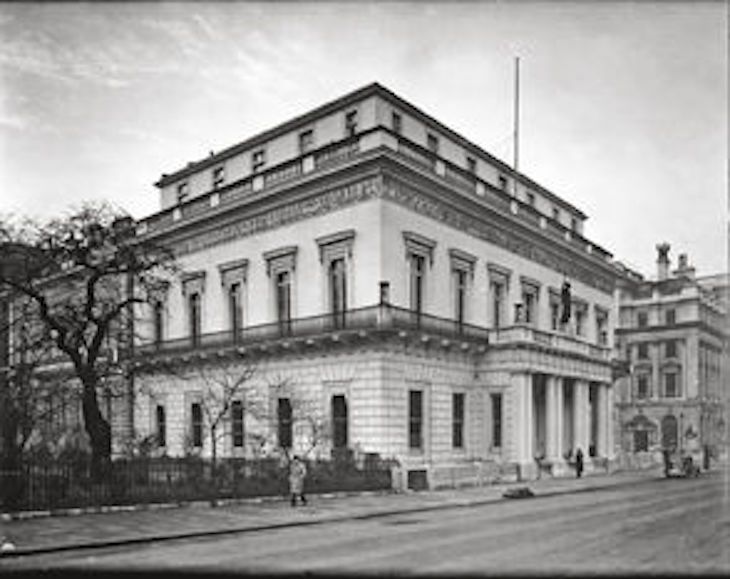
When Brian Brindley, who held his 70th birthday party in 2001 in the Athenaeum Club, returned from the lavatory, he asked his young handsome friend to do up his flies. ‘Oh Brian. That’s the first time someone has asked me to do *up* their flies,’ Martin retorted.
Moments later, he collapsed on to the thick pile carpet. Brian was pronounced dead by a doctor member, but clubs don’t like people dying on the premises so paramedics collected his body. I joined him in an ambulance which sped off to St Thomas’ hospital. When I turned round, I could see his corpse which was being pumped with electricity jumping up and down in the back.
Brian had the local branch of GYMNOS coming to stay for Christmas. This acronym stands for Gay Young Men’s Naturist Association
At the hospital, we were joined by my partner Keith Day and Damian Thompson, author of his famous obituary. He was then officially pronounced dead.
Brian Brindley had been disgraced ten years earlier by the News of the World and went to live in a dank basement flat in Brighton where he resigned from Holy Trinity, Reading and left the world of ecclesiastical responsibility; he had been a Canon of Christchurch, Oxford and Chairman of the Business Subcommittee of General Synod and had led the fight against women priests.
He had no interest in finance, so when his financial advisor revealed that he had an annuity policy which had come to fruition and he had £65,000, he enthusiastically bought a four storey house in Western Terrace in Brighton which he decorated fabulously in a combination of styles, including the Sir John Soane’s Museum and Brighton Pavilion. The rear dining room was painted with murals of Brighton, including one of Brian in full ecclesiastical clobber daintily walking down a path by the Pavilion. He was remarkably resilient strutting around the Brighton flea markets in shorts and a bandana. When he met Keith and me, he would purse his lips in a kiss and enthuse about the joys of Brighton.

He grew a little pigtail and was surprised that no one would offer him a job. We encouraged him to cut it off and he framed the lock with the words ‘A Sacrifice to Ambition’. Eventually he got a job with the diocese of Chichester where his knowledge of architecture was useful. But he became unwell and was unable to keep up the mortgage payments on his home.
I knew he had sold anything of value with the exception of an oil painting of a little girl. He would call me and ask if he could borrow “a couple of thou”. This happened more frequently, and one December he asked for three ’thou’ as he had the local branch of GYMNOS. coming to stay for Christmas. This acronym stands for Gay Young Men’s Naturist Association. Brian was an enthusiastic member and invited me several times, but I always declined.
He had a small yard at the back of his house featuring stone cherubs and York stone paving. It was walled to the third storey with a high brick wall and shrubs between his garden and his neighbour’s. When Brian had his GYMNOS parties, all the guests would remove their clothes and be served food by naked waiters. Towards the end of the party, they would drift off into a marquee assembled in the garden which became quite riotous. Brian was under the impression that it was all discreet and private, but much later on his neighbour, a Methodist minister and his wife, said they needed therapy after one party.
Brian came up with the concept of ‘The Grand Plan’. This was to get a group of his friends to buy the house at a discount so he could live in it for life. His idea was that we would pay for the upkeep and pay him an annuity until he died. I asked a number of people if they were interested but no one would, or could, take part. I discussed it with my solicitor and he recommended that it would be better if one person could take it on.
One day, Damian said that something needed to be done urgently so I organised the valuation and an actuary was employed to work out the value. I paid Brian £5,000 a year and all his debts were paid off and he got a lump sum. In fact, I had to get the bank to lend me the money which wasn’t easy at the time.
Brian was very happy with the arrangement. He bought new suits and seemed to have a new lease of life. My partner Keith was not particularly happy, commenting that since we had bought the house ‘he was skipping about like a lamb’. This was around the time the French woman who had make a similar arrangement had gone on to live to 117 years old outliving her purchaser by decades.
When the day of the 70th birthday dinner arrived, Brian had been to Stephen August, a once fashionable men’s hairdressers in Chelsea for a haircut. He arrived by taxi to our flat which had once belonged to Sir Winston Churchill. He was very weak and I showed him into the spare bedroom with a fourposter. He was delighted with his birthday present, a book about marbling.
When I returned with a glass of water, I could hardly bear to enter the room; the air was so rancid. I knew he had diabetic ulcers on his feet. He refused to see a doctor but agreed to see a friend who was a chiropodist who said it was the worse case he’d ever seen. He told us that unless Brian had his foot amputated immediately he might die within a day. When he left, Brian said: “The prognosis is not good. But I’d rather go down in flames than miss my birthday party”.
So when at St Thomas’ Hospital the doctor covered his face with a sheet and finally pronounced him dead we were not shocked. I realised that my investment in the Brighton house had not been a financial failure. But, in the aftermath of his death, the arrival of friends and family who believed that they should have shared in the house was very annoying and painful.
We searched in vain for a will, but amongst the piles of papers, including unopened post and more than £1,000 of uncashed cheques, we found nothing.
Brian had a sister, Nancy, who turned up one day in Brighton bearing her will which left her apartment in Bournemouth to Brian. She explained that she and Brian had made a reciprocal arrangement and the house now belonged to her. Brian had failed to explain the Grand Plan to her. She had cancer and was married to a driving instructor whom Brian despised, being of the wrong class. He wasn’t going to leave his beautiful creation to him.
I don’t know if Brian had gone about promising friends a share in his estate but many of them believed they were entitled to it. I invited Nancy and her husband to lunch and gave them the oil painting of the little girl and several thousand pounds. At this point I had no money but I borrowed from the bank and gave similar amounts to Brian’s other close friends. Damian got several of Brian’s friends to write chapters about him in a book wittily entitled Loose Canon with contributions from Alan Bennett, Ned Sherrin, Father Anthony Symondson and me.
I had met Brian when he was 37 and I was 17. He was large, flamboyant and a great talker. He changed my life forever. As a schoolboy he took me to Venice twice. My love affair with that city has continued ever since. Brian opened my eyes to a world away from a suburban housing estate. We were friends for seven years but then he got angry when I was too busy to drive him into the Berkshire countryside for lunch. Until his exposure in the News of the World fifteen years later, he stopped speaking to me. But from that moment, we were friends again and I did all I could for him, except going to the nude dinner parties.





Comments