

During the 1980s my friend Canon Brian Brindley was arguably the ‘highest’ clergyman in the Church of England, celebrating Solemn Masses of rococo splendour in Holy Trinity, Reading, a dreary little Victorian church on the Oxford Road. He also possessed the essential qualification of a great English eccentric: he did not know how eccentric he was.
When I was a cub reporter on the Reading Chronicle I would sometimes run into Brindley parading through Sainsbury’s dressed as an 18th-century Roman monsignor. His buckled shoes with red heels – painted by himself – clopped like horse’s hooves against the linoleum as he scoured the aisles for ever creamier puddings. I once watched him sail into a civic dinner in Reading in a cream tropical cassock with violet buttons. ‘My auntie’s got that frock,’ sang out one of the Labour councillors.
As the shadows lengthened, the butler lit the candles. The crab was magnificent
In 1988 Brindley celebrated the 25th anniversary of his ordination. Fr Anthony Symondson, a former Anglican colleague who had become a Jesuit, remembered ‘40 concelebrating priests wearing matching Latin vestments. The Bishop of Oxford’s chair was covered by a sumptuous canopy decorated with pink ostrich feathers. The function had more than an element of the opera buffa…’
A year later the comedy was over. A baby-faced News of the World reporter called at the Holy Trinity vicarage posing as a young man confused about his sexuality. ‘Brenda’ Brindley – as he was known behind his back even by the Archbishop of Canterbury, Robert Runcie – proceeded to fantasise about teenage boys while the secret tape-recorder whirred. His career was over.
For a man given to Bunteresque boasting when things were going well, Brian was unexpectedly stoical in the face of disaster. He became a Roman Catholic layman and devoted himself to writing columns in the Catholic Herald. One of them, a reminiscence of wartime rationing, began with the words: ‘I have eaten whale.’ This would not have surprised anyone who had seen the Canon bursting out of his Gammarelli soutane or as an undergraduate – Alan Bennett, his Oxford contemporary, recalls him rushing round the Exeter quad, hands flapping, ‘like some fat blackbird’.
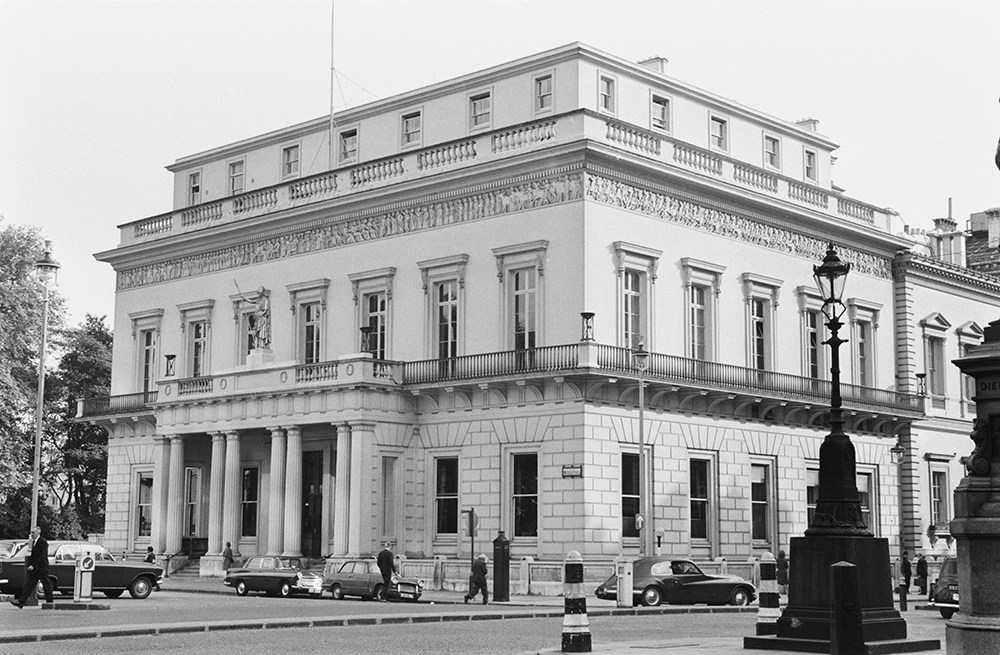
By now, however, he was emaciated by heart disease and covered his loose jowls with a white beard. But he still enjoyed seeing his friends eating lavishly. His 70th birthday fell 25 years ago, in August 2001, and he spent months planning an eight-course menu for a birthday dinner at the Athenaeum Club: prosciutto and figs, avgolemono, ‘drest crab’, lime sorbet, boeuf en daube, summer pudding, angels on horseback and fruit for dessert.

I was one of the dozen guests – not all gay but all men – who trooped into a cube-shaped room lined to the ceiling with books and filled with an oval table laden with silverware. Brian was holding court in a white dinner jacket and a waistcoat reproducing the wallpaper of Brighton Pavilion. He sat there with a stockinged foot resting on a gout-stool, barking instructions at a club servant; he looked a bit like Gillray’s brutal caricature of the future Prince Regent, ‘A Voluptuary Under the Horrors of Digestion’, but also alarmingly frail.
As the shadows lengthened in Pall Mall, the butler lit the candles. The crab was magnificent, which pleased me for Brian’s sake, but I was worried that he seemed to be pausing between sentences, bowing over the table as if before the sacrament. Then he turned to me and said, ‘I need to go out. If I’m not back in five minutes, come and get me’, and he tottered away.
The next thing I remember is looking up to see Brian, back from the loo, being helped into a chair. His white head lolled forward. ‘Can you hear me, sweetheart?’ someone asked. There was no response. Fr Symondson made the sign of the cross over Brian’s forehead, whispering absolution. We carefully lowered Brian to the floor. Half the diners were still in their places, standing with one hand on the table and the other clutching a napkin, like figures in a Victorian tableau, their faces frozen in a very English mixture of embarrassment and concern.
A doctor who had been dining at the club appeared in the doorway. He searched for a pulse, shone a light into Brian’s eyes, and told us what we had already guessed: ‘I’m afraid he has passed away.’ There was a long silence as we gazed down at our host. The flickering candles, the rows of leather-bound books, the body on the carpet: all the scene lacked was Hercule Poirot.
There was no question of continuing. The only person I knew who would have carried on eating in such circumstances had himself just died, ‘between the drest crab and the boeuf en daube’, as I wrote in his Telegraph obituary. A tail-coated waiter approached us and asked one of the diners, who had removed his dinner jacket while trying to revive our host, if he would put it on again.
Only later did I discover that, during the afternoon, a chiropodist had taken one look at his ulcerated foot and told Brian he would lose his toes if he did not go straight to hospital. ‘You could even die at your own dinner,’ he said. ‘Then so be it,’ replied Brian. ‘I shall go down in flames.’
It’s unnerving to think that a quarter of a century has passed since then. More than half the guests have since died – and, this being a gathering full of queens, some of the survivors have fallen out with one another. (Much to my dismay, my closest friend at the dinner has ghosted me for years and I’m not even sure why.)
Yet I don’t look back on the episode with too much sadness – and ‘episode’ is surely the right word. This was a stylish finale; Brian, who had been contemplating suicide after a decade of horrifying illness, could have scripted it himself. One line of dialogue, in particular, was worthy of Bennett, who wasn’t at the dinner but read a lesson at the funeral. During the drinks before dinner, Brian’s old friend Ned Sherrin bounded in and pressed a pot of caviar into his hand. ‘I thought I’d get you something perishable,’ he said, ‘as, let’s face it, neither of us has got long to go.’




Comments