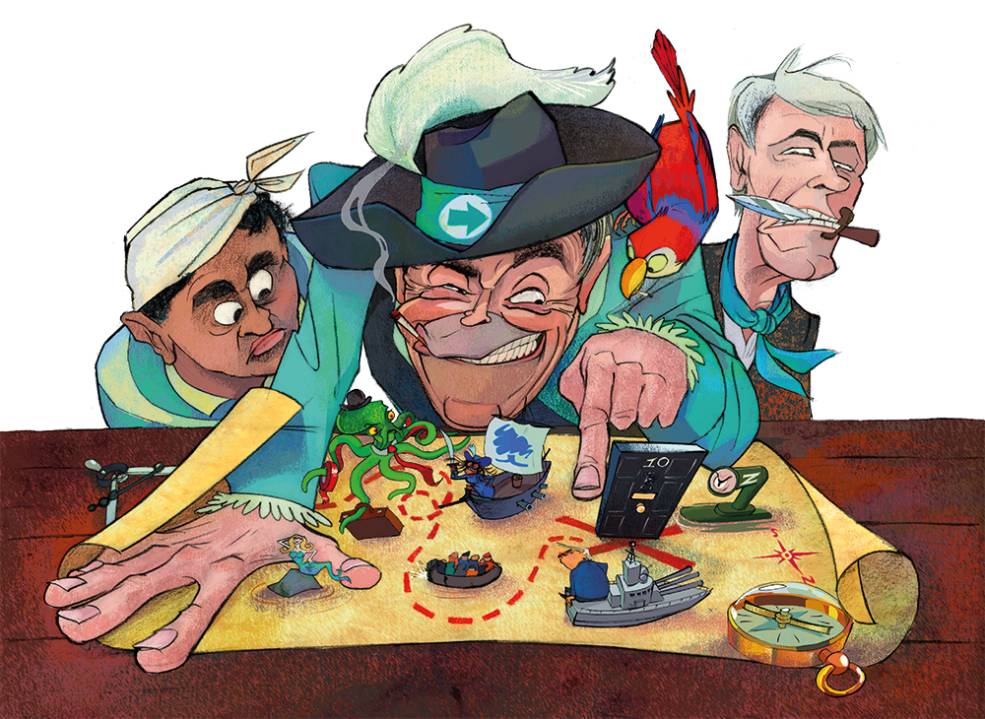


Of all the uses to which Ben Delo and Christopher Harborne might put their money, there are few more innocent than giving it to a political party. Neither want, nor expect, preferment, honours or patronage. Both are idealistic by nature and philanthropic by habit. They have all the personal wealth they need to fund their lifestyles, and harbour hopes only for enriching Britain by their actions.
I might not agree with all their ideas for how one might make this country stronger, or indeed how best to spend £72 million to improve our governance. But they have shown themselves a good deal shrewder than me in making money, and they should be entitled, within the law, to spend it as they wish. The self-righteous anger directed towards them reminds me of the Establishment reaction to Sir James Goldsmith when he launched the Referendum party in the 1990s. How dare this rootless cosmopolitan businessman seek to subvert our democracy, etc.
The briefing is that the new funds will go on a Reform TV channel and constituency campaign managers
If you are really worried about cash from the wealthy corrupting our democracy – and I am – then attention is better directed at the lobbying, lunching and crony corporatism by which major City players, incumbents in areas like house-building, defence and energy, and outsourcing giants such as Serco and Capita direct government action and funding to suit their own vested interests. There are daily conspiracies against the public interest hatched in boardrooms and accepted quietly by supine or compromised government departments. Harborne and Delo, by contrast, like Sir James before them, hand over their cash in the full glare of publicity and make their intentions both explicit and subject to the public’s votes. And the experience of Sir James was that his many millions of pounds could not secure anything like that number of votes.
What should invite scrutiny is how that money is spent. And here I worry for Harborne and Delo. They believe that they have been assured their donation will go to help preparing Reform for the arduous work of government. Perhaps a new Sir John Hoskyns will be commissioned to prepare a 21st-century version of ‘Stepping Stones’ – his detailed map of re-wiring the political economy of the nation which laid the groundwork for the Thatcher revolution.

But is the seminar room really where Nigel Farage enjoys splashing the cash? Economists argue that when you are analysing future spending you should study what people have done in the past, not what they say they will do in the future. The best guide to action is what they term ‘revealed preferences’. And the revealed preference of Farage is not to devote time, energy or, especially, money to determining how to reform the governance of multi-academy trusts or overhaul the Rural Payments Agency. It is to invest in the enterprise where he is Britain’s most talented entrepreneur – campaigning.
When Farage and the party he leads came under pressure earlier in the year to prove their credentials for government, he chose not to engage with detail but to rally the faithful in Clacton. Under fire on facts, he retreated to the comfort zone of campaigning. Of the millions that Reform has already raised, the vast bulk went on securing its (certainly very impressive) local election gains in May. Already the briefing is that the new funds will go on a Reform TV channel (unlikely to take its inspiration from the Open University, I suspect) and constituency campaign managers.
I don’t for a moment scorn the importance of effective constituency campaigning. If I ever needed reminding how vital such work is in determining political futures I could always have a word with the current MP for Surrey Heath – the Liberal Democrat Al Pinkerton. But the country doesn’t need convincing that Reform can mount impressive campaigns and Farage is a brilliant communicator. The country does, however, need to be convinced that Reform is credible and that the party has a programme for government every bit as robust as the bold claims it is making for the scale of revolutionary change Britain needs.
The signs are not, yet, altogether hopeful. Reform’s record in local government is threadbare and flagship councils such as Durham are riven and rudderless. James Orr, the head of policy, is hors de combat. And that itself is because the party diverted his formidable talents and time to fundraising for campaigning rather than pure policy work. I should declare an interest. I like and admire James and believe his thinking is fascinating and important. Which is why it is all the more regrettable that he suffered because Reform put the cash before the thought.
Reform does have talented figures with experience of government already in the Commons, of course. But will they stay there? On current polling trends, Robert Jenrick, Suella Braverman and Danny Kruger would all lose their seats at the next election – to the Tories.
Even while they sit on the green benches, their Tory past is a barrier to their thinking being embraced fully by those in Reform who’d prefer to be destroyers of conservatism rather than its replacement. Danny is a brave and brilliant man, but he is not listened to by Reform’s old guard as attentively as he might be. His patient work on Whitehall reform does not always commend itself to those, like shadow home secretary Zia Yusuf, who are looking to smash the Establishment, not tame it. As a result, Danny sometimes has the air of a midshipman from a genteel family at sea with a particularly bloodthirsty pirate crew – Hornblower on the Black Pearl.
The question for Reform, flush now with cash and its confidence renewed, is: does the party feel strong enough to reform itself? Can it make the transition all start-ups need to, from pitching effectively and scoring a success in its fundraising round, to producing a product that will prove truly transformative for the public?






Comments