Last month, I attended the International Chicken Gastronomy Festival in Twickenham. There was some questioning as to why I would want to spend my weekend gorging on fried chicken. None more so than from my significant other, a vegetarian. Part of the reason for this life choice (so she tells me) is that she once owned three pet chickens, Little Ginge, Gonzo and Mabel, who met their natural end in the food chain: being eaten by a fox.
Despite becoming a cheap option on the high street, chicken is also the trendiest
ROOST, as the event is known, is devoted to celebrating the humble chicken in all its fried, saucy and increasingly elaborate forms – ‘bird cookery without borders’. Traders included Bernard Hardison, the ‘Baptizer of Fried Chicken’, who is famous for submerging large batches of chicken into a custom deep fryer, and FOWL, a London-based chicken eatery owned by the founders behind the notable restaurant Fallow. Gone are the days of fried chicken being the preserve of greasy takeaways; it has now entered the realm of the modern ‘foodie’ and influencer, arguably the most notable being Eating with Tod, who uploads TikToks of himself grotesquely dipping wings into gargantuan buckets of condiment.
This change hasn’t been sudden. Chicken has taken over. The Financial Times has noted that there had been a 50 per cent increase in global chicken production in 2006 to 2023, from 48.3bn to 76.2bn. Chicken overtook pork as the world’s most produced meat in 2022, and one agricultural economist quoted in the same article offered a suitably ominous assessment: ‘We’re a long way off peak chicken.’
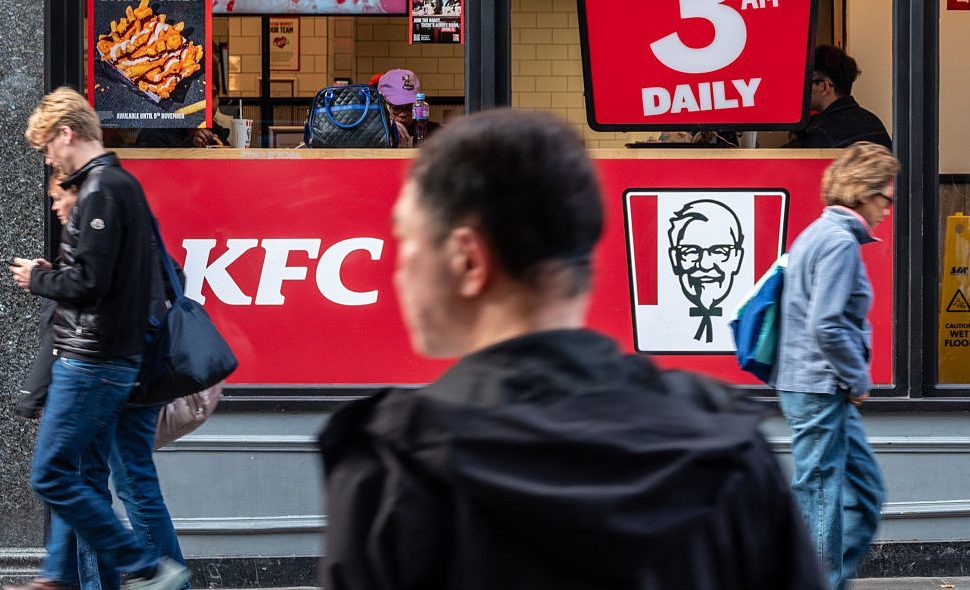
Britain has been enthusiastically taking its part in this explosion. Chicken shops, an oft-maligned part of one’s high street, have grown at a rate of 7.2 per cent over the past year, compared to under two per cent growth for other takeaways. More traditional British takeaways – including the Chippy, surely the nation’s traditional favourite – have realised this. There is far more profit in selling chicken than increasingly expensive fish.
But it hasn’t all been positive for poultry. Big Chicken: A Fast Food Conspiracy, a recent Netflix documentry presented by British comedian Mo Gilligan, attempts to ‘uncover’ the industry. In what is essentially a rip-off of 2004’s Super Size Me, Gilligan consumes fried chicken for breakfast, lunch and dinner; sits back and acts astounded that a clinician is concerned at the end of this ‘experiment’.
This is no surprise. Morgan Spurlock gained 11.1kg during his month scoffing nothing but McDonald’s (and ‘copious amounts of alcohol’ which may have skewed the findings). Gilligan also gained weight and reported a severe deterioration in his wellbeing, including mood swings and an increased risk of developing diabetes. But this is hardly a revolutionary discovery.
Readers of Fast Food Nation, Eric Schlosser’s early noughties book, will already be familiar with most of the revelations that are attributed to the fast-food and meat industries. After three years of research, Schlosser established that consuming vast quantities of calorific, typically nutrient-poor food is not the most effective route to longevity.

What has driven our surge towards ‘peak chicken’? Certainly, changing demographics have a part to play. Chicken shops are heavily (and often proudly) associated with black and South Asian communities in Britain, sometimes functioning as essential ‘third spaces’: an informal, community-driven place that exists between home and work. But the bigger story is the technological advances that have made chicken so affordable.
Having previously worked at the Institute of Economic Affairs, an organisation founded by Britain’s first battery chicken farmer, I must confess a particular appreciation for the technological developments that have made chicken so easily accessible today. 1967 was the first year that the government began recording chicken prices: a kilo cost 39 pence. In today’s money, this would be about £7.24. However, by the beginning of the 2020s, the same kilo of chicken cost a mere £2.76.
The industrialisation of chicken farming, with the help of the fast-food and supermarket industries generating terrific levels of demand, has, over roughly half a century, reduced the real price of chicken by about 60 per cent: a remarkable feat. As with all techniques and processes these days, there are critics, especially of intensive farming. Concerns surround the environmental and animal-welfare impacts. But all things considered, it is hard to deny the impressive nature of being able to bring to the population, of all wage-levels, a cheap, readily available source of protein that previous generations treated as a luxury.
Despite becoming a cheap option on the high street, chicken is also the trendiest. In whichever form you wish to purchase it, be that in a paper bucket or spending an afternoon contemplating its finer qualities at an international food festival, chicken has never been more ubiquitous.
Which brings me back to ROOST. Enjoying high levels of spontaneity and not purchasing the early-bird tickets, I ended up paying £35 for admission. Naturally, there was an underlying assumption that this might entitle us to some freebies; a portion of wings or tenders perhaps, not just entry into Twickers’ West Fan Village. I was disappointed. What my pals and I did receive, however, was a free promotional can of Kraken Ginger Beer, and a couple of voting cards which allowed us to nominate the best trader and the best chicken dish upon exit.
By the end of the afternoon, having sampled various elaborate interpretations of Britain’s favourite bird, I found myself craving something considerably less gastronomically ambitious: KFC. Fortunately, the voting booths were not easily identifiable.





Comments