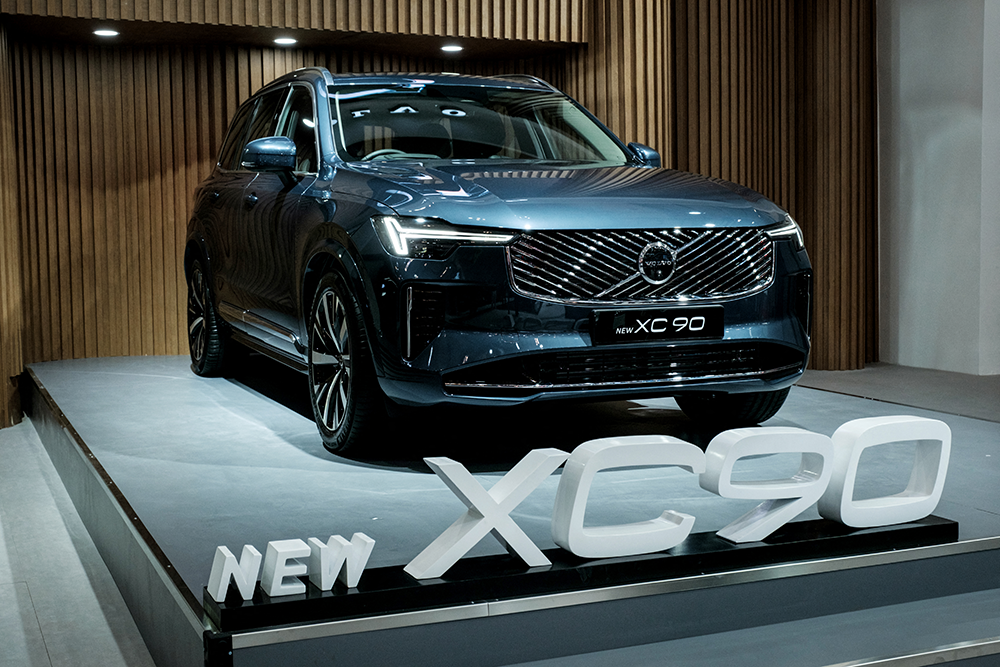

There is a World of Volvo museum in Sweden which I long to see. It was made by the architect Henning Larsen, which makes me laugh because I have been pretending to be a Scandinavian architect driving an XC90 all week long. This columnist does not know who she is, which is a good thing because the car can show me.
There is an urban myth that you cannot actually die in a Volvo, even of old age or hemlock
World of Volvo’s interior is that of a whale but wooden, as if made for some red-headed Jonah who is into automobile safety. Still, the world can always surprise you. I did not know until I studied World of Volvo that there was once a genuinely hot Volvo: the P1800, which looks like it was made by Alfa Romeo in 1965, though it was initially built in West Bromwich. Simon Templar drove the P1800 in The Saint, but the World of Volvo’s P1800 belonged to Irv Gordon, who drove three million miles in it – the world record for a private car. There is the kicker: of course it was a Volvo. I don’t know what Irv, a schoolteacher and resident of Long Island, was driving away from, or towards; perhaps Irv didn’t know himself. I read that he died in China ‘with his car’: his inner life is closed to us. But it had to be a Volvo because myths are true.
The Volvo XC90 Ultra is the seven-seater hybrid SUV and, within it, I would say I feel the closest to an adult I have yet felt. And I didn’t need to drive three million miles to know it. When I called the Bentley GT ‘functional’ in these pages, it was because I had not yet driven the XC90. Now I long to see them have a fight about which is the most sensible car – a functionality stand-off, if you will. The winner would be the Volvo, I fear, by price alone: this one is £85,000 but you can get an XC90 for £20,000 less. Volvo has been Chinese owned since 2010 but its Swedishness is well-preserved: I know this when I touch the gearstick, which is hand-blown crystal. The brand is thriving because anxiety is thriving: it had a record year in 2024. But that’s what happens, among other things, when liberal democracy starts to quake. People buy high-end Volvos because they make them feel safe.
The idea that the Volvo embodies a luminous safety is so internalised by the British collective that there is an urban myth that you cannot actually die in a Volvo, even of old age or hemlock. Not if you collide with another Volvo. I’m not going to ask the press office about this because when I asked if I could see the morgue on the Queen Mary 2 cruiseliner – still a legitimate question, for this columnist – its operator Cunard said no.

But Volvo is to safety features what Ferrari is to speed. Volvo invented the three-point seatbelt in 1959 and gave away the patent (I read Volvos can tell if you are pregnant); rear-facing child seats in 1972; the blind spot information system in 2003 (I particularly treasure this); and autonomous emergency braking in 2008. The idea of meeting Volvo’s head of safety and laying my head on his – presumably – high-end Norwegian fisherman’s jumper with tasteful and understated motif makes me feel light-headed, but I am childish and I never feel safe.
It’s fine-looking for such a large car: sinuous, not blocky, with a lovely stance. Cars are so good nowadays that it can be hard to pull them out of a line-up – but not this one. It has a quality of gentleness and aggression, as if it is both machine and cloud, and this feels peculiar and finely balanced. I thought only German cars were so intuitive but I am learning. Of course, it is silver, with luscious interiors: I cannot imagine it doing anything as pointless or decadent as being colourful. The ride is likewise tender and dedicated.
Aside from pootling, I drive three 13-year-old boys from Newlyn to Adrenalin Quarry near Plymouth, so they can toss themselves off inflatables and into lakes. I don’t understand it, but I facilitate it anyway. The contradiction between the Volvo and the quarry is novelistic. It is partly the semi-religious silence of the 13-year-old boy in the presence of a middle-aged woman he does not know, but it is like travelling by bubble: only a Rolls-Royce is quieter, and we pass through the complicated silence in happiness. The success of this car, I think, is pure angst, which is touching and very human for something made of steel and aluminium. The world is a fearful place, Volvo says, but you are safe with me.




Comments