For as long as I can remember, I’ve counted myself amongst the fortunate few with one foot in the city and the other – wellie-clad – entrenched deep in a muddy country field. When the roar of traffic, the crowds and the surfeit of cafés luring me, in my unbounded weakness, towards their £4 coffees become too much, off I scuttle to the quiet respite of rural life.
The draw is the place: an England that may never have existed, but which offers the consoling illusion of order
Except that, as any non-reclusive villager knows – or perhaps especially the reclusive ones – village life is rarely quiet. There are feuds and affairs. Financial calamities blight lives, disobliging livestock thwart those who would make their living from them, while resentments simmer dangerously over the running of local institutions. People drink too much, and they marry the wrong people. Occasionally they even tumble off roofs.
I am privy to all of the above because, unlike most town-and-country mice, my bucolic bolthole is not confined to weekends and holidays. I retreat to its hedgerows and the comforting whirr of agricultural machinery almost daily, although it’s true that I tarry there longer on a Sunday. There is, though, just one snag. My country pile does not exist in bricks and mortar – or, in fact, in reality. It lives inside my radio, and in my very psyche. Like millions of my fellow listeners, Ambridge and I go back to the cradle.
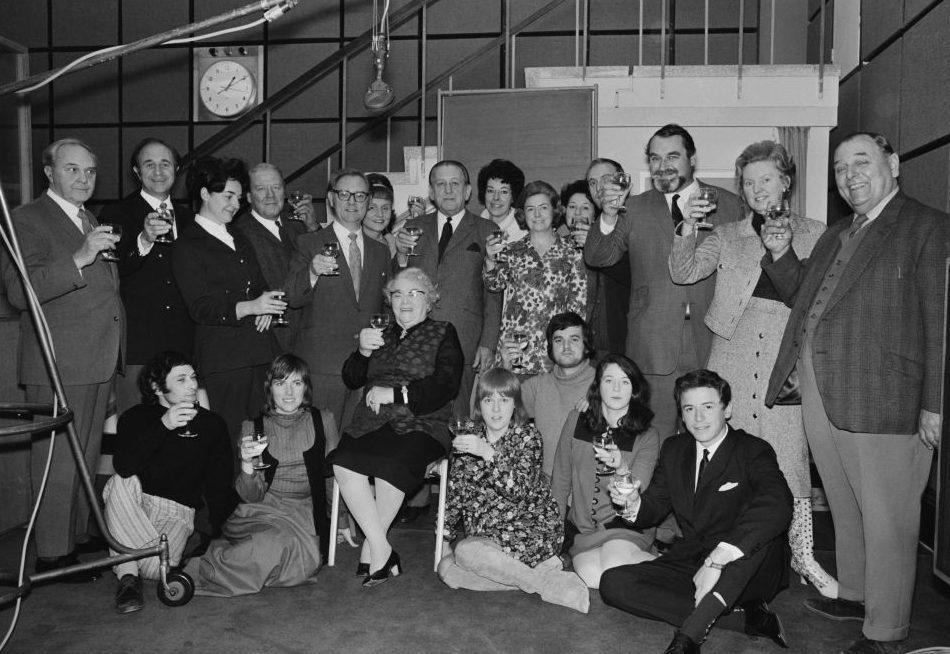
The Archers, now in its 75th year, first aired on the BBC Light Programme in 1951, its creator, Godfrey Baseley, inspired by the suggestion of a Lincolnshire farmer – Henry Burtt, may we bow down at his genius – for a ‘farming Dick Barton’, only without the violence. Farming, Burtt argued, supplied quite enough jeopardy of its own, what with the weather, recalcitrant cows and the precarious business of wresting a living from the land. And so thoroughly was the programme intended to burrow into British rural life that the Ministry of Agriculture and Fisheries became involved from the very beginning.
Burrow it did. Seventy-five years on, the lives of Ambridgians, played out somewhere in the fictional county of Borsetshire, hum eventfully on, and I find I know its inhabitants considerably better than I know many people who actually exist. This despite the fact that I have never been part of a farming community, nor even lived in a village, more’s the pity. As one exasperated friend would eagerly attest, on country rambles I am seized by debilitating terror if confronted by a field of cows. I could not begin to tell you how to inseminate a heifer. I’d fail miserably at aggy. Yet I can hold forth on the fortunes of Bridge Farm as though my battered Barbour depended upon them.
This is the strange allure of The Archers. Much as Agatha Christie’s body-accruing books bring a curious comfort, so these episodes, veering between the ultra-high and comedically low stakes, offer little punctuating escapes from the fractious world and restore some sense of the things that really matter. Such as: did Lynda Snell’s beloved Monty really savage those sheep? Will Justin Elliott reconcile himself to turning 80 without resorting to fillers? Will the silage be got in before the rain? Who will judge the chutney? Will Lynda corral enough disinclined villagers into her Christmas production? And who, for heaven’s sake, will triumph at the Flower and Produce Show?
The farming-light, plot-heavy formula is the dangled carrot, but the real draw is the place: an England that may never really have existed, but which nonetheless offers the consoling illusion of order. There is an episode of Peep Show, in which Mark Corrigan turfs a gaggle of all-night partyers out of his flat with the words, ‘I’m putting Radio 4 on, everything is normal.’ If the programme that happened to be on was The Archers, the effect would have been tripled.
Yet I suspect there is something else, something deeper, that has sealed it so hermetically within my psyche. That is early exposure, probably from the point of first sentience. My parents would not – heaven forfend – have imperilled my young imagination with, say, an episode of EastEnders, nor any other similarly histrionic TV soap. But Ambridge and the voices of its inhabitants were always there, a first introduction by osmosis to the world of grown-ups and their preoccupations.
Like the oldest of friends, you can miss three episodes, three months or – though why would you? -an entire year of The Archers and within minutes slip back into the stream. Someone will have fallen out with someone else; a Grundy will be in hot water; and Lynda Snell will inevitably be mounting her high horse while bossing some luckless villager into submission. Sure, it nods occasionally to more gritty landscapes – prison, coercive control – and though The Archers is famously billed as ‘an everyday story of country folk’, those country folk have endured enough adultery, addiction, bereavement and untimely death to rival the hapless denizens of Midsomer.
Yet beneath it all is this idea that life pootles on; lambing season happens come what may, fêtes go ahead, and all the while interminable discussions about farming will go on and on, rewilding or no rewilding. And that really is the meeting point of its plotlines with our real lives.
Something terrible has happened? Children/dogs/chickens must still be fed, and bins must still go out. Even as marriages implode and families fracture, the village shop survives and these familiar voices continue to appear in the kitchen while I am making supper, meaning that for 13 minutes I am transported somewhere else entirely. Perhaps it is that promise of continuity – of survival, even – that makes the fortunes of this Borsetshire village feel so strangely poignant.
There is an intimacy peculiar to radio in this too. We never see Ambridge, which means that each of us owns a slightly different version of it. I know exactly what the Bull looks like. So do you, if you listen. The chances that our two pubs bear much resemblance to one another are approximately nil.
Happily, I am not alone in taking all this deeply seriously. Emma Freud now hosts The Archers Podcast, in which actors and assorted Ambridge obsessives delve still further into village gossip (residents’ fashion choices, their various dysfunctions; all the big questions). A podcast about a radio programme about fictional people living in a fictional Worcestershire-adjacent village ought to, objectively, be ridiculous. Naturally, I listen to that too. As do, I suspect, many other fans, whose average age may be 56, but who are, according to cursory searches, also making notable inroads into under-35 territory.
A writer and family friend once wrote that, if and when something terrible should befall him, it would inevitably be to the mocking strains of The Archers theme tune. I hope, when my own time comes, that Barwick Green sees me out too. There would be something apposite about it: one listener gone, perhaps, but in Ambridge the cows will still need milking, and somebody will be furious about the village fête. Long live The Archers, then. Here’s to 75 more glorious years. Now, what about that silage?




Comments