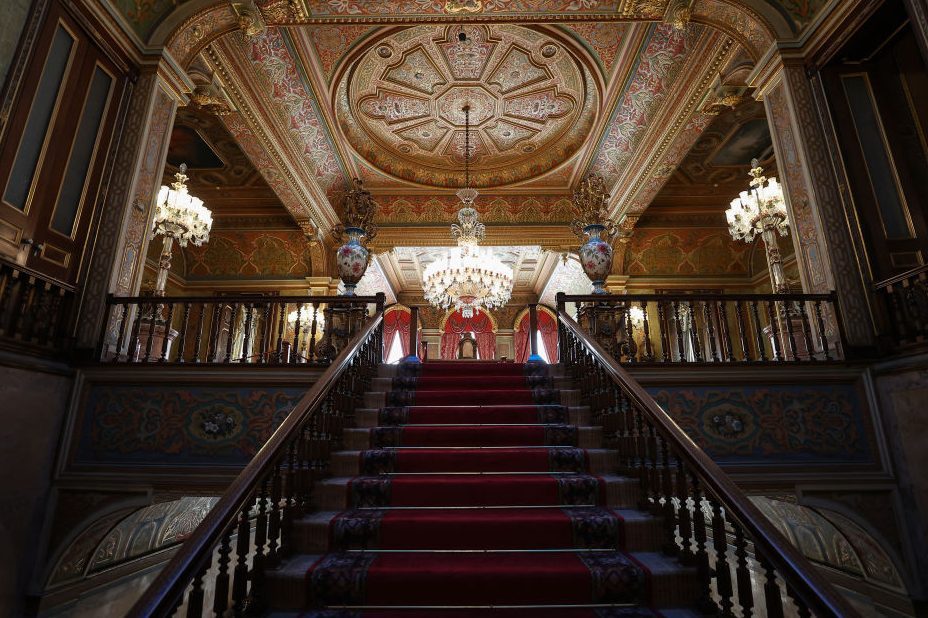
Rich people can be awful. Nowhere is this more true than in their unnatural habitat – the luxury hotel. There’s only one thing worse than tourists, and that’s wealthy, entitled tourists with their bratty kids and whiny complaints. How to enjoy the world of luxury travel while avoiding the luxury travellers? Easy. Go to blighted, war-torn, no-longer-fashionable places once bathed in dosh and celebrity but which now lie neglected and forgotten, washed up by the currents of history.
Doubtless there is something decadent and orientalist about loving sad, forgotten old hotels
My favourite and archetype of such places is the Splendid Hotel on Buyukada, an island in the Sea of Marmara an hour’s ferry ride from Istanbul. This five-storey wooden building was built in 1908 as the last word in seaside luxury, complete with a colonnaded palm court, bezique tables and large, lugubrious paintings of Swiss landscapes. Happily (for me at least, as I lived in a wooden Ottoman mansion on the island for fifteen years), Buyukada ceased to be a fashionable Hamptons-style playground for the city’s haute bourgeoisie in the 1950s, and was further depopulated after the last Constantinopolitan Greeks were chased out soon thereafter.
The Splendid remains as a charming relic which creaks when the lodos southern wind blows and boasts an Otis elevator older than the Turkish Republic. The rooms still have their original Edwardian furniture, and old Jewish ladies who take rooms for the whole summer play cards all afternoon in lounges where it is forever 1922. The owners – the estimable Hamamcioglu family, whose summer flat occupies the entire top floor – are great industrialists who are happy not to turn much of a buck from this charming but not-very-profitable property.

Istanbul’s Grand Hotel de Londres, opposite the much more expensive and sadly over-restored Pera Palace, was built as a railway hotel for Orient Express passengers in 1892. A comedy 1990s makeover saw some madman paint all the stucco detailing on the ceilings in lurid colours and add mafia-baroque-style wallpaper everywhere. But the wooden birdcage and sad parrot remain in the bar, along with the rickety lift and threadbare carpets.
Further east in Kars, near Turkey’s border with Armenia, is the Kar’s Otel (also known as the Katerina Sarayı), a grand mansion built when the town was part of the Russian Empire. This charming old hotel is full of samovars and other Russian-related antiques, making you feel like a banished Tsarist colonel. The hotel is also the setting for Nobel Prize winner Orhan Pamuk’s novel Kar, or Snow. As I was reading the novel, it emerged, as I turned the pages, that I was in the exact room (top of the stairs to the left) and indeed the very bed where the book’s star-crossed lovers fall into each other’s arms. Spooky.
Sadly, the once-lovely 1874 Palmyra Hotel in Baalbek, Lebanon, a charming Ottoman building overlooking the Roman ruins where de Gaulle stayed, was bombed by the Israelis in November 2024 and remains closed. And the charming 1911 Baron Hotel in Aleppo, Syria, a personal favourite of mine, was also badly damaged in the civil war – though the historic furniture was reportedly saved. Hopefully that includes Colonel T.E. Lawrence’s (unpaid) bar bill, which hung, framed, in the smoking lounge, as well as the posters for the Berlin-to-Baghdad railway.
Western Ukraine has some lovely grand old hotels, relics of Austro-Hungarian opulence that more or less survived seventy years as part of the USSR’s Intourist hotel chain. The Hotel George in Lviv, built in 1901 by the fashionable Viennese hotel architects Fellner & Helmer, is a high-ceilinged palace filled with curly Art Nouveau plaster and wooden detailing (though sadly the furniture is of 1980s Soviet vintage). In Habsburg-influenced Odesa, the Hotel Bristol (1899) and the venerable Londonskaya (1827) are in much better shape, having received a modern restoration that might be termed a tad vulgar. But then again, the original neo-Renaissance buildings with their fake marble columns and stuccoed archways were pretty deliriously louche when they were first built, so that’s fine.
For those readers who prefer not to holiday in war zones, look no further than the fading spa hotels of Italy. Montecatini Terme, in northern Tuscany, is a complete Belle Époque spa town beloved of Verdi, Puccini and D’Annunzio which hasn’t been fashionable in half a century. Federico Fellini caught the tail end of its pomp in his film 8½. Today the Grand Hotel Bellavista Palace, its rooms painted in delirious shades of violent pink and green, is a classic grand old hotel now patronised by elderly hypochondriacs who take the waters at the nearby Tettuccio, Excelsior and Leopoldine thermal spas. The Grand Plaza Hotel on Rome’s Via del Corso, while by no means down-at-heel, deserves an honourable mention as it’s so far resisted a hotel-chain generic makeover and hung on to its antique furniture, old-world bar and a vast, useless ballroom with suites of adjoining private dining rooms. Miraculously, these remain un-converted into a spa or luxury shopping mall.
Faded grandeur is becoming increasingly hard to find – at least in Europe. In recent years, decrepit grand old dames such as the Minerva, Rome’s oldest hotel, Palermo’s Grand Hotel et des Palmes and the Versailles-scale Grand Hotel Stamary in Zakopane, Poland, are among those that have all received multi-million-pound makeovers. They have rejoined the posh world of international luxury into which they were born. Others have sadly closed – for instance, the vast and legendary Grand Hotel des Bains on the Venice Lido (where Thomas Mann got the idea for Death in Venice), which has been shuttered since the failure of a scheme to turn it into condos.
Doubtless there is something decadent and orientalist about loving sad, forgotten old hotels. Objectively, it’s great news that decrepit properties all over Europe are being bought up and lavishly restored. Yet there is something irreplaceable about the atmosphere of the old places, as though the walls and furniture have soaked in a century’s worth of human life, love and drama along with the vanished cigarette smoke.
A grand hotel is a monument to human vanity, a secular modern cathedral devoted to comfort and luxury. New, such places are often suffocatingly brash. But the time-worn versions have atoned for the wicked ways of their youth. The strutting imperialists and adulterous financiers who once promenaded the lounges and palm courts are long in their graves. Elderly hotels become capsules of lost time, ambassadors of a long-vanished world. And one by one, we are losing them.




Comments