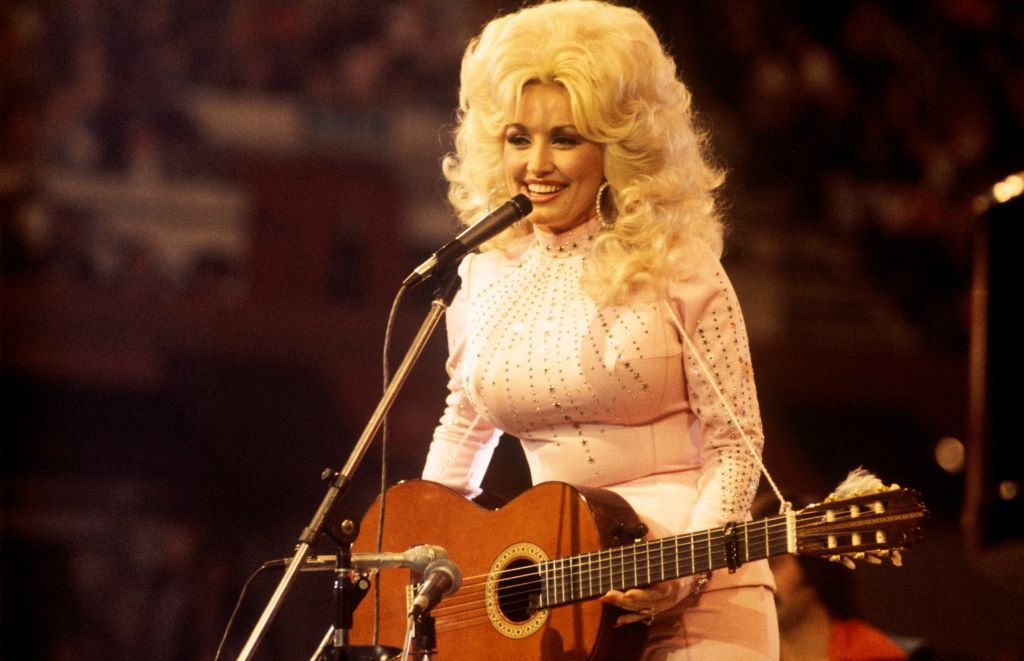
“And try to make the most of every moment / ’Cause if you never try, you never win.” There are few more appropriate lines with which to begin an obituary of Dolly Parton, although they do have the slight disadvantage of sounding like something that might be printed on an especially tawdry greetings card. Dolly – always Dolly, never ‘Ms Parton’ – was never particularly concerned about that sort of thing. She understood that sincerity was generally more effective than sophistication, and that if something was true there was little point in making it sound cleverer than it was. She was the greatest singer of her generation, the female Elvis if you will, and she was damned if anyone was ever going to persuade her otherwise.
The narrative that was the easiest to send to the press was that she came from extreme poverty in Tennessee and became one of the richest and most famous women in America. It is true, but it does not quite explain the international fascination with the character she presented. Dolly had the enormous hair, the epic (and, by her account, perfectly God-given) breasts, the Liberace-level clothes, the vast eyelashes and the self-deprecating jokes about all of them. She looked like a caricature of a glamorous country singer, and yet she was the person who had invented the caricature in the first place.
This was part of her considerable, and financially savvy, intelligence. Dolly was sufficiently cognizant to know that people were laughing at her, and decided that they might as well laugh on her terms. Her famous observation about how much money it takes to look this cheap was both a joke and a statement of intent. It was a remarkably concise description of her career. She took the things which might have been used against her – poverty, tawdry sexuality, vaulting ambition, vulgarity – and made them central to her success. There was no period in which she suddenly became respectable and abandoned the Dolly Parton act. Dolly remained Dolly, and the world adored her.
I listen to the music often, and I suppose I will listen to it more, now. The songwriting was as good as Carly Simon and Joni Mitchell, but they didn’t have the hair, or, to be crass, the tits. Jolene is not simply a catchy country song but an unusually frank account of sexual insecurity, in which the narrator has the difficult honesty to admit that another woman might be more attractive than she is. I Will Always Love You became one of the biggest songs in popular music when Whitney Houston recorded it for The Bodyguard, but the fact that Dolly had written it in the first place was the more important achievement, in addition to making her shedloads of moolah. She could write songs that survived being removed from their original context and made into something entirely different, which is considerably harder than it sounds. Dolly was never simply a dumb blonde, but one of the greatest stars of her, or any other, generation.
She was a performer, which helped. And she went on film as well as stage. There was 9 to 5, which made her an actress as well as a singer and gave her an unlikely place in the history of feminism. There was Steel Magnolias. There was Dollywood. Oh, how I wish I’d gone to one of her events there. At some point Dolly Parton stopped being merely a country star and became an institution, although she retained the slightly peculiar quality of someone who had wandered into the institution by accident and was enjoying herself too much to leave.
The wonderful and absurd thing was that ridiculousness never quite obscured the seriousness. Anyone who has been to Dollywood would know that the kitsch absurdity of the Parton brand was not simply a joke but a multi-million business. And there was a more serious side to it all, too. When she launched The Imagination Library, which was inspired in part by her father’s illiteracy, it became one of the most substantial expressions of her philanthropy.
She was also not a flirt, in any meaningful sense. Her marriage to Carl Dean lasted for nearly 60 years, while Dean remained almost conspicuously absent from the public life which his wife had created. For all of her apparent flirtation with everyone from co stars to the general public, he remained a stalwart, uneventful figure by her side: the supporting actor to the main event.
We shall miss Dolly Parton, in the same way that we miss all the great stars of our time. She was ridiculous, rhinestoned, dramatic and lachrymose, but she was also a woman who loved the people who made her the icon she is. She is irreplaceable, absurd and wonderful, and the music industry will never be the same.



Comments