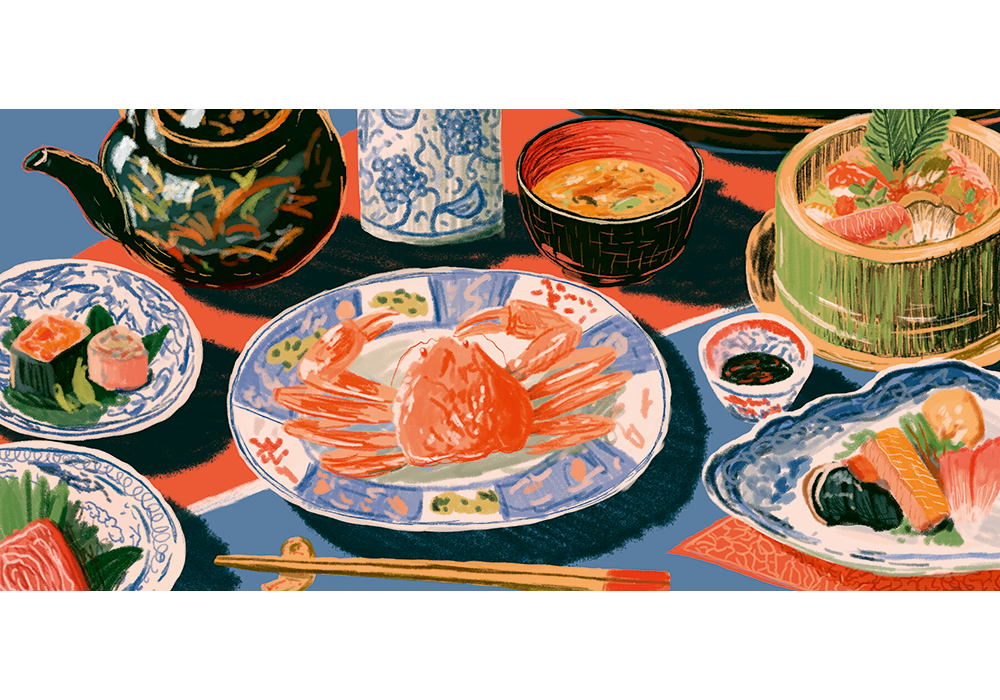

Four peachy-pink snow crabs lie in a row, waiting to be cooked. They could be dead, were it not for the flickering of an antenna or the occasional terrified roving of a beady eye.
Tonight, the crabs, which have been sourced from Fukui, Japan, and are prized for their sweetness and silky texture, will be ceremoniously shown to diners at Muku, a Michelin-starred restaurant in New York. They will then be split in half (still alive – fresh is best!) and cooked on a handsome hibachi-style ceramic grill. The crabs are one course in the fancy and formal kaiseki-inspired menus taking America’s coastal cities by storm.
“We want to show the seasonality, not by [just] showing the crab, but actually grilling the crab in front of you,” executive chef Manabu Asanuma tells me, gesturing to the creatures that lie trussed up on the table between us at his restaurant. To put it another way, as Asanuma says with a grin, “the customer is watching our show!”
Kaiseki is deeply ceremonial,with a set structure and a long history
In America, Japanese cuisine has long meant sushi, sushi and more sushi. And go to any sushi restaurant (from the priciest to the cheapest) and most will now offer an omakase menu. The concept – which means “I’ll leave it to [the chef],” but in the US has become synonymous with a procession of one-bite nigiri and sashimi – has become so commonplace and has lost so many standards in the process that it’s often little more than a marketing gimmick. Omakase, as Muku’s co-owner Rahul Saito explains, is oversaturated. “People have had enough… [they] are ready for a little bit more.”
Now, among the most rarefied Japanese restaurants, a new concept is attracting discerning diners: kaiseki, the ultra-refined, ultra-expensive, ultra-ritualistic meal of multiple courses that originally hails from Kyoto. Proponents in New York include the Waldorf Astoria’s Yoshoku; Yamada in Chinatown; and now Muku, which opened last September only to earn a Michelin star two months later – the fastest such achievement in the city’s history. In Los Angeles, n/naka provides a California take on kaiseki – for $395 per person. “We invite you to pause, savor and connect with the true grace of a moment,” the restaurant preaches.
Part of the appeal – unsurprisingly – lies in these restaurants’ exclusivity. Muku has just ten seats. At the equally intimate Yamada ($330 a head) guests are asked not to wear shorts or caps. Yoshoku marries the storied Park Terrace in the Waldorf Astoria (diners eat while eyeing Louis Rigal’s 1939 Art Deco “Wheel of Life” mosaic) with a six-course menu that oozes luxury.
Beauty, too, is paramount – as is skill. “What fish are you going to grill? How are you going to grill it to get the most flavor? And how are you going to present it to make it look pretty?” asks Asanuma.
Presenting a kaiseki meal isn’t a physical endeavor, it’s a philosophical one. Take the concept of serving three rice dishes in cha-kaiseki, the type of kaiseki eaten before ceremonial tea. While the first dish is designed to warm and prepare the stomach, the final steamed rice, served with miso soup and pickles, symbolizes a return to simplicity.
Kaiseki is deeply ceremonial, with a set structure and a long history. In an increasingly online world, it offers ritual, seasonal ingredients and, importantly, an abundance of rules: something the overly connected among us, eager for meditation and formality, crave. It’s become a signifier of status and, mirroring wellness trends, a retreat.
“Kaiseki is equal parts art form and cuisine. It is also confusing and full of ironies,” observes the Palate Project blog. It’s “the peak of fine dining, yet its origins lie in the Buddhist concept of self-restraint. [It] values the simplicity of natural ingredients, and yet it can also be a lavish, multisensory experience with painstaking attention to visual detail.”
In Japan, that might mean something as straightforward as a raw bamboo shoot, peeled and sliced in front of you, then placed in a clear dashi soup. That just wouldn’t fly in a city as polluted as New York. “That bamboo shoot is picked on a [local Japanese] mountain with clear water and eaten fresh – but that’s just not practical here,” says Saito.
The answer for Muku is to insist they serve their food kaiseki “style,” not as a traditional kaiseki. Take the foie gras – decidedly not a Japanese ingredient – poached in bonito dashi and blended with egg to create a custard-like texture. The result is a gelatinous dish that is creamy yet complex, rich yet restrained, with the umami of the dashi working hard to tone down the unctuous, fatty foie gras.
Instead of steaming its rice, Muku serves it softer and wetter, inspired by Italian risotto – all the better to absorb the broth. Soba noodles also make an entrance, enhanced by the owners’ roots: the nutty, flavorsome buckwheat hails from Asanuma’s parents’ farm in Yamagata Prefecture. Each morning, Asanuma hand-makes the noodles himself.
Rules – and breaking them – are things that chef Hirohisa Hayashi understands well. Hayashi grew up in Echizen, outside Kyoto, where his parents ran a kaiseki restaurant, which dated back to his great-grandfather. He studied the art of kaiseki at a traditional ryotei, or classical fine-dining establishment, in Kyoto – and hated it.
‘It’s the peak of fine dining, yet its origins lie in the Buddhist concept of self-restraint’
“It was very strict,” he says, clasping his hands together and frowning. “There are many rules. You have to do this. You cannot do this.” One example: sashimi must always be served in odd numbers (even numbers are inauspicious). Another: the stem of leafy greens must be placed to the right of the plate, with the tip of the leaf to the left.
In 2013, Hayashi opened Hirohisa in Soho, serving an unadulterated kaiseki menu – and found the locals were utterly confused (most asked why he didn’t serve sushi). He has since moderated. There are still Kyoto dishes such as kaburamushi (grated turnip steamed with fish). But he also plates scallop karasumi layered with flakes of black truffle.
And why not? “At the end of the day, we want people to love it, enjoy it, experience it, feel it – and use the five senses to have fun with it,” says Asanuma. He clasps his hands together in prayer, looks up – and smiles. “Just because it is Japanese, you don’t need to be in a temple.”





Comments