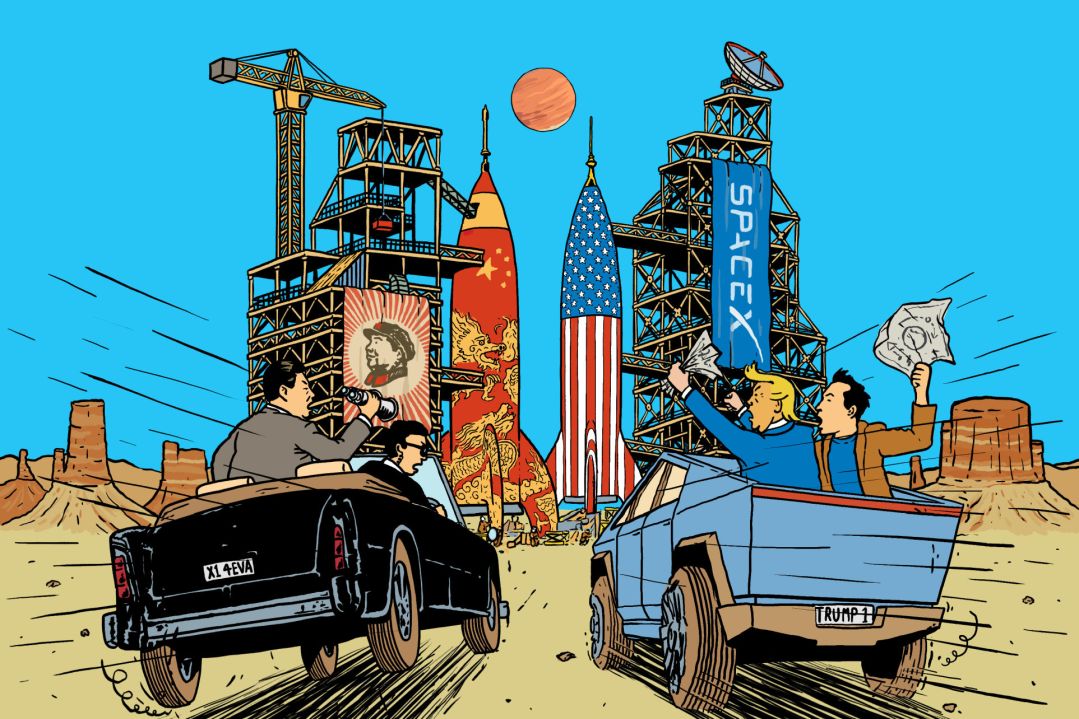
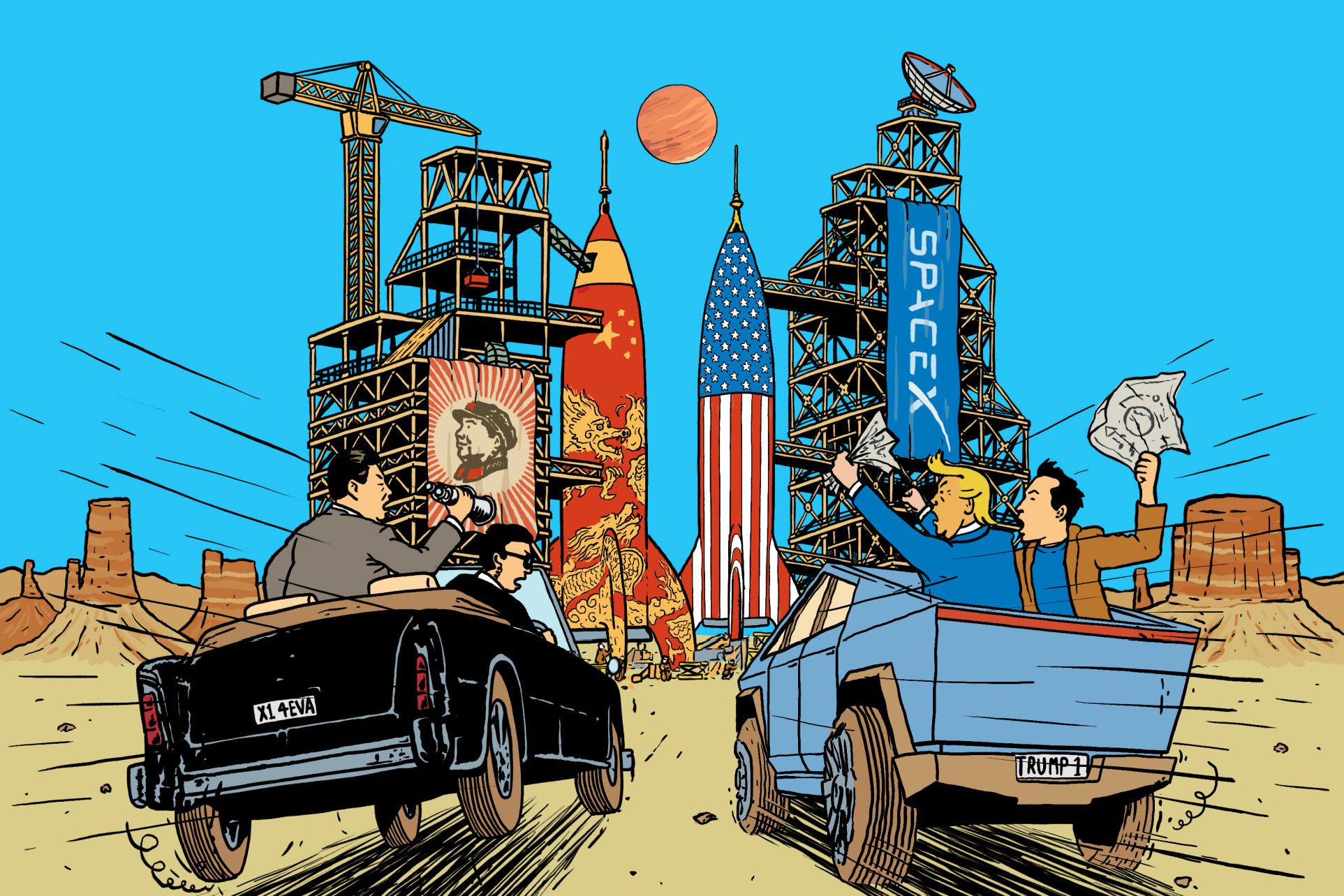
America has what might be the best evidence for life on Mars. NASA’s Perseverance rover has gathered rock samples that could contain compelling biosignatures of ancient microbial life. No one is quite sure yet, and the samples need to be tested in a lab before we can conclusively prove that our distant neighbor once harbored life. Too bad. We’re never going to see the results. In January, funding for the project was canceled. Donald Trump has other plans for the red planet.
He obsesses over competition with China and with planting the Stars and Stripes on alien soil. So to the horror of many of the world’s scientists, Trump has pulled the US space effort away from incremental robotic exploration to prioritize human landings on the Moon and Mars.
“Americans are explorers, builders, innovators, entrepreneurs and pioneers,” Trump said during his inaugural address last year. He pledged that the US would “pursue our manifest destiny into the stars.” His understanding of space comes mainly from Elon Musk, seen by many as wildly optimistic. Musk aims to launch unmanned Mars-bound spacecraft later this year, timed to the next Earth-Mars orbital alignment, with crewed missions to follow in 2028 if the uncrewed mission succeeds.
Although Musk continues to promote this ambitious timetable, most expect it to slip, including Jared Isaacman, NASA’s chief. He estimates that we won’t have people on Mars for at least ten to 15 years and even that is seen as optimistic.
Many scientists have criticized the cancellation of the samples’ return. Victoria Hamilton, of the Southwest Research Institute, said canceling it will overturn decades of research and diminish US space leadership on the global stage. She’s not the only one. Casey Dreier, head of space policy at the US Planetary Society, said that it was an “extinction-level event” for space science.
Congress partly sided with the scientists. They rejected most of Trump’s proposed cuts, allocating NASA $24.4 billion, which was much more than expected. But Trump still wants to slash non-exploration programs such as Earth science, climate monitoring and robotic missions, and allocate the savings to human exploration.
Undaunted by congressional opposition, his 2027 budget includes $1 billion for Mars-focused investment. The new money will be spent on building nuclear-powered spacecraft that will thrust astronauts toward Mars faster than conventional rockets and researching surface nuclear reactors to power a base.
Wider NASA funding is also being reoriented. The Space Launch System rocket and Orion crew capsule – the two main pieces of government-built hardware at the heart of NASA’s return mission to the Moon – are to be phased out. These will be replaced with privately developed rockets and spacecraft. Trump’s hope is that, by cutting back on proprietary technology for the Moon mission, NASA’s focus can instead turn to sending astronauts to Mars.
John Grunsfeld, the former head of science at NASA, thinks this outcome is the worst of both worlds. He says the US will end up with less science and a budget nowhere near large enough for Trump’s plans. Trading robotic science for a manned mission doesn’t make sense, he says.
Yet this is how the White House justifies canceling the Mars Sample Return project: the money is better spent elsewhere. And anyway, testing whether life once existed could be achieved by future humans on Mars. Despite scientific skepticism, putting astronauts on Mars remains one of Trump’s more popular initiatives – a 2023 poll found 57 percent of Americans are in favor. Trump’s drive is the greatest gamble since Queen Isabella of Castile symbolically offered to sell her crown jewels to fund Christopher Columbus. If the President fails, the US could lose a lot. China has plans to launch Tianwen-3 in 2028 to bring back its own Martian samples. They have a shortlist of 19 potential landing sites with the top three to be selected by the end of the year. Beijing is already building a high-security sample laboratory with stringent biosafety containment for analysis of Martian material.
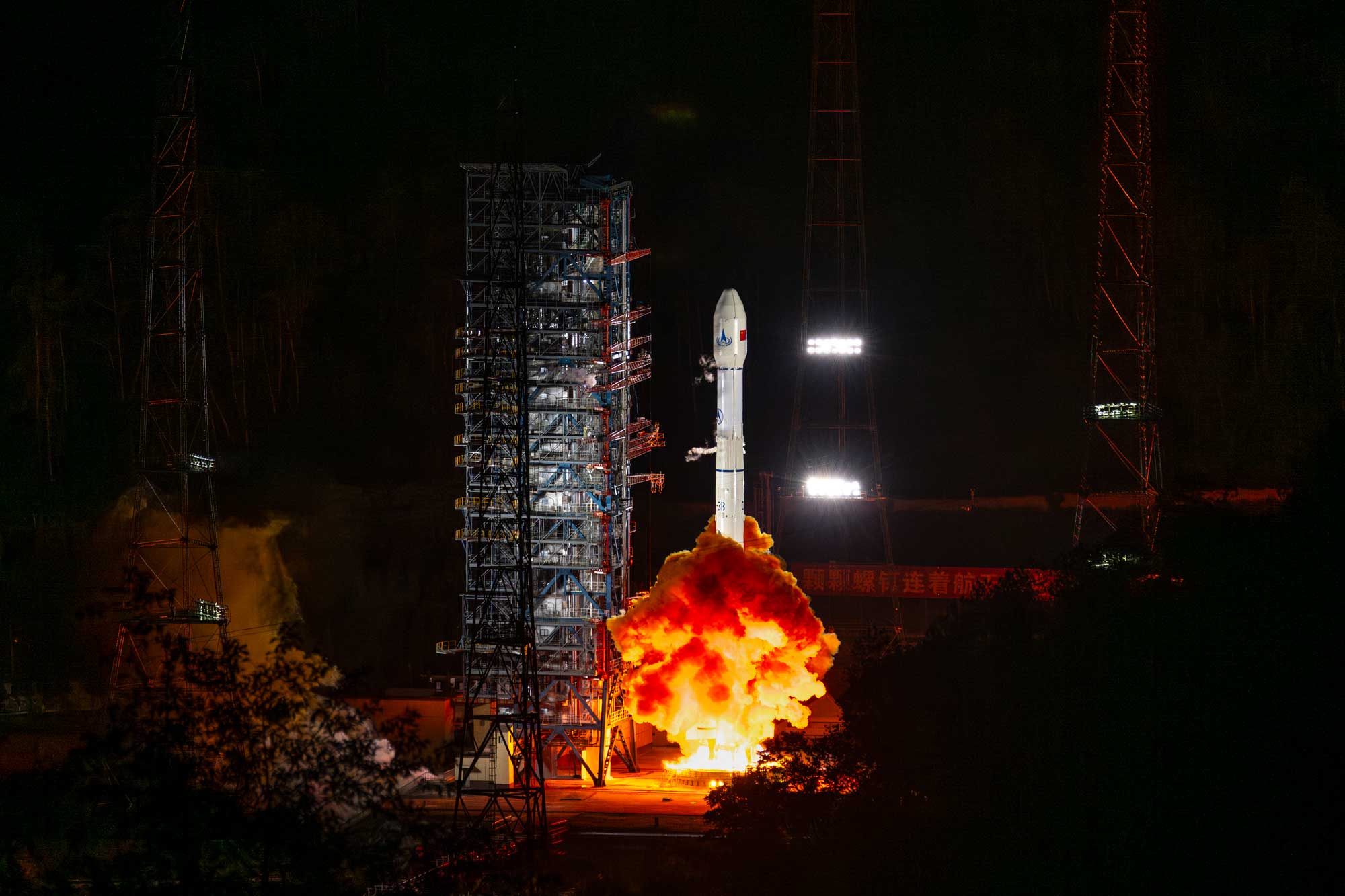
So, while the Perseverance samples languish, China could win this important race. Should that happen, expect China to use it for all it’s worth. The message will be clear: Beijing achieved what Washington could not.
Meanwhile, the race to put people back on the Moon is too tight to call. Isaacman says victory will be measured in months, not years. The US project started in 2004 and since then there has been only one human mission, the spectacular Artemis II. That was until China threatened to get to the Moon first and the US increased its pace.
Since his return to office, Trump has issued multiple executive orders aimed at countering the Chinese threat and ensuring American space superiority. He has ordered NASA to return astronauts to the Moon by 2028 and to establish the first elements of a permanent lunar outpost by 2030 to “prepare for the journey to Mars.” Every part of the US space program is being redirected at the red planet.
There are other projects that are being abandoned to meet that one goal. The US-led International Space Station is also soon to be retired, and Trump wants a series of smaller, commercially built stations in its place. Once that happens, China will have the largest low-Earth orbit station, Tiangong.
Should China win those three races – the return to the Moon, the largest space station and proving life existed on Mars – it could reshape the international order back here on Earth. Much of the world will conclude that China holds the keys to the rest of the century. That is why Trump has gambled it all on a manned mission to Mars.
No planet has embedded itself so deeply in our culture. It must have started on some African night when our ancestors, not yet human but with a spark of comprehension, pondered its strange yet familiar color. Since then, it has reminded people of a drop of blood in the sky. For the ancients, Mars represented war and ruin, pain and death. The same is true today. Mars will test humanity far more severely than the Moon. Musk’s dreams of a vast migration, millions of people starting again on a new world, will collide with the harsh reality of off-Earth living. That aim is still little more than a fantasy. Mars will be hard won, as the graves on the red planet will one day testify.
Despite scientific skepticism, putting astronauts on Mars remains one of Trump’s more popular initiatives
For new Martians, the Sun will be an unnerving sight, smaller and with no warmth as far as it’s possible to tell from inside a spacesuit or habitat. Stepping outside, there is nothing in the way of comfort. No movement except for the little caused by the wind and the rare landslide. No sound save for their own breathing in their pressure suits. And every breath must be measured, every calorie counted, every scrap of energy generated and accounted for, every crew member and relationship tolerated, every second of life meticulously planned. In all of human experience, there has never been an isolation as total as that of Mars.
In 2012, the Austrian skydiver Felix Baumgartner jumped from the stratosphere, launching himself from a capsule suspended from a helium balloon. He was at an altitude of 39 km in the very upper reaches of the atmosphere, which is cold, thin and deadly. If his suit had developed a tear, he would have lost consciousness within 15 seconds. The ambient pressure is so low that, within a few minutes, his blood would have begun to boil. Yet as Baumgartner contemplated the moment, the atmosphere around him was warmer and thicker than that found on the surface of Mars.
Jeff Bezos, the founder and funder of the Blue Origin aeronautics company, once said: “My friends who want to move to Mars? I say, ‘Do me a favor, go live on the top of Mount Everest for a year first, and see if you like it – because it’s a garden paradise compared to Mars.’”
The challenge of Mars will define the 21st century, alongside AI, the control of the genetic structure of our bodies, the quantum revolution, nuclear fusion and our environment. Of all these, the US and China know that it is Mars that will establish the order of things for the centuries to come.
At this moment there is briny water flowing on Mars; ice forming at the Martian poles; the morning mist is clearing from the Valley of the Mariners; a dust storm stirs in the northern plains. And the first person to visit Mars is currently living somewhere in China or America.






Comments