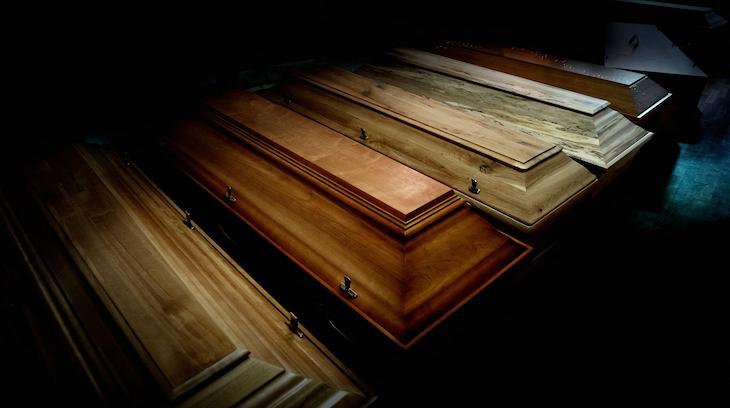
Ronnie’s family has been in the same line of work since the 1880s. His office is next door to a flint church which can trace its origins back even further. The churchyard has turned the colour of straw this year but Ronnie’s premises are cool. I’ve come to see him on the unthinkable errand of choosing a coffin for my younger brother. It helps that Ronnie’s exactly what you’re looking for at a time like this, beginning with his name. He doesn’t stay seated behind his desk but rises to clasp my hand in both of his; the same with my brother’s son, who is accompanying me, and for whom this is an even more unconscionable shopping trip. Ronnie is in his sixties, though he has younger-looking teeth, and is thinning a bit on top. He is wearing traditional undertaker duds (“the stripes”).
I tell him, “We’re glad that Mike is with you now and not the coroner.”
“We could walk outside, past our mortuary. Your dad would be on the other side of the wall from us…?”
Ronnie nods gravely. “A hundred per cent.”
Michael died suddenly in hospital in high summer, part of the spike in morbidity this scorching season. There were getting on for 3,000 ‘heat-associated deaths’ in England and Wales in May and June as a result of the heatwaves, according to the UK Health Security Agency, and perhaps the toll will be much the same when the numbers are in for July – when Mike died – and August. He was 63, never smoked and rarely drank, and made his living as a personal trainer. He went to hospital complaining of breathing difficulties. He went into cardiac arrest almost immediately and never recovered. The cause of death was eventually given as a pulmonary embolism, a blood clot in the lungs. It was a month before the coroner released his body, though an investigation into his death continues.
Ronnie has done hundreds of funerals, including my dad’s thirty years ago and mum’s ten years later. But he talks to us for two hours about arrangements for my brother and treats our concerns as if we were the first people to whom they had ever occurred. His answers, though, are those of a seasoned professional. Yes, we may place messages in Mike’s coffin. He can be dressed in whatever we like but no glass or rubber. There are documents for me to sign as next of kin. Ronnie places them before me with the unobtrusive deftness of a waiter performing silver service. Embalming? I mark the box for “No”.
“What are ‘first orders’, Ronnie?”
“Those are the services we perform for your brother.”
My nephew and I must be staring blankly at him because Ronnie gives me an anguished look through his spectacles. “It’s to do with dignity,” he says at last, with the air of a man who’s been forced to betray a great confidence.
The classic square-shouldered coffin shape is reserved for gentlemen, I learn, while ladies repose in a casket with a more rounded profile. The family don’t want wood or veneer. My brother was a fresh air fiend, and a bit claustrophobic. We’re interested in willow.
“The Stockberry is very popular,” says Ronnie, opening a brochure and smoothing it out on his desk. There’s a choice of colour with this model and we like the look of the darker one. “Ah yes: the ‘Toffee’,” says Ronnie.
He wonders about ties. I assure him I’ll be wearing one.
“I meant our ties,” he says. “We’ll be in the stripes, but some people like us to wear a blue tie or red. Football colours.”
I mention that I rang his firm the other day and a man called Chris answered – Ronnie’s brother? “Our stonemason,” he corrects me. “He’s been with us for sixty years. If you look at the churchyard out there, ninety per cent of the newer headstones are by Chris. We used to have two men who dug the graves by hand but now a machine does it.”
There are letters and cards of appreciation on a table. I notice a mini coffin, the size of a chocolate bar. “What’s that, Ronnie? Is it an air freshener?”
“It’s for stress!” he laughs. He grabs it and gives it a squeeze. “Would you like it?”
I was able to see my brother within an hour of his death but his son was away. He wonders if he could look in on his dad while we’re here. Ronnie regrets that it’s not possible but can be arranged before the funeral. Then he has a thought.
“We could walk outside, past our mortuary. Your dad would be on the other side of the wall from us…?” This nonplusses my nephew, very understandably. But as we go out into the heat again, by the churchyard and the sun-baked earth full of Chris’s stones, I find I’m not distressed by the thought of my brother on the other side of the wall, in the cool of Ronnie’s premises, almost home again.



Comments