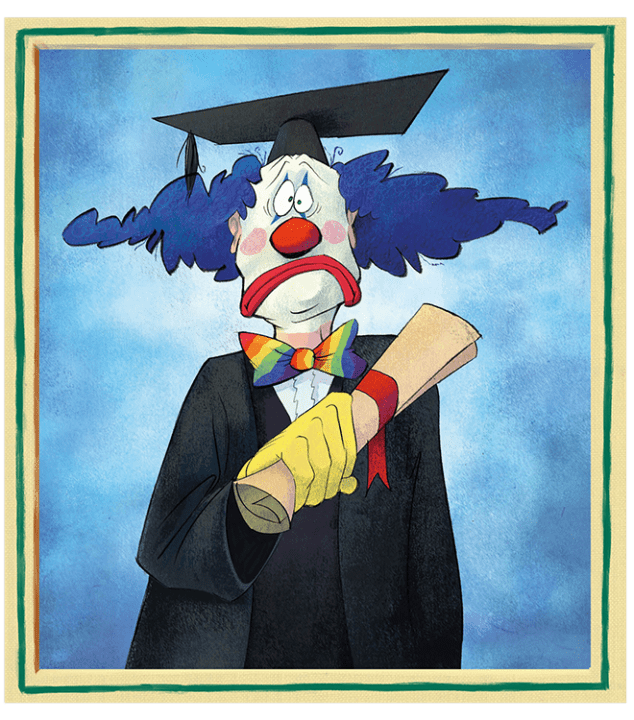


Daniel Defoe observed that plague victims “never perceiv’d that they were infected” until they discovered the “tokens” on their skin. By that point, “nothing could follow but certain Death”.
Something similar might be said of Britain’s universities. In recent days, the Jason Arday affair has captured the world’s attention because of its absurdity. But the humiliation of Cambridge is not an early sign of infection. It is just a particularly visible bubo.
At one level, Arday’s fall reveals how, even in the most elite universities, DEI (diversity, equity and inclusion) dogma has warped intellectual standards to the point of madness. Yet a deeper examination reveals poor Jason to be merely a poster boy for the increasingly fetid system that is British higher education.
Take the London School of Economics (LSE), which has produced 21 Nobel Prize winners, was ranked number one in the UK by the Times Good University Guide last year and is internationally acclaimed for its teaching on economics, finance and politics. However, all first-year students must now take LSE100, the university’s “flagship interdisciplinary course.” Students may choose to study one of three modest questions: “How can we transform our climate futures?”; “How can we control AI?”; or “How can we create a fair society?” One student described the course as “famous for being a massive waste of time”. What is lost in academic discipline is made up for in ideological indoctrination.
Participants constructed walls, ladders and bridges out of Lego as metaphors for racism
LSE students who opt to study “How can we create a fair society?” discover a course description asserting: “As the expanding billionaire class increasingly dominates political systems, while gender and ethnicity gaps widen, the question of how to reach a fairer world is both urgent and contentious.” Even stranger than the courses are the people who teach them. Among them is Dr. Alex Frankovitch, whose PhD thesis was entitled “Fucking and Being Fucked: Towards a Sexual Ethics of Sex on Drugs.” One student recalls asking Frankovitch about Warren Buffett, only to discover that they (to use Dr Frankovitch’s preferred pronoun) had never heard of him.
Dr. Carolina Are is, according to LSE’s website, a “digital criminologist… researcher-activist and content creator” who won a Sexual Freedom Award in 2019. She gives lectures on reducing “online harms” and “how we can control AI.” When not contemplating man’s struggle against machine, she is a pole-dancer and instructor. The website linked to her university profile contains her showreel and invites visitors to “learn a pole dance choreography, pole tricks, floorwork or twerk with me via Zoom!” Sadly, Friedrich Hayek, the father of modern free-market economics, did not offer similar services when he taught at LSE.
Are is entitled to do what she wants in her free time. But what sets alarm bells ringing about her academic standing is that pole-dancing seems to be not just an outlet for relaxation, but the focal point of her research.
One of her most recent papers is called “Sexy jail” and performative transparency: Evaluating shadowbanning notifications and appeals in Instagram’s Account Status amongst pole dancing content creators”. It examines the treatment of pole dancers, “a demographic greatly affected by algorithmic precarity in the creator economy,” and concludes that Instagram’s system has been “ineffective and discriminatory.” An important finding, no doubt, but is such material what LSE students signed up for? One student complains of having to be careful not to use any technical language in submitted work due to Dr. Are’s lack of expertise.
When asked how students should put together a presentation for the course, to be assessed for their final grade, Dr. Are allegedly answered: “I really hate when a white man gives the presentation… It’s just so boring.” An LSE spokesperson said Dr. Are “has a relevant PhD and is qualified to teach on the course” and that she denies making the “boring” comment.
It would be comforting to dismiss all this as an eccentricity peculiar to the LSE. But so many universities across the country are wasting student time in much the same way. At Exeter, you can study for an MA and PhD in magic and occult science. At Liverpool, you can pay £6,850 a year to do an MA in “The Beatles, heritage and culture”. At Falmouth, students can undertake a BA in “Esports & Livestreaming” at the university’s “renowned Games Academy.”

Students of global sustainable development have previously had the chance to enroll in a “surviving the apocalypse” module at Warwick. Given the growing instability of the world, that may sound potentially useful. Yet the syllabus suggests projects on “mushrooms and zombies” and insists the course has a “subtle (?) but unmasked convenor neurodiversity (ADHD) guiding its set-up and delivery”. I’m not sure I’m sufficiently neurodiverse to understand what that means.
Students on all these courses are eligible for undergraduate or postgraduate loans. It’s impossible to know what percentage of that financial support will ever be repaid to the taxpayer.
And it’s not as if prudent students can escape the madness by pursuing more conventional subjects. Those studying English and comparative literary studies at Warwick, for instance, can pick up 15 credits by studying a module on “Queering the Literary Landscape: LGBTQ+ Literature and Culture in the Contemporary World”. Even a math degree offers no refuge. Students at Edinburgh might be surprised to learn that the school of mathematics is committed to “decolonizing”. The faculty claims that “the history of mathematics typically centers cisgendered, straight, white European men” and recommends that students should take implicit bias tests.
Madness in the lecture theater is just the more visible by-product of a much longer production line. Before students can study zombies, pole dancing and astrology, academics must first turn these subjects into recognized fields of research.
Earlier this year, a team of five researchers published a paper on “Decolonizing the sciences: Enhancing the experience of staff and students from racially minoritized ethnic groups using LEGO® Serious Play®.” This work was the culmination of a study across three northern English universities in which 50 adult students, researchers, academics and professional staff were asked to build Lego models representing their experiences of racial inequality, institutional barriers and decolonization. Participants constructed walls, ladders and bridges out of Lego as metaphors for racism. Somehow this childish activity now constitutes academic research.
There’s more. A researcher at Rose Bruford College, in southeast London, is investigating “the lack of career development support for established drag performers.” The project is intended to contribute “to drag studies as a growing academic field, addressing a current lack of attention about how to sustain this historically working class and popular performance form.”
Meanwhile, at Bath Spa, a senior lecturer in organizational behavior and leadership has received a grant to investigate “cognitive and emotional costs of identity regulation among ethnically diverse early career professionals”. The project bemoans that “professions in the UK often promote values like competence, meritocracy and individual achievement, reflecting white and western norms.”
Students complain it is impossible to find a normal supervisor, so preoccupied is everyone with queering
At least that’s privately funded. The government’s Department for Science, Innovation and Technology has just shelled out for a project at the University of Essex entitled “Towards a queer communism: Past, present and future horizons of liberation.”
None of this is new, of course. Frivolous and absurd studies have been pouring out of higher education institutions since at least the 1970s. In 2012, Robert J. Wallis of Richmond University published a paper analyzing people’s experiences jumping on a life-size inflatable Stonehenge, concluding that “bouncing on the artwork-cum-plaything provided an immediate sensory and visceral experience which was meaningful in relation to the real Stonehenge.” This somehow gazumped Spinal Tap for Stonehenge silliness.
The difference today is that the rot appears to have spread throughout academia, from top to bottom. Even respected journals aren’t safe. I was surprised to find an article in Shakespeare Quarterly “refusing to celebrate” the quatercentenary of the publication of the 1623 Shakespeare First Folio. The author reasoned that we should not be “dedicating our energies, at a time of international emergency, to the production of ever more scholarship on a 400-year-old book.” If this is really his view, we have to wonder what he is doing in the English department of Gonville and Caius, Cambridge.
The author goes on to blame the Folio for climate change, arguing that Henry and Emily’s Folger Shakespeare Library collection “was built from the money he made working for the Standard Oil Company and its later derivatives, which became the progenitors of ExxonMobil.” He then asks us to reflect “on the extent to which modern cultural dispensations float on an often unacknowledged reservoir of fossil fuels.” Drill, baby, drill.
Professor Jason Scott-Warren, who wrote the article, is the director of the Cambridge Centre for Material Texts. He supervises graduates on English and European Renaissance literature and has been arrested several times for his environmental protest actions.
Sane students complain that, even in more prestigious universities, it is nigh-on impossible to find a normal supervisor for a dissertation, so preoccupied is everyone with queering, decolonizing or sticking themselves to motorway bridges. It’s a lot easier to condemn Shakespeare for causing climate change than it is to properly analyze his work.
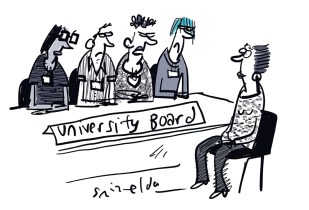
We will never really know what is going on in lecture theaters and supervisions. The University and College Union has long objected to unannounced lesson observation to assess an academic’s competence and most students don’t complain. But in the pointless courses, the insane modules and the absurd journal articles, we can see the symptoms of a morbid university disease in this country.
Faculties and academics have all broadly been left to their own devices for decades. The Office for Students doesn’t regularly inspect what is happening inside university classes. Even after the introduction of the revised Teaching Excellence Framework, starting next year, no one will ask if academia is providing any valuable insight or skills.
Student finance has guaranteed cash flow for many institutions which, judging by the quality of their offering, should have gone under. But the sickness is terminal for some. This month, after years of difficulty, the University of Kent completed its merger with Greenwich. Greenwich’s vice-chancellor is CEO of the new “super university” – a triumph for the former polytechnic.
It would be easy to rue the decline of a formerly prestigious institution. But a brief glance at how academics at Kent have spent their time and resources tells a different story. Why did they fund a study into “what drives sex toy popularity” in 2023? Why is one of the senior lecturers in 18th century studies currently supervising a project on queer readings of fan fiction and the “omegaverse?”
It’s a lot easier to condemn Shakespeare for climate change than to analyze his work
It’s not all decay. Many universities still have healthy organs, uncorrupted by ideological inanity. Researchers at Kent, for instance, were responsible for developing the retinal-imaging technology now used in many hospitals, as well as genome sequencing parrots to understand beak and feather disease. Yet while scientists slave away, their peers in Kent’s Durrell Institute of Conservation and Ecology are busy publishing research about “racial and economic disparities in coastal access and engagement.”
Academia lacks a proper incentive structure. There is no higher authority to differentiate the value of curing cancer compared with producing yet another autoethnography. Trusts like Wellcome, and our own government, are happy to hand out grants for the latter without pausing to ask what it’s all for.
If your life’s great passion is the study of bouncy castles, pole dancing or writing essays on autoethnography, there ought to be nothing to stop you from working at Toys R Us, a gentleman’s club or the Guardian. But these people have all chosen to pursue academia. They are attracted to the status it confers. This was the world in which Jason Arday thrived. His colleagues at Cambridge were carrying out research on how fairy tales can break the gender binary in playgrounds or writing “a self-portrait of an artist who teaches.” Is it really surprising that his error-ridden thesis didn’t stand out against this backdrop?






Comments