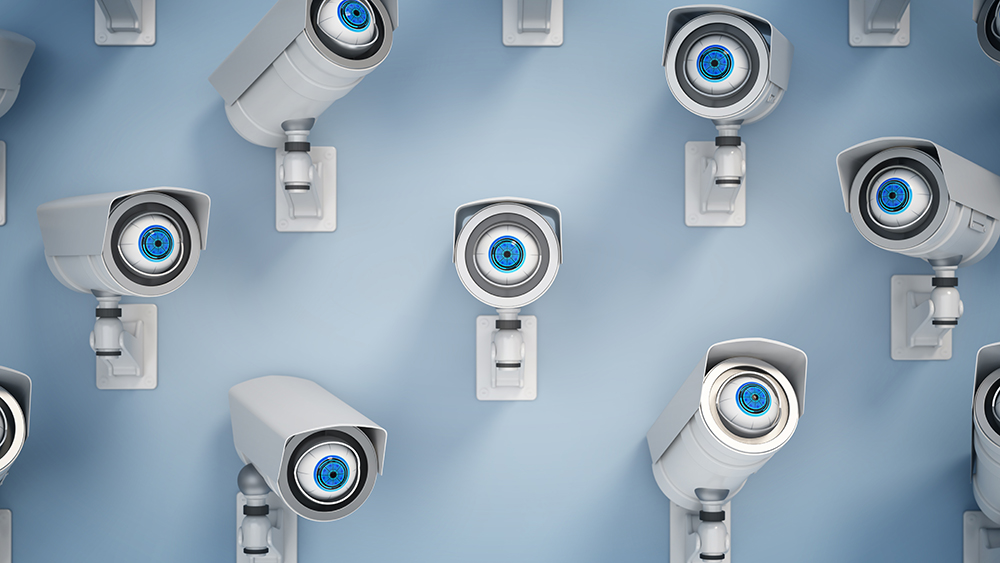
Some people think that the United Kingdom ranks as an unusually surveillance-heavy society, what with all the CCTV installations, doorbell cameras and automatic number plate recognition systems that have proliferated in the public sphere – but they would be wrong. In fact, according to Ruben Andersson’s Age of Security, the whole world is sliding towards a state of perpetual surveillance, where everybody is spied on all the time, by cameras and communications interceptions and data capture, without debate or accountability or even much public reflection on what is happening.
Do we actually want to live in this state of heightened supervision, looked over by what we are told are ‘machines of loving grace’ (as the novelist Richard Brautigan once wrote)? Does it matter? And who cares? Those are the questions tackled in this book about the global shift towards a security culture and the possible cost of that shift.
Of course there is surveillance and there is surveillance. The total of surveillance cameras in London, for example, is high, at more than 60 cameras per 1,000 of population. But if you only count government-linked cameras, then Washington DC has more spycams per head than anywhere else in the world; Dubai has the densest population of cameras accessible to the government (2,072 per square mile); and Stockholm is per capita the most intensely remote-monitored city in Europe.
In short, everyone is getting into the game of looking at everyone. Whether you are in Delhi (a quarter of a million public CCTV cameras) or Doha (15,000 cameras for a population barely over a million) someone is watching you. We are approaching the point where the dream of the East German Stasi is fulfilled: that everyone should be spied on, all the time. This may be in the name of security, or safety, or community cohesion, or defence of civilisational values – it doesn’t really matter. Once established, the logic of the surveillance society is that surveillance has to expand.
This logic does have inherent contradictions – not that they count for much in practice. The more surveillance expands, the more resources it demands (someone or something has to look at the output); and because resources usually have a natural limit, the more surveillance expands the less effective it becomes, with the result that what is needed is… more surveillance.
This is a logic that is very difficult to reverse, although not impossible (in the few cases where UK local authorities have reduced the number of CCTV cameras it has been for cost reasons). It used to be the case that surveillance growth was limited by manpower: on the day the Berlin Wall fell, the Stasi had 91,000 full-time employees, one for every 180 citizens, and one in every 30 citizens was some kind of informer. The state had already run short of people to spy on people.
Today these limits do not apply. Artificial intelligence can do the work of countless thousands of surveillance bureaucrats much faster and much more cheaply (although not necessarily to any better purpose). Yet there are other intrinsic limits to the total security concept, and the viability of what Andersson calls the ‘harm-industrial complex’ that seeks to install ever more monitoring devices, and instil ever more paranoid needs for them.
The whole world is sliding towards a state of perpetual surveillance, where everybody is spied on all the time
Although this book does not dwell other than very briefly on the second world war, it was then that one of the paradoxes of security thinking was identified: the more secure any system tries to make itself, the more insecure it becomes.
When, in the 1930s, the German military began to adopt the message coding machine known as Enigma, it quickly became so complex – with trillions of combinations – that its users began to believe that they had achieved a total security advantage. This turned out to be the fundamental flaw. Any security system is crackable, and Enigma was no exception. The true vulnerability was belief in invulnerability. In the face of compelling evidence to the contrary, the Germans refused to believe that Enigma had been compromised and carried on using it.
This is what the goddess of witchcraft in Macbeth means when she says: ‘And, you all know, security is mortals’ chiefest enemy’ (the epigraph of this book). Macbeth, an early exponent of the paranoid style in politics, becomes so fixated on threats and their suppression that he ends up convinced of his own invulnerability. A modern Macbeth might sit surrounded by hundreds of screens and data feeds (the studio furniture of just about every contemporary TV thriller), unaware that all this security technology has bred its own fatal insecurity.

We might reflect on that as we install another dashcam or home security system. Most of the great changes in the way we live come about by stealth. There has never been any referendum on whether we want to live in a world dominated by cars, for example, or to have the skies filled with aircraft, or have music piped everywhere. So do we really want to live in a world of security systems, all devised – they say – for our safety and convenience?
The answer may well be ‘yes’. As I put the finishing touches to this review I read that in my provincial English town the number of security cameras had just been more than doubled (to ‘strengthen community safety’). The voices on the street approve: it is reported on the BBC that public opinion says that the cameras will crack down on people gathering in groups and making noise.
So that’s a relief.





Comments