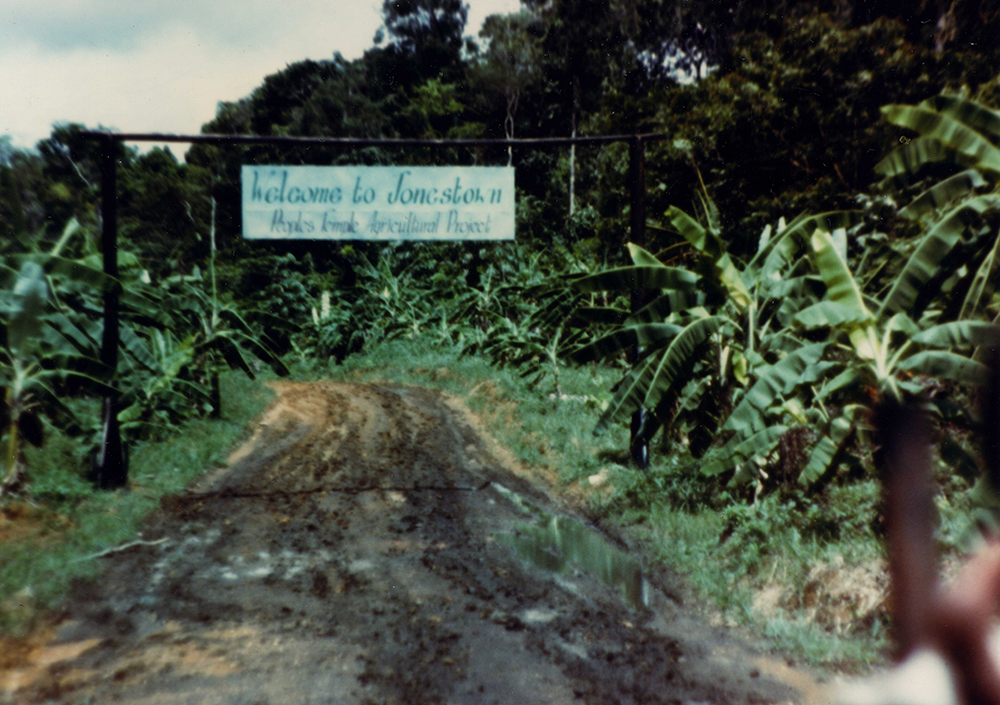

The Jonestown massacre, in which more than 900 people were killed and a US congressman was shot dead on a Guyanese airstrip, has been written about in dozens of books. Shiva Naipaul met some of those aspiring Jonestown authors loafing on a Georgetown hotel terrace. “Sex. Race. Suicide. Murder. Corruption. A hot Third World country. That’s a classic mix,” one said to him. There have been both forensic and lurid accounts of the Jonestown apocalypse, in which crowds of American expats were forcibly dosed with cyanide-laced Flavor Aid, but nothing comes closer to its dark, post-colonial heart than Journey to Nowhere. The book was first published in 1981, three years after the massacre, but fell out of publication. It’s now been reissued by Outsider Editions, a new imprint dedicated to republishing lost classics.
The Spectator once ran the Shiva Naipaul Award, whose rubric talked about encouraging the “observation of alien cultures” rather than conventional travelogues. The award was a memorial. Naipaul died of a heart attack in August 1985, six months after his 40th birthday, getting up from his typewriter mid-paragraph and never returning. I still have the program from his memorial service, held in the early-December chill of an old London hall. I arrived early and had to endure several moments of nerve-racking small talk with V.S., the elder, more famous Naipaul. Martin Amis read from Auden’s “In Memory of W.B. Yeats.”
The problem with the ‘Third World,’ Naipaul maintains, is that it does not and cannot exist
In strict taxonomic terms, Shiva’s work falls into two main categories. The early novels, Fireflies (1970) and The Chip-Chip Gatherers (1973) are comic tragedies set in his native Trinidad (a third novel, 1983’sA Hot Country is less exuberant and was less successful). By the early 1980s, sustained by a fruitful connection with this magazine, Shiva had set himself up as a contrarian essayist, with some withering things to say about fashionable attitudes to what was then becoming known as the “Third World.” The thread of dispossession and anomie runs through all Naipaul’s books. Its theme will be familiar to anyone who has ever read one of his novels. People exist on their own terms, not as representatives of the demographic blocs to which ideology insists they belong, sustained by a series of myths that are more often personal than collective. At the same time, they have historical destinies to pursue. “The colonized have evolved numerous strategies of evasion,” Naipaul writes midway through An Unfinished Journey, a posthumously published collection of essays.
One of those essays, “Flight into Blackness,” is a meditation on Australia’s relationship with its Aboriginal minority, which at one point caused its author to be banned from entering the Northern Territory. Either the Aboriginal accepts that he is an Australian citizen, Naipaul argues, or he retreats into a kind of adventure playground made up of koala bears, red native earth and lofted didgeridoos. This was bracing stuff for the early 1980s and rendered even more objectionable to left-wing critics by the fact that the man expounding it had brown skin and could therefore be written off as a white man’s poodle.
“It is now fashionably radical to inform immigrants from India and Pakistan and Cyprus that they too, for the sake of solidarity, must simplify themselves into Blackness.” Shiva was ahead of his time. Yet more outrageous was his documentary The Illusion of the Third World, commissioned by the newly established British TV station Channel 4 and delivered direct to camera, with Naipaul looming larger and larger out of the screen so that, by the end, his face completely dominated it. The problem with the “Third World,” Naipaul maintains, is that it does not and cannot exist: the composite parts are too various and the people in it too remote from each other. What remains after the sloganeers have done their work is “a form of bloodless universality that robs individuals and societies of their particularity… a flabby western concept lacking the flesh and blood of actuality.” By this time Naipaul had witnessed the flesh – and indeed some of the blood – of actuality firsthand. Specifically, in the jungles of the Co-operative Republic of Guyana.

The tragedy at the heart of Journey to Nowhere gets a mention toward the end of The Illusion of the Third World. Here, having conducted a tour of various former colonies now bent on “racial assertion and militancy,” Naipaul reminds us that, “it was in Guyana… that Third Worldism was to attain one of its more gory climaxes when, at Jonestown, nearly a thousand black refugees from the United States were half-forced/half-persuaded by their revolutionary minders to swallow a cyanide-laced cocktail and so demonstrate their defiance of fascism.”
You sense that the reluctant visitor is both fascinated and appalled by Guyana: everything about it from the squalor of the streets to its corrupt and egotistical leader Forbes Burnham is hard evidence for a thesis about the damage “freedom” can do to a newly liberated nation state that has no obvious means of achieving it.
He is equally absorbed by the tantalizing figure of the Reverend Jim Jones, whose Peoples Temple cult set up shop there in 1977 under the aegis of the Guyanese government. Jones inspired devotion in his acolytes that Naipaul documents by reprinting the letters sent back to worried relatives in the US. Jones’s disciples are both star-struck and faintly evasive. As a journalist, Naipaul could always sniff out phoniness like a deer in search of a saltlick, and he finds truck-loads of it here. And yet increasingly, as the trail winds on, you divine that his real interest lies less in the horrors of Jonestown than in their North American seedbed.
This is San Francisco, from which Jones and his henchmen relocated in 1977 in the wake of a hostile media putsch. In California, talking to liberal politicians and erstwhile supporters of the Temple, Naipaul finds not so much regret as, well, embarrassment. For Jones, it transpires, had political heft in the San Francisco of the 1970s. He endorsed mayors, ornamented gubernatorial clambakes and received supportive letters from a vice president (Walter Mondale) and, in the shape of Rosalynn Carter, a president’s wife. Come the 1977 newspaper blitz, in which former members of the Peoples Temple criticized Jones, and solidarity was expressed by Jane Fonda and her activist husband Tom Hayden.
Elsewhere Naipaul comes across stony-faced feminists who tell him that they “don’t care for your European contempt” and dazed long-hairs avid to convince him that the whole thing is a CIA plot. Meanwhile, Naipaul flings his associative nets ever more widely, back in time to Age of Aquarius hippiedom and Black Panther consciousness-raising, forward again to an event called the “New Earth Exposition,” where he reflects that he has become “almost inured to the singular blend of eco and ego, of technologically minded worldliness and etherealism, of overripe self-consciousness and opulent complacency.”
‘Those whom the gods would make mad, they send to California’
By this point in the proceedings, seasoned observers of the Johnson-to-Nixon era American counterculture will recall another of its anatomists. This is the Joan Didion of Slouching Towards Bethlehem (1968) and The White Album (1979), the exemplary West Coast liberal prowling the drug-alleys of the Haight and the rooms full of children out of their heads on LSD and finding in their political evasions and moral vacancy something very close to a pathology. “Those whom the gods would make mad,” Naipaul writes in the American-set second half of his own book, “they send to California.”
Naipaul never got over his Guyana trip. Not long before he died, when his father-in-law asked him why he didn’t return to the comic vein of Fireflies, he replied, “How can I? I have walked over the bodies in Jonestown.” If his later work is defined by a takedown of “Third Worldism,” then, in the end, it returns us to the solitary figure of Naipaul himself. He was a Trinidadian Hindu who, while never forgetting his roots, cut a path into the heart of the British establishment. Other speakers at the memorial service included Alexander Chancellor, the former Spectator editor whose father once ran Reuters, and Naipaul’s Old Etonian publisher Christopher Sinclair-Stevenson. This dual existence pursued him to the end: it was never more pitilessly exposed than in Journey to Nowhere. A place where the pious hope of post-colonial liberation became, quite literally, an escape from life.






Comments