

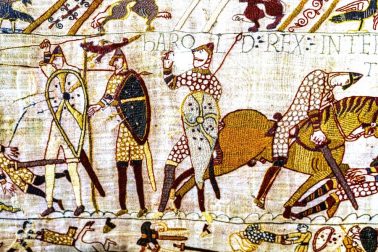
When Dwight D. Eisenhower had to decide whether to launch the D-Day armada he kept a close eye on the weather. Pick the wrong moment and the entire cause of winning the war would have been set back and the lives of 135,000 soldiers imperilled.
The supreme allied commander, head of a fractious coalition riven by egos and infighting (you see where I’m going here), had plenty of expert advice, as is made clear in David Haig’s play Pressure. The British meteorologist, James Stagg, warned that the original date for D-Day, 5 June 1944, would be storm-ridden, but saw a window of opportunity the next day. The American meteorologist Irving P. Krick was more gung-ho and urged Eisenhower not to postpone. Ultimately, the decision was Eisenhower’s alone. Walter Bedell Smith, his chief of staff, wrote later: ‘I never realised before the loneliness and isolation of a commander at a time when such a momentous decision has to be taken.’

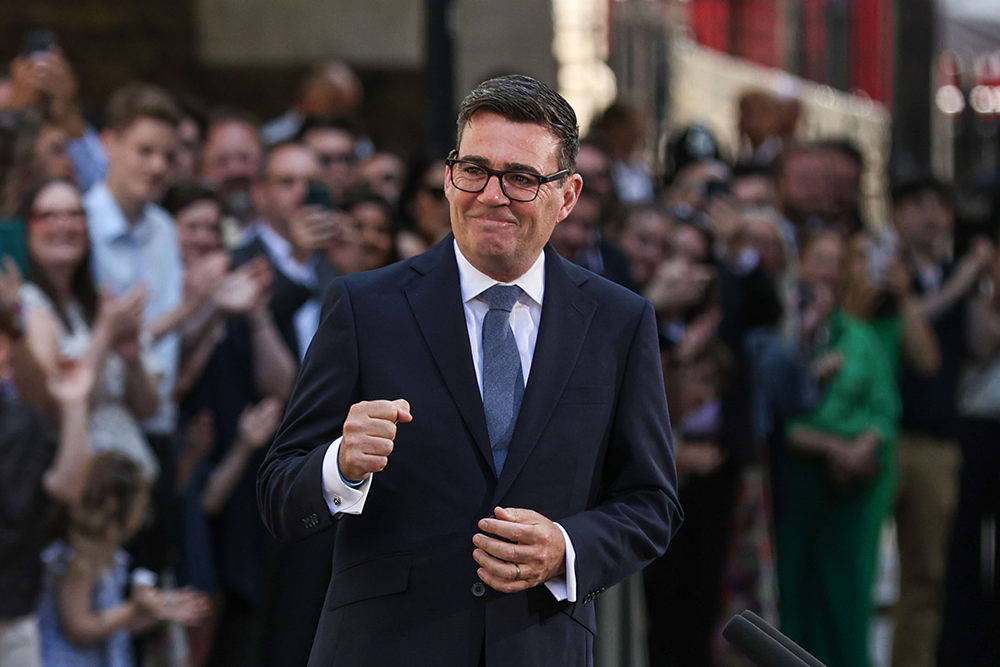
I thought about all this as I watched the brief flicker of uncertainty in the eyes of Andy Burnham when Laura Kuenssberg asked him whether he was prepared to rule out a general election before 2029. Burnham’s aides are adamant, consistent and emphatic: ‘It is A.B.’s settled view,’ one says, that there will be no early election. But Burnham’s hesitation was that of a man calculating the trade-off between survival now and long-term freedom of manoeuvre.
There was a look, a pause, then: ‘I’m going to rule it out, yeah… There’s no early general election. I don’t think people want it. The opinion polls say some people do, some people don’t.’ He was focused on ‘getting the country back where it should be, getting it working’. This was more or less what Gordon Brown said in 2007 before he bottled the ‘election that wasn’t’ and more or less what Theresa May said in 2017 until she went for it. Burnham is a good communicator and I think he communicated exactly what he thinks – the policy is that there will be no election, unless the policy changes.
As I watched, I recalled the words of a senior Labour strategist a few days before Burnham entered No. 10: ‘No matter what I’m telling you at the time – and I will be telling you that there’s no way we are going to do it – if we have a steady five-to-eight-point lead, I will be telling him to go for it.’
Several sources claim James Purnell, the Downing Street chief of staff, is keener on an election than Burnham. But literally everyone I have spoken to inside government and close to it is clear that no preparations are being made. ‘Before the election that never was [in 2007] spads were asked to save government info on personal files, and they haven’t been,’ the former adviser notes.
But glance at the polls, the nearest thing politicians have to a weather forecast. More in Common put Labour on 28 per cent, four points ahead of Nigel Farage’s party and six clear of the Tories – Labour’s first lead since March last year and their highest vote share since November 2024. The Green vote share has collapsed to 8 per cent. Now consider the views of Deborah Mattinson, pollster to both Starmer and Brown. She says political bounces last only six months and tend to peak three to four months after a new leader is installed. This is James Stagg’s window of clement weather.
Burnham has shown he is adept at retail politics on energy prices and bus fares, but £1 a week off your electricity is a momentum shifter, not a solution. The good vibes will fade when John Healey unveils a Budget. The PM wants to enact the biggest transformation of the state since Margaret Thatcher, much of which would benefit from a new manifesto and a new mandate. Burnham gambled his career to fight Makerfield, seeking a bigger prize, so he has form.
The trade-off is between survival now and long-term freedom of manoeuvre
Gambles don’t always work, even if you are a successful gambler. Ask David Cameron, who won the leadership, the AV referendum, the Scottish referendum and the 2015 election before his luck ran out. This would be even higher stakes. Like Eisenhower, Burnham would effectively be gambling with the (political) lives of Labour MPs.
He currently has a working majority of 166. If you offered him a majority of 66 (Blair’s margin in 2005) he might well take it. But that means 50 Labour MPs losing their seats, and double that number would fear doing so. For a man known as a ‘people-pleaser’, it seems an almost insurmountable hurdle. A former No. 10 adviser notes: ‘I don’t think the survivors would ever forgive Andy.’
A campaign would also bring its own problems. A wise Labour source explains: ‘Imagine for a second what the tax section of a new Burnham manifesto would look like. As soon as there is one word of difference from Labour’s pledges in 2024, the entire election becomes about that. But if there is no difference, what is the point of calling an election? It is a complete lose-lose scenario.’
But the Tories don’t want an election, because they want three more years for the public to forget past failures in government. Farage says he does, but one prominent Reformer argues: ‘Reform is a mess at present. The PM should use his conference speech to outline a future under Burnham and go to the country and catch Reform UK cold. We won’t have a fully prepared manifesto. There are likely to be some eyebrow-raising candidate scandals that can distract from Nigel’s messaging and rattle him, while Burnham is all smiles.’
History tells us that Stagg was right. The storm he predicted swept in on 5 June, followed by the break in the weather he foresaw on the 6th. ‘I don’t like it, but we have to go,’ Eisenhower concluded.
I doubt Burnham will draw the same conclusion. There is a legion of good reasons why he will not. It may be for the good of the country that Burnham’s leftist economic instincts are stuck in the straitjacket imposed by the 2024 manifesto and Rachel Reeves’s fiscal rules. But if you think the halting answer he gave to Kuenssberg is the last word, I’ve got a bridge to sell you. When
parliament returns on 1 September it may look, for the benefit of his own political project, as if he should go for it.





Comments