
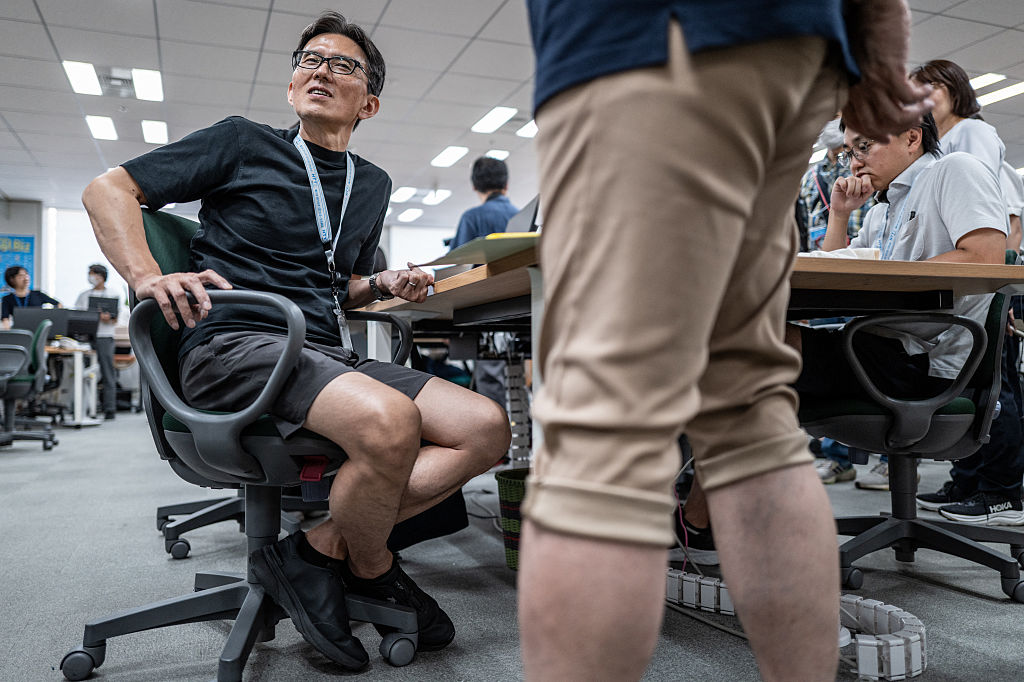
As Tokyoites swelter in 95-degree heat and 80 per cent humidity – and companies are forced to cut back on the air-conditioning due to prices inflated by the Iran war – the salarymen, Japan’s army of traditionally sober-suited office workers, have taken the drastic step of going ‘cazh’. This means not just short-sleeved, open-necked shirts but, at the urging of the local government, horror of horrors: T-shirts and shorts.
In most countries, it wouldn’t be much of a problem, but such seemingly innocuous changes are especially problematic here, due to the amount of time the Japanese spend in the office
In response, some female Japanese staff, quaintly referred to as ‘office ladies’, are apparently so livid that the term ‘leg-hair harassment’ (‘sune-hara’) has been coined and is gaining currency. Leg-hair harassment refers to the feelings of revulsion felt at suddenly having to witness the bare and hairy legs of male colleagues.
The shorts at work initiative is the latest wheeze of Tokyo governor Yuriko Koike. It is a continuation of a now twenty-year campaign (called ‘Cool Biz’) aimed at getting office workers to dress down, enabling their companies to save on energy bills. When it began in 2005, it was endorsed by then-Prime Minister Junichiro Koizumi, who was often seen without a jacket or tie.
The Cool Biz campaign has been declared a success, of sorts. It is credited with reducing energy bills and boosting macroeconomic activity (people buying more casual clothes). It has become accepted, if not universally followed, around the country. There was even an upgraded ‘Super Cool Biz’ campaign that urged workers to wear ultra-breathable fabrics, T-shirts and trainers (Andy Burnham would no doubt approve).
The move to shorts is inevitable said Koike as ‘we are running out of layers to remove’. It has proved lucrative for some, with business attire retailers starting to stock ‘Cool Biz’ lines. Yofuku no Aoyama, one of Japan’s leading office-wear firms, has just begun stocking nylon shorts. A spokesman for the company said they were carefully designed to be appropriate for an office with due consideration given to how they would look when the wearer was seated.
Take-up of the latest stage of the dress-down policy has been slow but steady. On a recent cruelly hot afternoon, 11 out of 70 male workers were seen wearing shorts in a Tokyo government office. This may not sound like a dramatic change but in ultra conservative Japan it is significant, and it means 22 potentially harassing limbs to alarm and distress female staff.
Cool biz can be seen as part of a wider attempt by the authorities to overhaul and modernise Japanese office life, which has long been characterised by stifling formality, punishing hours and low productivity. The model that kickstarted Japan’s economic renaissance in the 1960s of long, hard Roman galleon-style toil is becoming increasingly redundant in a dynamic, tech-dominated, global economic environment.
Greater flexibility is clearly needed, and office attire is part of that. But is shorts in the office a step too far?
In most countries, it wouldn’t be much of a problem, but such seemingly innocuous changes are especially problematic here, due to the amount of time the Japanese spend in the office. The official figures are average, but do not account for the pervasive custom of unpaid overtime. Offices are also typically small and open plan. If you spend 12 hours a day (some of it unpaid) in a cramped space with a small group of colleagues, every little tick and foible can assume outsized importance.
This was demonstrated last year by a previous workplace panic over ‘smell harassment’ (‘sume-hara’), when a spate of complaints emerged from workers forced to endure clammy proximity with a malodorous colleague. It was blamed for lowering job morale and even leading to absenteeism and sickness.
Another particularly Japanese issue is the absence of any outlet for pent-up frustration in a rigidly hierarchical and etiquette-laden office environment. You just need to endure. In a strict Japanese office, even discussing non-work-related topics is frowned upon. Japan is one of the few countries where The Office wasn’t a hit and where a local version would not have worked.
What makes sume-hara is a little different from general workplace stress is the feminist dimension. Some women are apparently furious about the basic unfairness of a concession which, though technically granted to both sexes, in effect, due to societal expectations of female attire, can only be enjoyed by men, with women expected to wear full-length skirts at work.
As a man, I felt obliged to to get an authentic office lady take on this issue. A Japanese friend who works for a legal firm, explained a particular problem is when a man’s legs are very white, due to lack of exposure to the sun, and the hair very thick and black. She also mentioned that the contrast between hairy legs and a bald head was particularly nauseating to Japanese feminine sensibilities.
As for the equality angle, she displayed an impressive command of colloquial English. I feel obliged to quote her directly: ‘If men get to show off their hairy legs, we women should be allowed to show our bingo wings’.





Comments