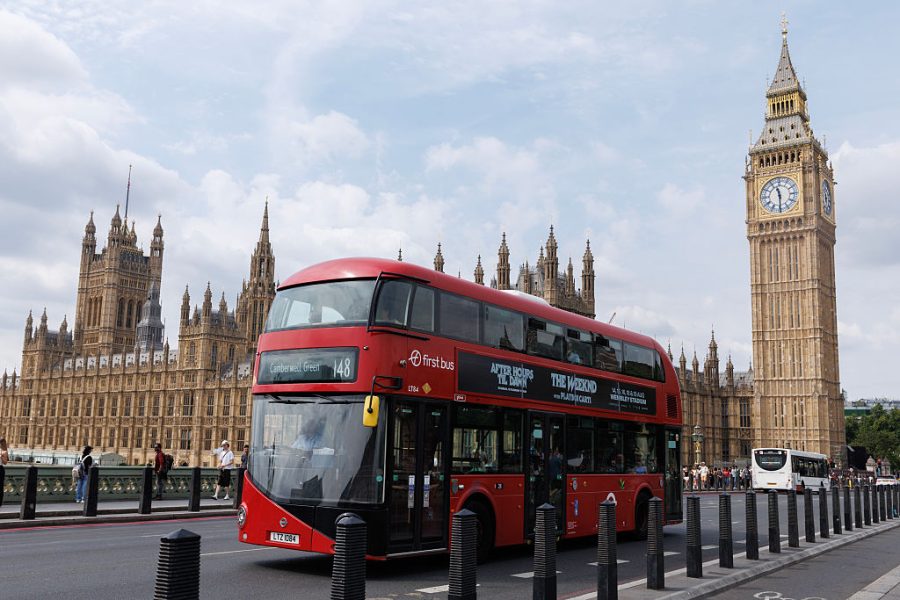
Andy Burnham has announced a reduction in the cap on English bus fares, down from Starmer’s £3. Remarkably, he might be right to do so. ‘For too long people have said that cheaper transport isn’t an option,’ he has announced.
I don’t accept that. I’ve done it before and I will do it again now: a £2 cap on bus fares for millions across the country. Lower fares will help people get to where they need to, giving them breathing space to help with the cost of living.
The one-year measure will cost some half a billion pounds, and this time won’t apparently be freed up by cancelling an ID card scheme that wasn’t itself funded. Instead, most of the money will come from financial rearrangements at the Department for Energy Security and Net Zero, whose very name trembles under its weight of virtuous propaganda. Money that we have been giving away abroad to pay for green initiatives and climate resilience will be turned from gifts into loans, apparently creating immediate room in the accounts to spend it on buses. What happens to the trick in future years is murkier still.
There may be better, more targeted ways to help those on lower incomes
Over the years, Labour MPs have queued up to tell the nation that Margaret Thatcher said that any man who found himself on a bus past the age of 26 should consider himself a failure. Martyn Jones stated it as fact in 2003, Shahid Malik and Fabian Hamilton in 2007, Chi Onwurah in 2010. The austere political scholar Jeremy Corbyn said it in 2019, although he showed his progressive credentials by dropping the age to 25.
In fact, there’s no record of Thatcher saying it at all. The line derives from the glittering and ill-fated Brian Howard, poet, aesthete and New Statesman journalist, but it was popularised by Loelia, Duchess of Westminster, when she gave the age as 30 in her 1961 autobiography. I had never heard of it during my trips with parents on the number 16, through Alan Coren’s Cricklewood, or the ever-tardy C11 winding through the mean streets of West Hampstead, nor even on exhilarating solo adventures as a pre-teen on the 13, leaping from the open rear platform as it slowed for corners in Swiss Cottage.

Buses meant freedom, and for a great many people they still do. Bus subsidies aim to attract people out of their cars, to make busy cities more efficient, and to help those of limited means preserve their independence and freedom to work.
Milton Friedman judged that government interventions most commonly achieve the opposite of their intentions. But there is evidence that something has gone right in the state of Manchester; the question is whether the bus price cap is it. Burnham introduced it there in 2022 before the Conservatives rolled it out nationally the following year, and he maintained it locally when Starmer raised the national limit to £3. Manchester introduced franchising, subsidising less profitable routes at awkward times or to poorly served areas.
Peak-time restrictions for the elderly were removed; eligible 16- to 18-year-olds were allowed to travel free. Integrated contactless payments meant passengers could swap from buses to trams and be automatically charged the cheapest available combined fare. The scheme was a success: bus journeys rose, punctuality improved, millions of bus miles were added, ticket revenue went up.
The £2 cap also arrived amid a staggered programme of other measures, including fleet investment. An analysis performed for the Department for Transport put the English cap’s preliminary benefit-cost ratio at 0.71 to 0.9, before estimated wellbeing and distributional benefits were included. On its immediately measurable effects, therefore, every pound of public cost bought between 71p and 90p of benefit. The additional journeys were mainly for leisure, with some evidence that the effect was greater at weekends. No one knows if the cap reduced car usage, but licensed cars in Greater Manchester continued to rise.
There may be better, more targeted ways to help those on lower incomes. Other countries offer a wealth of different approaches. Austria and Germany offer massively subsidised flat-rate monthly travel passes. France has the Versement Mobilité, a ring-fenced payroll tax giving local governments considerable control – a wiser move when local governments are reservoirs of competence and efficiency than when they’re not. But Burnham is right that he has experience to draw upon in Manchester. He’s even right that it has worked, although whether the cap is the effective bit is far less clear.
I would rather that Burnham funded the cap not by converting foreign climate grants into loans, but by not sending our money abroad to pay for other people’s green initiatives. But the cap may be sensible if it comes alongside other measures. What’s stark is the small scale of its ambition.
Burnham is opening a Downing Street branch office above a Slug and Lettuce pub in Manchester. He is calling it the ‘biggest rebalancing of power our country has ever seen’. Perhaps this rebalancing really will prove more consequential than the 1832 Reform Act, which gave Manchester its first two MPs, and Burnham is merely starting with the details and working outward. Or perhaps the fare cap shows we’re being run by an experienced city mayor, not a statesman.
Burnham’s leap from Manchester to Downing Street may prove less exhilarating than the one from the back of the number 13, one hand on the pole, as it slowed for a corner in Swiss Cottage. And a good deal more hazardous, for him and for us.



Comments