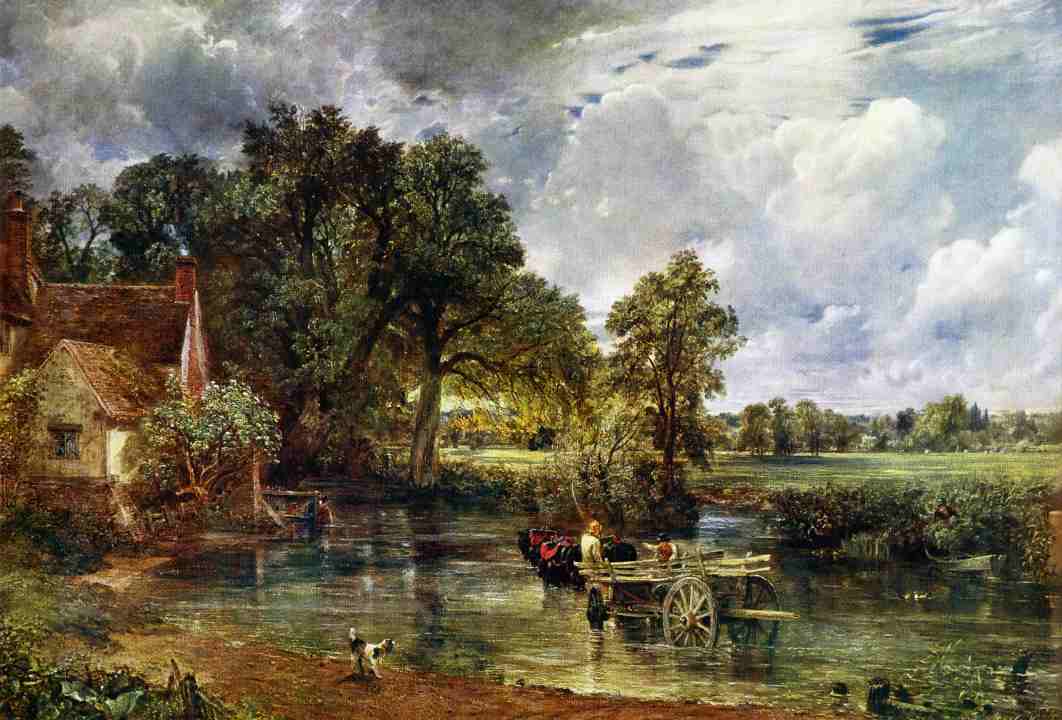
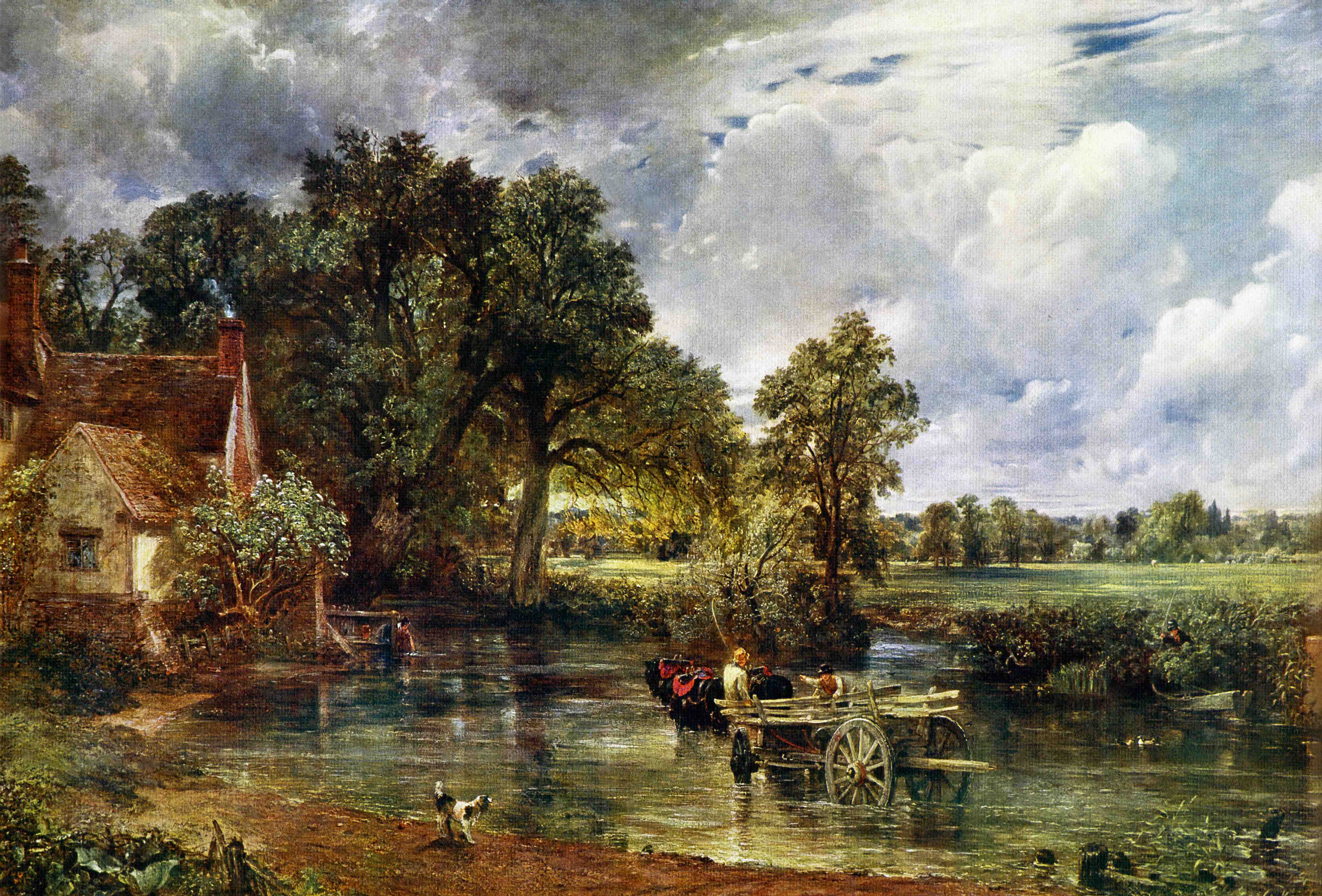
Generally speaking, I’m against moving major artworks from galleries in large cities to the provinces, where there are fewer people to see them. But there are exceptions. This summer bears witness to one such exception – the decision by the National Gallery to loan John Constable’s ‘The Hay Wain’ to Christchurch Mansion in Ipswich as part of an exhibition celebrating the 250th anniversary of the artist’s birth.

Because whatever you think you know of ‘The Hay Wain’ – one of Britain’s best known and beloved oil paintings – you’ll have never seen it like this before. As well as giving you an opportunity to see it without a French tourist’s backpack bumping into you, seeing it in this location confers another astounding benefit: the actual scene it depicts at Flatford Mill on the Essex-Suffolk border is just 12 miles away.
That’s right. So you can see the picture and then go and see the real thing. Which is quite something when you consider that it was painted in 1821, just six years after the Battle of Waterloo, and has never been displayed so close to the view it has made famous.
Which brings me back to my bold statement above: you’ll have never seen ‘The Hay Wain’ like this before. If you’ve only seen it in the cavernous room 40 of the National Gallery surrounded by other Constables, Turners and Corots, you really haven’t seen it at all.
First, the painting is much lower in Ipswich than it is in London, perhaps just a couple of feet off the ground at most. Second, there is no barrier in front of it so you can – if you like – put your nose a centimetre from the glass and scrutinise each genius brushstroke or smear of the palette knife. Third, it’s spotlit – rather than relying on the distant bulbs or daylight in room 40 – which really makes it zing.
As a result, the painting does things to your retinas that it’s never done before. It’s vibrant, immediate, immense and altogether surprising – like bumping into Arnold Schwarzenegger in Pret in Hounslow.
If that wasn’t enough, the other joy of the exhibition is to show you how this masterpiece came about and how a painting created 90 miles away in Hampstead by an artist in his mid-40s was the culmination of decades of artistic effort, experimentation and observation.
Before you see the painting, the curators show you 20 earlier works – dating from around 1800 – landscapes and studies of the places Constable lived (his childhood home in the village of East Bergholt), where he went to school (Dedham) and where he worked as a teenager, unhappily, at his father’s mill in Flatford.
By the time you stand before ‘The Hay Wain’ – which Constable originally entitled ‘Noon Landscape’ until his pal John Fisher came up with a better name – you begin to recognise things from his earlier works: components, like Willy Lott’s cottage or the boy fishing, which he had never synthesised before with such startling success.
It’s vibrant, immediate, immense and altogether surprising – like bumping into Arnold Schwarzenegger in Pret in Hounslow
Above it all is that sky, which goes from fairest, cloud-specked blue on the right to grey-black above the left-centre, providing drama and tension. Constable said the sky was ‘the chief organ of sentiment’ in a painting and so the curators have put three of his cloud studies (painted at Hampstead) on the right of ‘The Hay Wain’, just to emphasise the point.
Among the earlier works is a small oil painting from around 1810, entitled ‘Stoke-by-Nayland’ – a light, lively landscape with a laden figure in the foreground, before a veil of tall trees on one side and pinkish sky on the other. Like two views of East Bergholt at sunset (both painted in July 1812), these were painted en plein air – a technique pioneered by Constable and the product of his desire to tell the truth, as he put it, about the landscape.
Among the other main pieces on show here is Constable’s ‘Boat Building near Flatford Mill’ (exhibited at the Royal Academy in 1815), which again you can again see the remains of in Flatford. There is also the major ‘A Boat Passing a Lock’, painted in 1826, which Constable presented to the Royal Academy when he was elected a full Academician in February 1829. This came just months after his beloved wife, Maria, died, and the painting of two barefoot figures trying to move a barge upstream into a lock is full of struggle.
The final big hitter of the show, on loan from the National Galleries of Scotland, is an elevated viewpoint, ‘Dedham Vale’: a kind of drone-shot of the whole of Constable country, with the village of Dedham at the centre and the River Stour running out to the sea. Painted in 1828, as the curators state, it melds the tradition of the Old Masters with Constable’s drive for an art rooted in the ‘love and study of nature’.
So go to Ipswich. You won’t be disappointed. They also have Constable’s palette and various other personal nicknacks too. But it’s ‘The Hay Wain’ that I predict you’ll never forget seeing if you see it there. It proves Constable’s statement: that ‘painting is another word for feeling.’ Because it is.
The Hay Wain: Walking Constable’s Landscape runs until 4 October 2026 at Christchurch Mansion, Ipswich Museums





Comments