


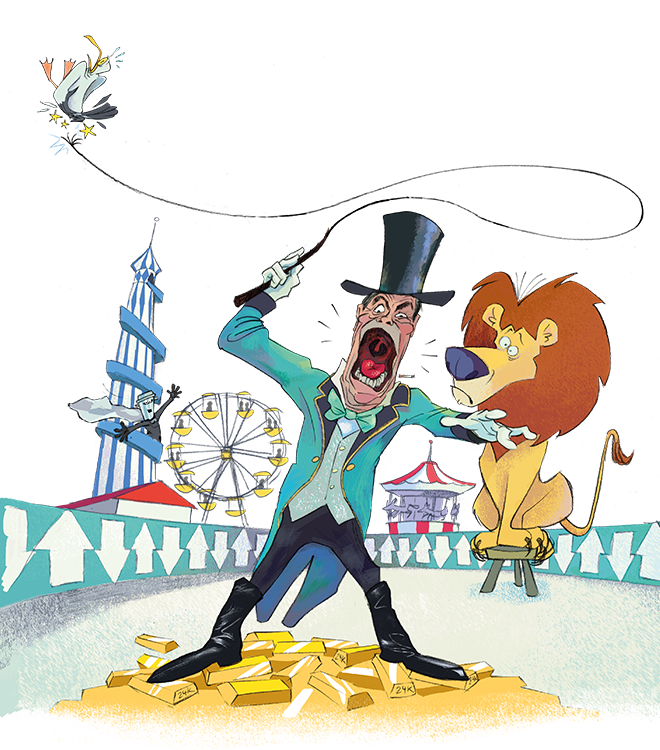
When Reform high command gathered in the boardroom of their Millbank headquarters last Tuesday, the meeting was supposed to be to select candidates in their 120 most winnable seats and choose dozens of campaign managers. It went on for six hours, as party chiefs instead addressed a growing sense of unease that the great momentum of 2025 has been lost.
A source familiar with the discussions reveals that Chris Bruni-Lowe, Nigel Farage’s pollster and message man, has been concerned for months that Reform needs to do something big to ‘take back control’. ‘Chris challenged people, saying things aren’t working the way they need to,’ the source says. ‘James Orr [the head of policy], Rob Jenrick [the shadow chancellor] and Zia [Yusuf, the home affairs spokesman] were all asked for their best ideas, but nothing much was forthcoming.’ It was at this point, the source says, that Farage said words to the effect of: ‘It’s time to put my own testicles on the line.’ A Reform source says: ‘Since about February there has been a growing feeling that we were becoming a party which was no longer in command of its own destiny as we would wish to be. Restore is growing. Every innovation we made in political technology was nicked and adopted by the other parties.’
It was at this point he said words to the effect of: ‘It’s time to put my own testicles on the line’
Farage’s desire to act was intensified by reports in the Sunday Times over the weekend that his friend ‘Posh George’ Cottrell, a convicted fraudster, had paid for his security before he became an MP and let Farage stay in his London home – neither of which Farage had declared as benefits in kind to the parliamentary authorities. He was already under fire for failing to register a £5 million gift from the billionaire Christopher Harborne, whose crypto interests he has backed as party leader. Both matters are now the subject of investigations by the Parliamentary Commissioner for Standards.
The final straw came when Sky News and other broadcasters ‘doorstepped’ Farage’s daughter at her home, after pictures of the house appeared in the Times. A longstanding friend of Farage says: ‘I’ve never seen him so furious. He has never, ever used his children. Most voters don’t even know he has children.’
Farage announced on Tuesday that he would resign his seat in Clacton and fight a ‘People vs the Establishment’ by-election, arguing it is for his constituents, not the political powers that be, to decide if he represents them. This will pause the inquiry, but it can resume if he is re-elected. If the standards committee recommends a suspension of ten sitting days or more, he could face a recall petition and a second by-election.
Farage’s calculation is that such a move would look like the Establishment ganging up on him. His team already know how they will campaign if that happens. Since the 2016 referendum he and his deputy Richard Tice have planned to fight a second EU vote with the slogan ‘Tell them again’. There is no seat in the country they are better prepared to contest: when Douglas Carswell (the former MP for Clacton) defected from the Tories to Ukip in 2014 he took with him a computer containing years’ worth of canvassing data. ‘[Farage] sees himself in a David and Goliath battle with the Establishment and this is his slingshot,’ says an ally. ‘I reckon there is a fair chance it will take Goliath in the middle of the forehead.’
Shortly after Farage finished speaking, he got a call from David Davis, the former Brexit secretary who resigned his seat in 2008 and fought a by-election on the erosion of civil liberties. ‘Copycat!’ said Davis, a friend of Farage. ‘This makes you my protégé.’ Farage just laughed.
What Reform did not perhaps anticipate was that the main parties would react as they had done to Davis, by standing down and leaving Farage alone to fight the comedy candidate Count Binface. This denies Farage the cathartic showdown he wanted. ‘They’re cowards,’ a Reform source says. ‘They know he’ll win.’

The Tories, Labour and Rupert Lowe’s party Restore Britain all say they will only fight a second by-election – proof to Reform aides that they are in cahoots. Even when most people were ignoring Restore, US strategist Gerry Gunster, who also advises Farage, identified them as a looming danger. ‘Restore is a Tory put-up job, expertly organised by Gavin Williamson,’ says a Reform source. Sir Gavin, a former Tory chief whip who won his Westminster seat in 2024 in curious circumstances after the Reform candidate stood aside at the last moment, denies that he is the Midlands’ answer to Machiavelli. ‘Not true,’ he says.
But the claim highlights the degree to which Lowe is living rent-free in Reform heads and the degree to which they still see the Tories as an establishment conspiring against them.
You wouldn’t know it from much of what passes for political debate in this country, but two things are true. Yes, many figures in the Establishment are out to get Farage. Some are peddling text messages to media outlets about his private life. But it is also the case that even sage voices in Reform think that their leader would have been wiser to declare the £5 million gift, and believe his team have handled the fallout badly. A Farage ally who thinks he should have been more transparent explains: ‘When you have been vilified as much as he has, he is not inclined to give his enemies any advantage at all.’
Outsiders struggle to understand why he remains loyal to Cottrell, who was jailed in the US for wire fraud and has just published a book about how to launder money. Cottrell has accompanied Farage to meetings with foreign diplomats and blue-chip company bosses. ‘He just barges in and asserts himself,’ says one City source. ‘These people are quizzical and shocked that he is there. It holds back businesses from engaging.’
However, Reform insiders say Farage is a ‘father figure’ to Cottrell and to Dan Jukes, an aide who has been with him for a decade. ‘Because George and Dan are totally sure of their positions, they give Nigel good advice based on what’s in his interests,’ says one. Another source contrasts Cottrell to others who are ‘paranoid and egotistical maniacs who spend their time fighting internal battles about who gets to fly with Nigel’.
So has the refusal of the main parties to join the fight in Clacton scuppered Farage? I don’t think so. There has always been a tension between Farage the insurgent and Farage the prime-minister-in-waiting. The desire to seem as though he was taking preparations for government seriously peaked earlier this year with a series of defections by Tories with cabinet experience and plans by Danny Kruger to work out what Reform would do with power. But this has not won over polite opinion or much of the Tory press. Tuesday’s gambit suggests Farage wants to return to what he knows best: talking directly to his target voters through videos and social media.
He wants to return to what he knows best: talking directly to target voters through videos and social media
Inside Reform, Farage is seen as a modern John Wilkes, the radical journalist who was elected as MP for Middlesex in the 1768 general election, was expelled from parliament as unfit to hold office and saw three by-elections in 1769 overturned by fiat. Wilkes argued that it was for the people of Middlesex to decide their MP, not the political establishment. There were protests in the streets and, in 1774, Wilkes was elected Lord Mayor of London and returned to parliament.
In essence, Farage’s move shows he understands that politics is only partly a game of rules: it is mostly a contest of perceptions. ‘He knows this is a game of psychology and comparative narratives,’ an ally says. ‘He knows that if he is backed by the people of Clacton and he has commanded a whole bunch of front pages, he will have won.’
The front pages may be in shorter supply now that Clacton is not a competitive contest, but calling this by-election is about putting his argument to the voters that he and they must once more put two fingers up to the Establishment. The established parties of SW1 have refused to dance to Farage’s tune. His calculation is that his target voters will hear it anyway.


Comments