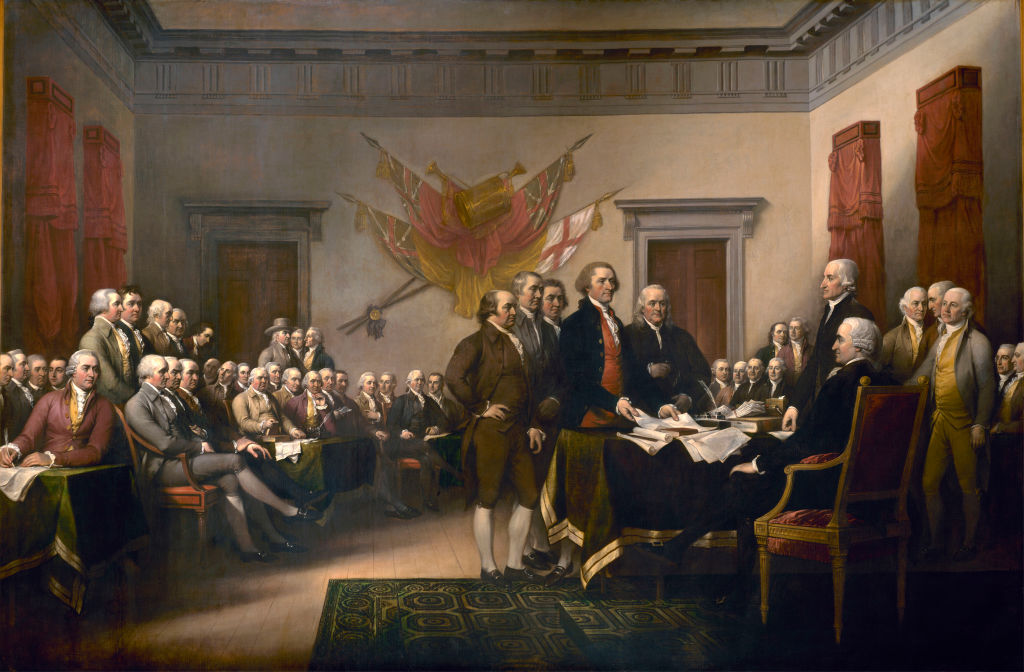
The 250th anniversary of America’s Declaration of Independence comes at a moment when Anglo-American relations are buffeted by competing visions of global order. It’s a reminder that what today we call the ‘Special Relationship’ wasn’t always so smooth and took more than a century to develop. At each stage of the process – from rebellion, through two wars, decades of tension, and then a firm alliance based on generally-shared values – the American Declaration of Independence played a central role. From treason in 1776, it became part of the ‘title-deed’ of the English-speaking world in the 20th century, whose call for liberty and equality still defines the values shared by Britain and America. Yet when it first reached London, in the summer of 1776, the Declaration seemed to declare the final separation of mother country and colonies.
The Americans had not just rebelled against the King, charged Lind: ‘the Declaration of the American Congress is an insult offered to everyone who bears the name of Briton.’
By the standards of the day, it did not take long for news of the Declaration of Independence to reach London. Adopted by the Continental Congress on July 4, 1776, in Philadelphia, and printed as a broadside that same evening by the Irish immigrant John Dunlap, the Declaration was sent to Britain on July 28, where it arrived by the middle of August, beginning a long, fraught, and complicated part of transatlantic relations.
It was Vice Admiral Lord Richard Howe, commander of British naval forces and brother of General William Howe, commander-in-chief of British forces in North America, who sent a copy of the text of the Declaration to London at the end of July 1776. It arrived by mid-August and quickly was publicised, appearing in the London Chronicle in its August 15-17 edition. That same month, the influential Gentleman’s Magazine also printed the Declaration, calling it a ‘desperate measure’ and blithely dismissing Thomas Jefferson’s 27 charges against King George III by stating ‘whether those grievances were real or imaginary… we will not presume to decide.’
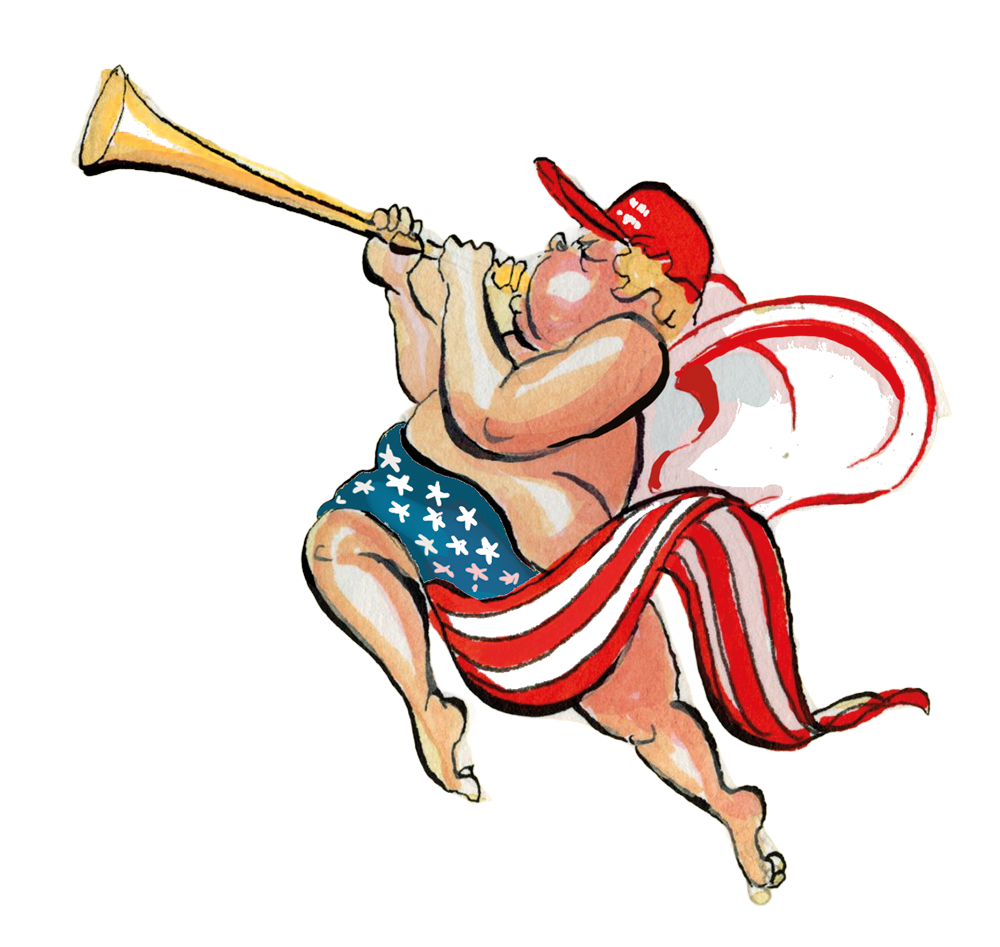
A flood of British responses to the Declaration soon followed. James MacPherson’s The Rights of Great Britain Asserted against the Claims of America: Being an Answer to the Declaration of the General Congress went through eight editions in 1776 alone. MacPherson dismissed the Declaration as a mere ‘paper’ in which ‘the facts are either wilfully or ignorantly misrepresented.’ In the autumn, John Lind, a London barrister, published An Answer to the Declaration of the American Congress, casting the conflict as an affront to national honour. The Americans had not just rebelled against the King, charged Lind: ‘the Declaration of the American Congress is an insult offered to everyone who bears the name of Briton.’
Had Lind been able to read Jefferson’s original draft, he would if anything have been more incensed. Wisely struck from the final document by Congress, Jefferson’s passionate denunciation of the British people lamented that ‘We might have been a free and a great people together; but a communication of grandeur & of freedom it seems is below their dignity.’ Americans must ‘forget our former love’ for their British brethren, demanded Jefferson, and instead ‘acquiesce in the necessity [of] our eternal separation.’ As it was, the blunt, even hyperbolic, criticism of the King (and by implication Parliament) was enough to ensure deep enmity towards the Americans by wide swathes of the British public.
Nor was the King amused. On October 31, in a speech at the opening of parliament, George commented publicly on the rebels’ action for the first time. ‘They have… presumed to set up their rebellious Confederacies for Independent States,’ he declared. ‘If their Treason be suffered to take Root, much Mischief must grow from it, to the Safety of my loyal Colonies, to the Commerce of my Kingdoms, and indeed to the present System of all Europe.’ Beyond this, the King was silent. As his biographer Andrew Roberts notes, George likely never read the Declaration and never referred to it in his extensive correspondence.
But while patriotic Britons denounced the rebels, domestic political opposition to King George’s government translated into muted support for the Americans. The Virginian diplomat William Lee, younger brother of the proposer of independence Richard Henry Lee, who had lived in London for nearly 20 years and had been appointed a political agent of the Continental Congress, wrote from London on September 10 that the opposition party Whigs ‘do not say much, but rather seem to think the step a wise one… and what was an inevitable consequence of the measures taken by the British Ministry.’
Edmund Burke, perhaps the most famous Whig of the day, had long advocated for the colonists’ rights as Englishmen, including in his famous 1775 ‘Speech on Conciliation with America.’ Yet the Declaration put Burke in a difficult position, as he could not approve of outright revolution. Instead, unsympathetic to the Declaration’s assertion of American sovereignty, he lamented the loss of ‘a large and noble part of our Empire.’ As both King George and Burke understood, the Americans had not just created a country. They had thrust Britain into a new era, threatening its very existence as an imperial power. The Declaration was a treasonous move against the King, a blow to the Empire and an insult to the British people.
Such would be the prevailing attitude over the next century and more, made more needling by the relentless economic growth of America. Not until London and Washington faced authoritarian threats in the 20th century did the Declaration pass in the British mind from being treason to the ‘the third great title-deed on which the liberties of the English-speaking people are founded,’ as Winston Churchill proclaimed on July 4, 1918. In linking the American Declaration with Magna Carta and the English Bill of Rights, the arch-imperialist Churchill acknowledged that the liberal constitutional democracies shared core values that separated them in a fundamental degree from autocratic regimes. Though both Britain and America would maintain colonies and spheres of influence, as well as segregation in America, all of which complicated their claims of equality and liberty, the distinctive nature of liberal democracies, imperfect as they were, became crystal-clear when the two nations were soon faced with the rise of totalitarian regimes in Soviet Russia, Nazi Germany, and fascist Italy.
Perhaps the apotheosis of the Declaration of Independence in British minds was best symbolised when that ancient parchment was carried away to Fort Knox during the second world war. Placed next to it in the impregnable vault, secretly carried from Washington, D.C., was the finest copy of Magna Carta, written in 1215 and owned by Lincoln Cathedral, and sent to America for the world fair before being locked up for safety. For the next three years, the two documents that shaped the Western conception of individual liberty lay protected deep in the American heartland as the fate of the world was fought out around the world.
From being condemned as treason in 1776, the Declaration of Independence had by the 20th century become part of the glue cementing Anglo-American ties, their shared values more enduring than their differences. As Britons criticise Donald Trump for threatening individual liberties and Americans fear Britain is criminalising free speech critical of immigrants and non-Western cultures, the strength of those shared traditions will be tested in the coming years. Yet its quarter-millennium of endurance should give hope that the creed expressed in the Declaration will continue to inspire – and link – Britons and Americans alike.
Michael Auslin is the Payson J. Treat Distinguished Research Fellow at Stanford’s Hoover Institution and the author of National Treasure: How the Declaration of Independence Made America, from which this article is adapted.





Comments