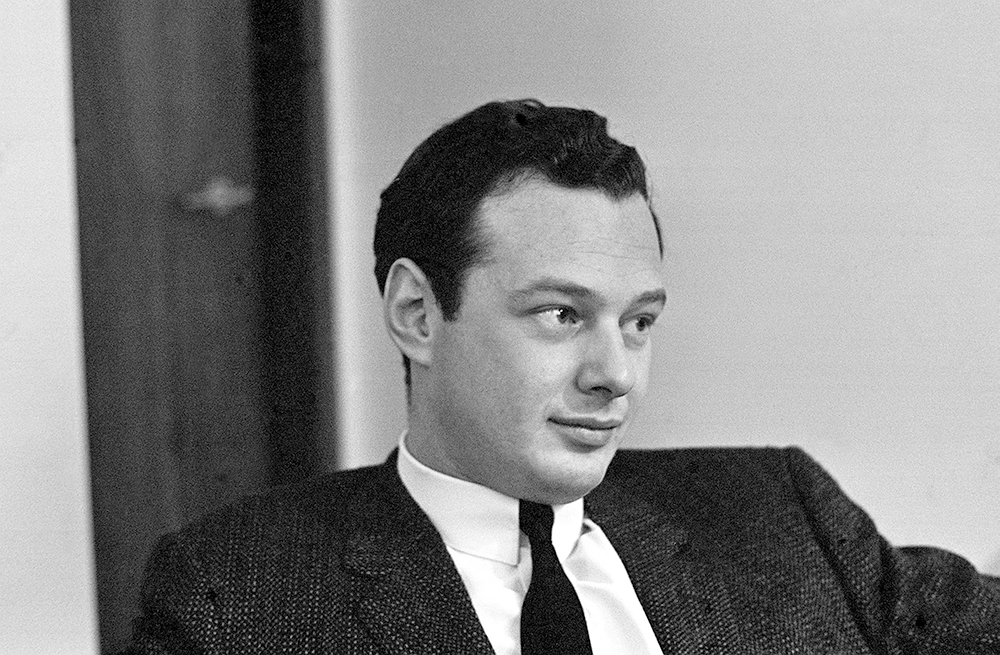
We know the facts about Brian Epstein’s death. The Beatles’ manager died in bed at his Belgravia home on 27 August 1967, six years after he struck gold in a Liverpool cellar, a month before his contract to manage the Beatles was due to end and four weeks after homosexual acts between men were partly decriminalised.
At the time of his death, the 32-year-old Epstein was addicted, adrift and depressed – not least as a result of a long effort to hide his sexuality and the low-level anti-Semitism he encountered everywhere. One moment he was manically active, the next he was in despair, according to those around him. He had overdosed in the past and had been treated at a psychiatric hospital. On the day he died, his blood contained alcohol, antidepressants and barbiturates. The coroner recorded a verdict of accidental death through an ‘incautious self-overdosage’ of sleeping pills, taken over time, not suddenly. Paul McCartney, the most pragmatic and least impressionable Beatle, has said he believes the verdict was correct.
In Shout!, his 1981 biography of the Beatles, Philip Norman posited the theory that Epstein’s death may not have been accidental. An unnamed source, ‘necessarily anonymous’, he wrote, alleged that Epstein was killed by the American mafia in revenge for a botched merchandising deal. Now, in what is intended as a bombshell, Norman claims that Reggie Kray, the violent East End celebrity gangster, intimated the same.

It’s a headline-grabbing idea, but the evidence offered is thin. Kray, who was jailed for life in 1969, did not say that Epstein was killed by the mob; he merely hinted at it. Norman was not party to this elliptical conversation. Kray talked to Peter Trollope, Norman’s researcher and a one-time crime reporter on the Liverpool Echo, who interviewed the gangster in prison in 1985 and then relayed to Norman what Kray had said. It is a third-hand anecdote more than 40 years old. Trollope died in 2024, so cannot corroborate the story; and Kray, who died in 2000, was a myth-maker.
Norman also claims that Reggie told Trollope that he and Ronnie, his paranoid-schizophrenic gangster twin, considered seizing contractual control of the Beatles from the vulnerable, drug-addled Epstein by blackmail. The idea of the Fab Four being ordered about by the murderous Krays is so ludicrous it cries out for a comedy dramatisation. Norman’s secondary evidence for Epstein’s death being a hit job is mostly circumstantial: there were doubts about the competence of the pathologist; and the contents of the Belgravia bedroom looked ‘rather like theatrical props’, with the positioning of a half-read novel and a plate of chocolate digestive biscuits.
The rest of Mr Moonlight is a crisply written canter through Epstein’s rich and mysterious life, though much of it is known already. The focus is on his secretive nocturnal habits – hence the title. In 1960s Britain, Epstein’s exposure as a gay man would have ruined his reputation and would probably have derailed the Beatles. Norman draws on interviews conducted for his earlier books with the people around Epstein, many of whom are long dead, and his own experience, including a mind-boggling alleged encounter with Little Richard, the Beatles’ favourite rock-and-roller.
After Epstein’s death, his mother, Queenie, a woman who had loved life, people and parties, retreated into silence, her grief compounded by the rumours about her son. But she was interviewed by Norman for Shout! and she collaborated with Ray Coleman, another journalist and friend of the Beatles, on his extensive 1989 biography, which remains the best book about Epstein. Queenie hoped that Coleman’s book would silence the gossip and leave her son’s memory in peace.
But far from receding into the past, Epstein is suddenly everywhere. This year a play by Tom Wright at London’s Kiln Theatre attempted to dramatise Epstein’s relationship, possibly sexual, with John Lennon. A forthcoming book, co-authored by Gary Kemp, formerly of Spandau Ballet, guarantees to reveal the secrets of Epstein’s address book. Norman’s biography adds to this round of Brianmania by promising ‘the most intimate and revealing portrait yet’ of ‘this complex, conflicted and ultimately tragic figure’.
Epstein’s life was short but it was not tragic. He deserves to be remembered as a visionary: the first to realise the Beatles’ potential; the first to take a British band to America and make America listen; the first to put music in a stadium. Today’s pop stars labour in the world he created. The tragedy is that rumours about his death persist on unconvincing evidence, and they risk defining his life.
Mark Lewisohn, the most authoritative Beatles historian (and a former research assistant to Norman), has published only one of the three planned volumes of his Beatles biography. Until he writes more, the knowledge vacuum in the Beatles’ story will fill up with half-truths and noise.
Comments