

Americans have been enjoined, as we approach our country’s 250th anniversary, to be a bit more grateful. Good advice. It is not just the freedom of speech and the purple mountains’ majesties we should be taking stock of. It is also our knack, in recent decades, for miseducating ourselves, failing to read the signs of the times, making wrong choices – and then profiting from the fallout.
In the global financial crisis that ran for a decade after 2008, blunders in American financial engineering, from complex derivatives to mortgage-backed securities, bankrupted debtor countries and cost several others their sovereignty, most notoriously Greece. The world’s investors responded with the so-called “flight to quality,” pouring their national savings into American financial products and enriching the very bastards who broke the world economy. After 2019, the Covid epidemic arose in China from another foolish American idea, “gain-of-function” research, which set scientists the task of making dangerous viruses more dangerous, the better to design vaccines for them. The pandemic killed millions and idled billions, but it will wind up earning trillions for the American biotech industry.
So, although it is a cause for worry, it is not necessarily a cause for despair that we are approaching our quarter-millennium mark under the shadow of the craziest foreign-policy error in American history. When a head of state, without ever laying out a coherent war aim, dresses himself up as the Prince of Peace while threatening to exterminate an entire civilization… well, that does go beyond the predictable forms of hubris to which all empires are liable.
What makes the US great is a set of institutions, intuitions and cultural habits it inherited from England
The Iran war will exact a high price for the United States if there’s any justice in international relations. Luckily for us, that remains a big “if.” Misreading situations has become a habit. As Haven Hamilton, the preposterously bespangled country-and-western crooner played by Henry Gibson in Robert Altman’s Nashville, sang in 1976, “We must be doing something right to last 200 years” – but he didn’t know what that something was, and we have no clearer idea half a century later. We tend to think of the United States as the greatest common denominator of all the world’s virtues, particularly those involving freedom. “We think they’re American values,” said Hillary Clinton in 2014 when she was promoting a book about her time as secretary of state, “but in my view, they’re universal values and we need to stand up for them.” Of course, if they really were universal values we wouldn’t need to stand up for them.
Lyndon B. Johnson had similar thoughts. “The land flourished because it was fed from so many sources,” he said in the mid-1960s. But that’s not true, either. Culturally speaking, the US is a varied place – at least during its periodic bursts of uncontrolled immigration. But as a constitutional matter it is not diverse at all. What makes the US great is a very specific set of institutions, intuitions and cultural habits that it inherited from one country: England.
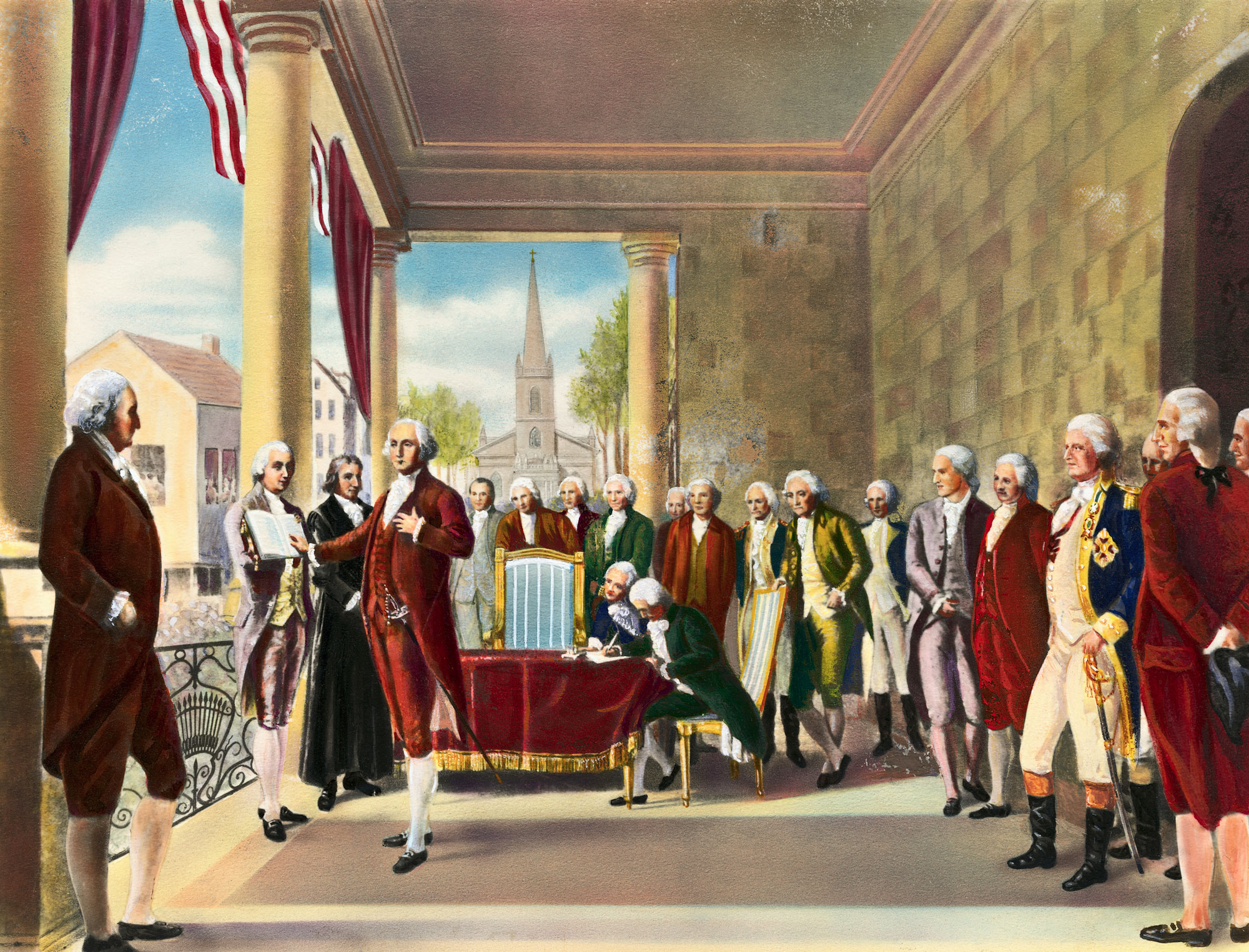
Constitutionally, America is still an English place: Lockean in peace, Hobbesian in war. That is why it has managed to last for 250 years while both infuriating other western nations and inciting their envy. The English are an outlier among European peoples, especially in their idea of liberty, which was until quite recently as absolutist as ours and difficult for other quite advanced civilizations to understand. (This was before Keir Starmer began sending armed constables to arrest senior citizens for their Facebook posts.)
No continental nation has ever been so strongly allergic to political censorship as the British were a century after their own civil war, when we were writing our First Amendment. Nor was there ever a nation-state with the reverence for unfettered trade that the English had – especially with the first stirrings of the Industrial Revolution, which came as the American Revolution was beginning. (The other great thing that happened in 1776, coincidentally or not, was the publication of the Scotsman Adam Smith’s The Wealth of Nations.) In the 18th century, those most inclined to agitate for commercial adventurism were the very Whigs who made up the revolutionary elites of the 13 colonies. When the revolution succeeded, their ideals were radicalized by the fact that the conservative opposition to them had been chucked out. So American ways are not wispy universalisms. They are cultural achievements, if we can use that word for the fervently held prejudices of the most acquisitive subgroup of the most irrational people in Europe.

As prejudices go, these are ancient ones. The Englishmen of the 13 colonies took up universal male suffrage long before anyone in the old country thought to. We codified the duties of our chief executive before the French declared an end to kings in 1789. As a result, America, for all its superficial modernity, is more tightly bound than other western countries to more traditional forms of social organization. It was set up when people’s ideas of right and wrong owed as much to the Renaissance as to the Enlightenment. A mix of monarchical sentiment and classical republican ideals was coursing through the hearts of the early columnists, as the Harvard historian Eric Nelson showed in his 2014 book The Royalist Revolution.
Nelson’s Harvard colleague, the political theorist Harvey Mansfield, called American liberal democracy a “mixed regime,” balancing the Aristotelian categories of democracy, oligarchy and monarchy. The historians Rowland Berthoff and John M. Murrin argued 50 years ago that the Founders’ understanding of classical republican virtues was indeed in vogue in the 18th century, but in the early part of the century. So by the 1780s, these ideas were already a bit fogey-ish, and certain patriots might have professed them as a defense against accelerating change. Today, the persistence of American hegemony even in the face of the country’s economic and cultural decline mystifies many people. But perhaps America’s antique, pre-democratic elements suit it to a period in which we seem to be witnessing the close of the 250-year-long Enlightenment parenthesis.
Europeans, including Brits, have older cultures than ours, but newer political cultures. In recent years they have been slower to take up the American progressive brainstorms of the post-Cold War era – from wokeness to gender ideology – but have clung to them even as those novelties have grown slightly ridiculous in the US. Why is this? We should recall what we were saying about the radicalizing effect of expelling an opposition. America, after the flight of the Tories in the 1770s and 1780s, became a narrower-minded but more purposeful, more streamlined Britain.
History offers plenty of other examples. Consider the sudden conservatism of Francisco Franco’s Spain – which had been for more than a century a hotbed of anti-clericalism – after its Civil War ended in 1939. Or consider the way Russia has evolved in a more nationalist direction since the Ukraine war, with the self-exile of its cosmopolitan elites to Berlin, Istanbul and elsewhere. (It was one of Vladimir Putin’s more savvy acts of statesmanship that, rather than insisting his adversaries share the sacrifice of the war, he let them flee it, and with it their share in the running of the state.)
In the wake of World War Two, the countries of western Europe were refounded in such a way as to exclude those elements incompatible with international rules laid down by the US. These rules were devised by the most gifted State Department diplomats of the generation of George F. Kennan and Dean Acheson, and elaborated by the most gifted nonprofit technocrats of the generation of George Soros. The result has been the remaking of the civilized world as liberal America’s caricature. Does Germany, for instance, owe more to Frederick the Great and Bismarck than it does to JFK and LBJ? No one who witnessed the adulation of Barack Obama on the streets of Berlin in 2008 will consider the answer obvious.
The persistence of American hegemony in the face of economic and cultural decline mystifies people
Elements of populist America, and not just Donald Trump, have grown uneasy with the progressive drift of Europe, its evolution into a borderless and even nationless space. American conservatives’ more general preoccupation about Europe is of longer standing. If Christopher Lasch is right that liberalism is parasitical on conservatism, relying on it for stability, predictability and common sense, then the American Empire depends similarly on cues from the more traditional cultures out of which it was built. Victory in the Cold War robbed the US of this resource, unleashing the character-sapping, empire-eroding power of consumerism, much as the Spanish discovery of silver in Potosí unleashed the character-sapping, empire-eroding power of inflation. Too bad. Preserving republics has been understood through most of history to mean preserving specific peoples and their specific virtues.
The US has, over the past 250 years, followed much the same course as Britain, only slightly later. We, like the British, built an empire in the 19th century – we just tend not to notice it because it turned into our country. From the present perspective, the quarter-millennium of US history breaks down into three periods of roughly 80 years apiece, separated by two ruptures. There is the constitutional era that was ended by the Civil War – Lincoln’s refounding of the country. There was an industrial era, ruled over by railroad men and Wall Street financiers, that reached its culmination with World War Two – Franklin Roosevelt’s refounding. This brought an imperial era, ruled over by technocrats and techies. As in Britain a century ago, a debate seems set to begin on whether this empire, too, has run its course.






Comments