
It was when Keir Starmer claimed never to have had a dream that I knew we were dealing with potentially one of the funniest prime ministers Britain had ever seen. Sure, some people would have been amused by the magnetism for calamity exhibited by Theresa May, the almost comedically unbelievable mendacity of Boris Johnson or the downright absurdism of Liz Truss, but a really funny prime minister is the one who demands to be taken seriously, and particularly one who is convinced that he has forced the British people to do so.
The shallow majority, the largely unimpressive parliamentary party, the “bastards” who betrayed him, the total lack of ideas and the obvious personal failings will now all be touted from various quarters as reasons that led this farce to unravel quite as quickly as it did. For what it’s worth, I think it was clear from the first couple of months. There were multiple signs early on: Lord Alli, Southport, the clucking anger at PMQs when it became clear the job wasn’t the walk in the park which he’d spent the last five years implying it was.
The prime minister we were told the nation needed turned out to be the one it deserved
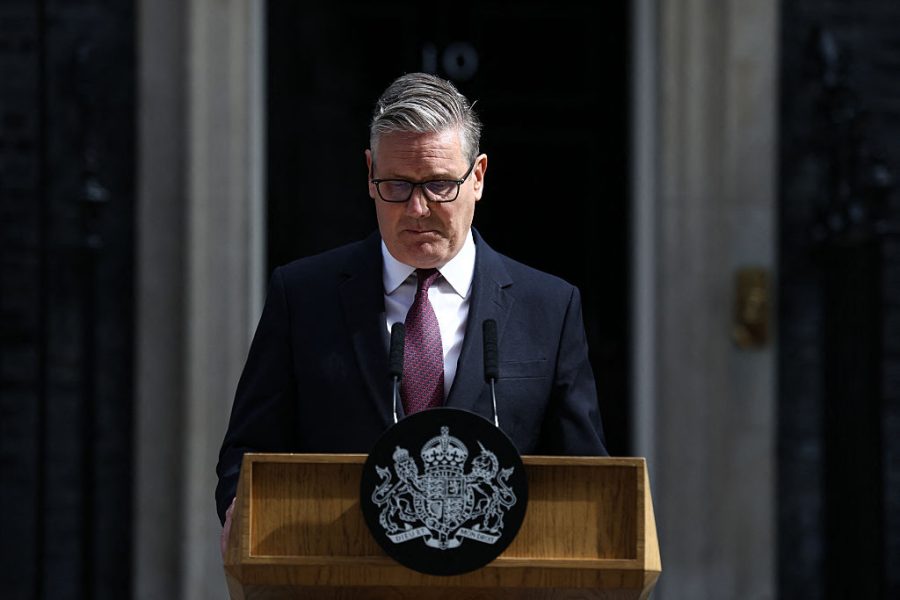
But whatever caused it, now it’s all over. Like the mediocrities before him, Starmer leaves amid what is now a set piece of absurd theater: the Downing Street lectern man, the vultures of the press licking their lips, the few members of the cabinet still talking to the outgoing prime minister standing behind and wondering which title they’ll take for their peerage, the interruptions by the appalling Steve Bray, a man as funny as pancreatic cancer, who thinks that blasting music out of his giant speakers is the height of political commentary.
People may enjoy this piece of evolving ritual, but it seals Britain’s reputation as the Italy of the 2020s. Even the weather appeared to have got the memo, though it still remains a hell of a lot easier to get a train between Rome and Milan than it is between London and Manchester, as Andy Burnham may be about to find out.

But for now, the stage is Starmer’s, his “meep meep” of adieu. He claimed in his brief speech that he was going with “good grace.” Lord Hermer – who must surely be googling one-way tickets to The Hague now that his protector is gone – called his speech “a moment of extraordinary dignity.” The legacy project is already in full swing; he is being painted as a statesman gone too soon: the creation of the myth of the Noble Starmer is now underway.
Of course, there are things one might point to as vaguely positive in Starmer’s time. His support for Ukraine, his refusal to get involved in Trump’s Iranian adventure, his giving David Lammy a platform by way of a national morale boost. But the rare moments of wisdom are so obviously outweighed by the outright cowardice and mendacity as to be totally eclipsed.
It’s very hard to be a statesman when you see no value in the parliamentary system or its 900-year-old history and visibly dislike both politics and the electorate, when you instinctively prefer “Davos over Westminster,” in his own words.
Picking a low point is tricky. Implying that people, even those protesting peacefully, who were understandably upset about the violent murder of little girls at a dance class were basically a sort of British prototype for the Sturmabteilung was hardly statesmanlike. Nor was his claim that those who wanted an inquiry into grooming gangs were jumping on “a far-right bandwagon.” The Chagos debacle, Mandelson, the constant air of a harassed pig trying to escape a confined space. Any of these alone really should put him in the Heath-Callaghan-Balfour body of PMs; when combined, they put him much more in the Eden-North-Truss category.
In the three-minute speech, Starmer claimed he left the country “far stronger and fairer.” This vague statement of abstracts will be his touted legacy. It wasn’t that he didn’t try for a more concrete one; but his efforts to ban kids from YouTube and to usher grannies into the suicide booths have all so far been frustrated, in part because his innate personal failings have made persuading his party and the public impossible. Yet it feels odd that he’s claiming to have transformed the country in such a short time, not least because it feels just as doomed as before but with a higher quotient of suicidal farmers, an even less coherent constitution, a number of ancient educational institutions shutting their doors and a welfare bill so engorged that we can no longer defend ourselves.
There will be much commentariat-painting of Starmer as exhibiting decency, competence and integrity. It probably doesn’t feel like that if you were one of the people he pushed under the bus to save himself, it probably doesn’t feel like that to the pubs and businesses and farms and schools shutting down, it probably doesn’t feel like that if you’re a Chagossian, or a military veteran, or a rape gang victim. Indeed, aside from vibes and the fact that he is “like them,” it is very difficult to see where those who laud Starmer as decent, competent and having integrity have got the idea from.
That perhaps is Starmer’s real legacy: to be the man who embodied more than anyone else the vast gap between those who govern and the governed. The prime minister we were told the nation needed turned out to be the one it deserved. Most deliciously of all, Starmer has embodied the absolute reversal of Blair by proving, even in his departure, that things can, and will, only get worse.



Comments