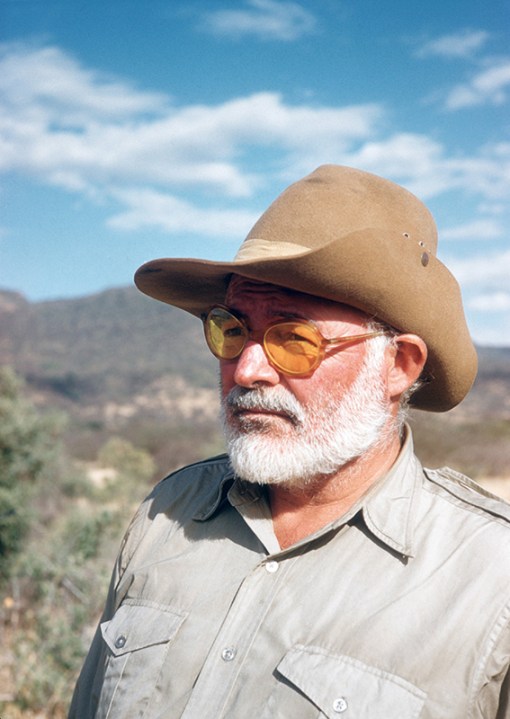
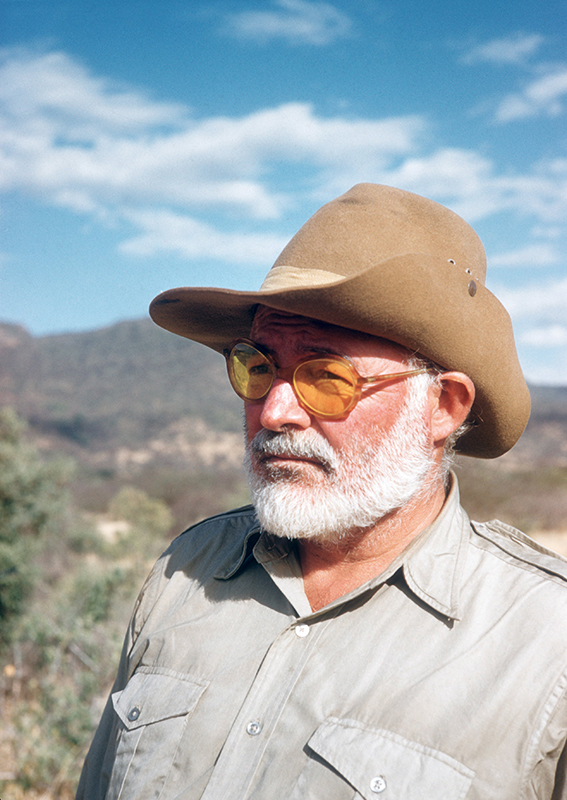
To pinpoint the precise moment Ernest Hemingway came up with the idea for his first novel, The Sun Also Rises, which is celebrating its centenary this year, is not difficult. All we have to do is follow the trail back to Pamplona.
In 1925, after a cold winter in Paris, a 25-year-old Hemingway was keen to return to the San Fermín bullfighting festival in the Basque town of Pamplona, near the northern coast of Spain. He had yet to make his mark as a writer, although he was surrounded by some of the heavyweights of expatriate literature: Ezra Pound, F. Scott Fitzgerald, Gertrude Stein and Ford Madox Ford, all of whom believed Hem had a future as a novelist. He worked closely with Ford on the expat literary journal the Transatlantic Review, and Gertrude Stein was a regular visitor to his tiny Paris apartment above a nightclub called the Bal au Printemps. Stein would sit on Hemingway’s huge Empire bed and advise him how to improve his short stories, while his wife Hadley and son Bumby played in the kitchen.
It was Stein who suggested he travel to Spain to gather material for a novel. Hemingway assembled a posse of pals to accompany him, including Harold Loeb, Don Stewart and Duff Twysden, an English bohemian who became the model for Lady Brett Ashley. The other two friends would become Robert Cohn and Bill Gorton in the novel, while Hem would cast himself as troubled war veteran Jake Barnes.
What keeps the reader engaged is the simmering tension Hemingway captures between all the characters
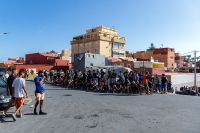
The big attraction at San Fermín was the bullfighting, the daily corridas surrounded by a full week of 24-hour partying. Hem considered himself a true aficionado of bullfighting – rare among Americans in the 1920s – and knew the names of all the matadors in the fiesta that year, knowing some of them personally. To adherents such as Hemingway, the sport is a combination of artistry, theatre, violence and technical precision that generally ends with the death of the bull by the sword of the matador. On the rare occasions that it doesn’t, then the matador’s days are over. Hemingway was keen to impress his expatriate companions: he knew more than they would ever know about the mysterious art of the corrida de toros. While in Pamplona he watched carefully the faces of Loeb, Stewart and Twysden during the first corrida, noting how they each reacted. It must have been exhausting for Hem. While his chums were drinking themselves into oblivion and falling out with each other, he was doing the same, all the while storing away the details for his debut novel.
His first collection of short stories, In Our Time, had received praise, but he had yet to find his true voice. In Paris he had only written a satirical novella mocking the writing style of Sherwood Anderson, which was rejected by American publisher Liveright. All roads pointed to Pamplona, and getting his teeth into some juicy subject matter for a novel that came from the heart.
This was Hemingway’s third visit to the fiesta at Pamplona. But by this year, the magic had already seeped out from San Fermín. Don Stewart recalled the heady days of just the previous year, remarking that “something had gone out of Pamplona.” Limousines were pouring in from Biarritz in southern France, delivering members of the British aristocracy late to the party. The only bright spot was the arrival of a major new talent in bullfighting by the name of Cayetano Ordóñez, who debuted as a matador in Ronda at the age of 19.
Alongside all of this was the constant friction between Hemingway and Harold Loeb over Duff. Loeb had had a short fling with her before she moved on to another man who wasn’t her husband, while Hemingway (married himself) held a secret yearning for Duff that was never, as far as anyone knows, consummated. Matters came to a head late one night in a bar, when Loeb asked Hem to step outside and resolve their differences with their fists. Loeb got as far as removing his spectacles and placing them carefully into his pocket, before seeing that Ernest was smiling at him in the dark street. “I don’t want to hit you,” said Loeb. “Me neither,” replied Hemingway, and they returned to the bar.

If brawls outside bars in Spain sound about as sophisticated and literary as the spring break antics of college boys in Florida, you might be surprised to learn that this episode was turned into one of the greatest novels of 20th-century American fiction. Hemingway lifted entire conversations from his friends, stringing it all together into a tale that relies heavily on the events of the trip, yet remains a marvelous fiction. He made copious notes while in the thick of it, but the real work took place when they had all left Spain. Hemingway spent the winter of 1925 in the ski resort of Schruns, Austria, reworking and editing. Writing a novel about bulls being slaughtered in the hot Spanish sun must have seemed poignant while he was surrounded by the cold of the Austrian Alps.
The Sun Also Rises does not benefit from a page-turning plot. Most of the events described within its modest 200 or so pages all took place during that trip to Pamplona, with only the names of his friends changed to create characters in the novel. Its detatched point of view can make the reader feel remote from the emotions of the characters, and at times the novel reads like a Paul Theroux travelogue, as if Hemingway wishes to share every little detail of his trip to Spain.
Yet many critics, contemporary and subsequent, have praised The Sun Also Rises for its critique of the so-called Lost Generation, those privileged Americans so damaged by World War One that they drifted around Europe in a permanent alcoholic haze. When you consider that the Great War had only ended six years before the writing of the novel, and that Hemingway himself had taken an active part in the conflict, it begins to seem highly relevant. Coupled with the fact that in the US, Prohibition was still making it illegal to have a drink in public, the antics of his cast begin to seem more sympathetic.
What keeps the reader engaged is the simmering tension Hemingway captures between all the characters, without which the tale would plod along in an unsatisfying way. Who wants to read about a bunch of expats getting drunk in Spain? Pit them all against each other, throw in a mysterious war wound causing impotence in the protagonist, set it against the passion and violence of the corrida, and you have yourself a swell novel, as Hem himself might have put it.
The point of view of Jake Barnes, based on the author himself, is remote and critical. Barnes is a cynical observer of the tomfoolery of his compatriots. He participates in their drunken idiocy while at the same time coolly criticizing it.
Hemingway’s position among the literati of 1920s Paris was not much different from this. Apart from Gertrude Stein, he generally liked to pick fights with his fellow writers. He had a huge falling out with Ford Madox Ford over his stewardship of the Transatlantic Review while Ford was back in the US. Hemingway ran a satirical piece mocking T.S. Eliot, writing that he would like to bring Joseph Conrad back to life “by grinding Mr. Eliot into a fine dry powder and sprinkling that powder over Conrad’s grave in Canterbury.” There are frequent accounts of Hem bouncing about the room in boxing gloves while Ezra Pound reads his poetry out loud. He comes across as wary of the effete, bespectacled denizens of literary Paris, and ultimately threatened by them. James Joyce called Hemingway “a naif – not a naive writer, just a naif.”
Hemingway is mythologized to a much greater extent than any of his contemporaries
Initial reviews of The Sun Also Rises were divided between praise for Hemingway’s sharp prose style, which captures the spirit of the Lost Generation, and accusations that the novel was empty and trite. The public, however, loved it – and it quickly became such a hit that women adopted the style of Lady Brett and young Ivy Leaguers sought to emulate the Hemingway lifestyle. Pamplona received many more American visitors the following year. Unintentionally, Hem had promoted, rather than criticized, the expatriate life. And it led to a glittering, eventful career, only brought to an end by his suicide in July 1961.
Hemingway is mythologized to a much greater extent than any of his contemporaries. His life is probably better known to many people than any of his books, whereas someone like F. Scott Fitzgerald is a more mercurial figure lurking behind the might of his grand, epic novels.
I still think we should read Hemingway, purely because he was there, and because he mattered. Without Hemingway there would have been no Kerouac, no Burroughs and probably no Hunter S. Thompson. His raw, pared-down prose brought an entire generation to life on the page and paved the way for a fresh, immediate style of writing that abandoned all literary constraints and attempted to place the reader at the center of the action. The Sun Also Rises – and with it rose a remarkable voice in 20th-century American literature. We should be forever grateful.




Comments