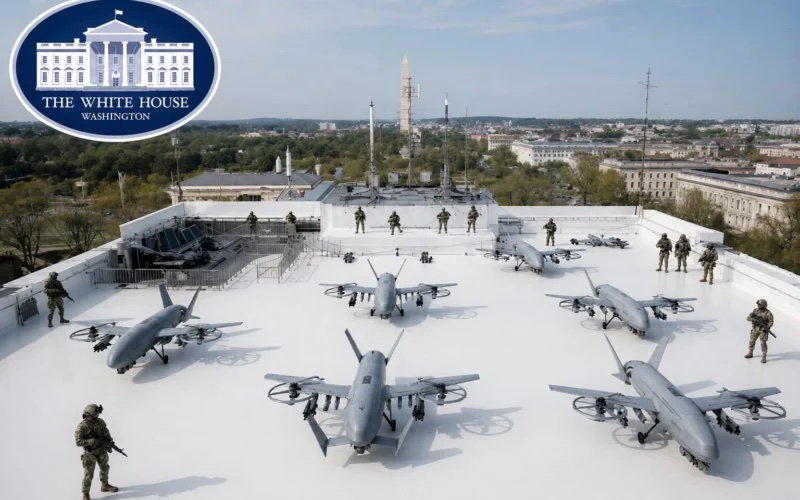
When Donald Trump unveiled plans for a counter-drone installation on the roof of the new White House ballroom, critics called it theater. They may be right about the installation. But they are wrong about the threat.
I have watched the character of warfare change faster in the past four years than in the previous forty. In Ukraine, a one-way attack drone that costs a few hundred dollars routinely destroys Russian armored vehicles worth millions. Both sides now field these systems by the hundreds of thousands. Entire stretches of the front are governed not by artillery or air superiority in the traditional sense, but by small, expendable aircraft that soldiers can carry in rucksacks and launch from tree lines. I have stood in Ukrainian production facilities and seen the pace of their innovation. We are well behind.
If we build a counter-drone strategy the old way, we will field systems that are obsolete the day they arrive
Here is what that war is teaching us: the drone has become the defining weapon of modern conflict, not because it is the most powerful weapon on the battlefield, but because it is the cheapest effective one. A determined adversary doesn’t need a sophisticated air force. It needs a commercially available aircraft, a basic payload and enough time to practice. The barriers to entry are low. That’s what makes this different from any other air threat we’ve planned against before.
A defense built entirely around expensive interceptors fails the moment an adversary sends more drones than you have missiles. No country, including ours, owns enough high-end interceptors to win that exchange at scale. The Ukrainians figured this out under fire, adapting toward layered defenses that combine ground-based systems, drone-on-drone interceptors, electronic warfare and low-cost interceptors fielded at volume. They did it because the old exchange ratio was already failing.

That same logic applies here. A small unmanned aircraft doesn’t respect the assumptions that have protected national landmarks for a century. It flies below the radar horizon. It can be launched from a parked car, a grassy area or even a rooftop blocks away. It can carry a camera, a payload or simply the intent to capture our reactions to it. This isn’t hypothetical. Drones have been flown over the Capitol, over military bases, over nuclear facilities. The FBI and the DHS have warned that domestic and foreign actors are using them to surveil critical infrastructure. Cartels have used them on the southern border for years. The Islamic State used them as weapons in Mosul. The threat is already here.
What happened on the battlefields of eastern Ukraine did not stay there. The tactics, the hardware, the doctrine, all of it is now available to anyone willing to study. Terrorist organizations, criminal networks and lone actors have watched the same war we have. They have drawn the same conclusions about cost and effect. The question is not whether they will apply those lessons here, it is when. A country that waits for the first mass-casualty drone attack on domestic soil to build its defenses has already lost the initiative.
The conversation about the White House drone port is the right one to be having – it’s just not the right answer. What we actually need is harder to capture in a photograph. It entails giving federal agencies clear legal authority to detect, track and, when necessary, defeat drones near critical sites. Right now, that authority is inconsistent and contested across agencies. It requires funding for detection and tracking system at scale – not just in Washington, but at every installation and piece of critical infrastructure a serious adversary would target. And it means doing this quickly, because the threat is not waiting for our procurement system to catch up.
That is where I have real concern. We are good at writing requirements and slow at fielding hardware. In Ukraine, a frontline unit identifies a problem and a domestic manufacturer ships a revised solution in weeks. We measure that same cycle in years. If we build a counter-drone strategy the old way – every solution perfect, expensive and delivered late – we will field systems that are obsolete the day they arrive.
It also means leaning on American industry differently than we have before. The companies moving fastest on small unmanned systems and counter-drone tools are often not the primes we are used to writing checks to. They are smaller and more willing to iterate. A serious national effort would give them a real seat at the table, buy in volume and accept that some systems will be replaced quickly – because that’s the nature of this fight. Domestic manufacturing of these systems is a strategic requirement.
The threat isn’t coming from state actors alone. It’s coming from non-state actors, from individuals, from anyone with a grievance and enough money to walk into a consumer electronics store. That’s a different kind of threat from the ones we’ve built our defenses around. It requires a different kind of response – faster, cheaper and fielded in volume.
The drone port might not protect the White House. But the conversation it forces might, if we are willing to face hard answers about authority, funding and the industrial base. The instinct is correct: drones have changed warfare. They are changing the threat at home. The question now is whether we treat this like the strategic problem it is, or wait for an incident to make the case for us. I have seen what happens to forces that adapt too slowly. The cost of being late is always higher than the cost of being early.




Comments