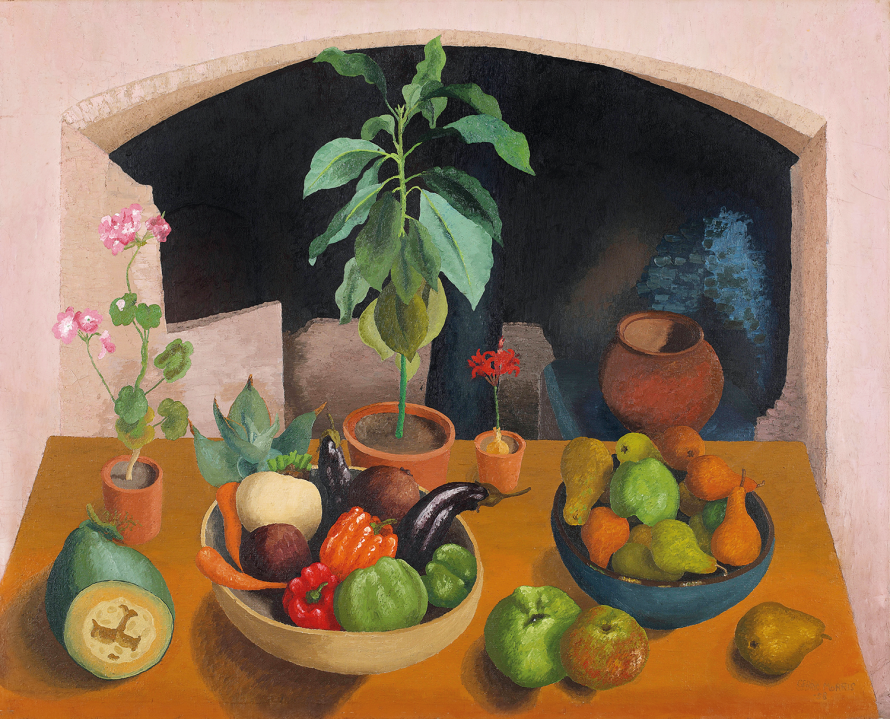
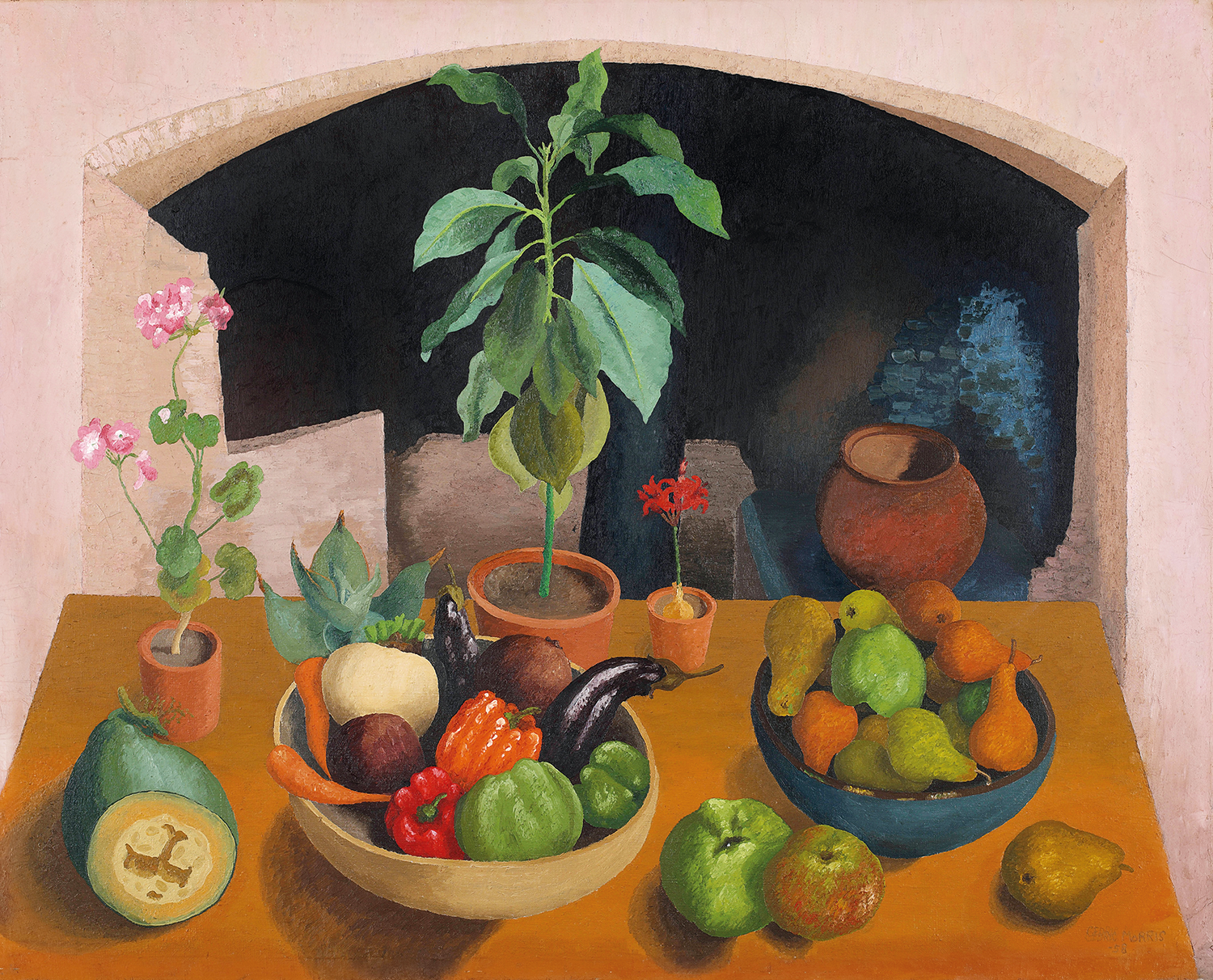
From 1940, at Benton End, near Hadleigh in Suffolk, the artist Cedric Morris brought his eye to breeding irises. Eliminating hated shades of ‘salmon or knicker’, he was, according to his biographer Hugh St Clair, ‘unstinting in his efforts to produce a pure, delicate pink’. Forty years of dedication brought a wild abundance to the garden, which was packed with cultivars, including ‘Benton Baggage’ (pale rose with a blue blaze), ‘Benton Persephone’ (very large white flowers) and ‘Benton Mocha’ (coffee-coloured, with a bright orange beard). A living flower painting. Sacheverell Sitwell saw the tones of ‘vellum, chamois and fuchsia’ – the walls of the half-timbered house were also lime-washed pink – as a 16th-century Japanese scroll, but truly, it was a Cedric Morris.
Lett-Haines’s apple pie used to be served with beak marks that had been made by Morris’s pet jackdaw
In an infinity loop of cultivation, Morris’s paintings are now being consulted by gardeners working to restore Benton End. The rare flowers were exported widely to gardens such as Sissinghurst, but Benton End itself went to seed after the death of Morris in 1982 and his partner Arthur Lett-Haines in 1978. This was a double disaster, as the site was also a small but important art school where Lucian Freud and Maggi Hambling had studied. A major fundraising and renewal effort by the Garden Museum has resulted in the tentative first public admissions to Benton End this summer. To celebrate, the Garden Museum and Philip Mould Gallery have put on a charming if half-formed exhibition.

As if entering a stage set, one steps into a mocked-up half-timbered building with an authentic sign for ‘The East Anglian School of Painting and Drawing’. The recreation of the tiled Benton End kitchen sink, complete with arty postcards and a tired old pebble of Pears soap, is marvellous, and it would be churlish to point out it is devoid of the earthiness remembered by so many graduates. Hambling recalls scraping maggots off the meat; Lett-Haines’s delicious apple pie used to be served with beak marks that had been made by Morris’s pet jackdaw.
A clever optical illusion allows us to view the Benton End dining-room table as if from above – I heard gallery-goers gasp with excitement as they saw it. There are also nice insights into Lett-Haines’s work, with his small, quirky sculptures of bones, eyes and goo that he called ‘Humbles’ dotted around. I could tolerate the canned birdsong – Morris was a passionate conservationist – but I found the sub-Max Richter mood music grating. Benton End was, after all, a place that Ronald Blythe, the author of Akenfield, described as having an atmosphere that was ‘robust and coarse, exquisite and tentative all at once, rough and ready and fine-mannered and also faintly dangerous’.
Students were well fed and watered, with Lett-Haines – a friend of Elizabeth David – providing two sophisticated meals a day with wine. The school was never, alas, profitable. Morris’s 1944 painting ‘The Eggs’, used on the cover of the Elizabeth David book An Omelette and a Glass of Wine, is here on loan from the Tate, reverberating with purple and pastel.
It wasn’t all roses at Benton End – there were some really terrible portraits produced. Philip Mould is determined to pin the appalling 1939 ‘Man in a Black Scarf’ on the young Freud. It is here, flatly attributed to Freud, and forgivably bad – he was barely 17, had been expelled from Bryanston and painting for the first time. I’d guess it was only obtained by Denis Wirth-Miller, Freud’s long-term frenemy, as a means of embarrassing him. Morris’s flair for painting flowers did not extend to people; he himself said: ‘Every time I paint a portrait, I lose a friend.’ But nothing in a garden or an art school goes to waste. Fertility thrives on error, and yes, the ‘Freud’ should be compost.
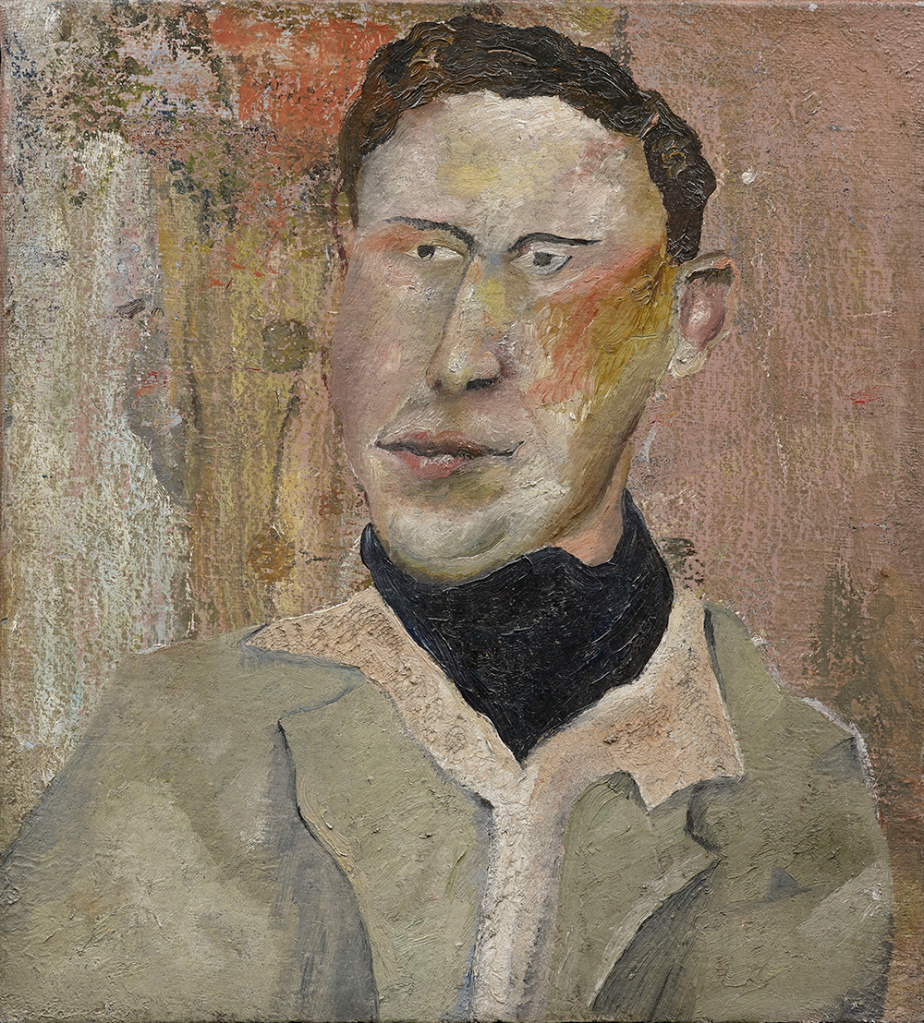
It wasn’t all roses at Benton End – there were some really terrible portraits produced
The omission of Hambling – who isn’t even named – is bizarre. She is one of the school’s greatest graduates – also arriving as a tender shoot after failing school. She went on to study at the Slade and Camberwell, but ‘nowhere ever matched the cut and thrust of Benton End… it prepared me for the world and I found out who I was. My mother said “I wish to goodness you had never set foot in that place” – but it was too late.’
‘I think that Cedric, who did not express his feelings easily, put his passionate sense of colour into his garden,’ wrote his friend Kathleen Hale, author of Orlando (the Marmalade Cat). Also unnamed here, she put likenesses of both Morris and Lett-Haines in her books and was a sometime lover of the latter. Life is more complicated than canned birdsong. This show is a mixed bag but the opening of Benton End is an important achievement.




Comments