
Per Sir Humphrey Appleby: ‘A basic rule of government is never look into anything you don’t have to and never set up an inquiry unless you know in advance what its findings will be.’
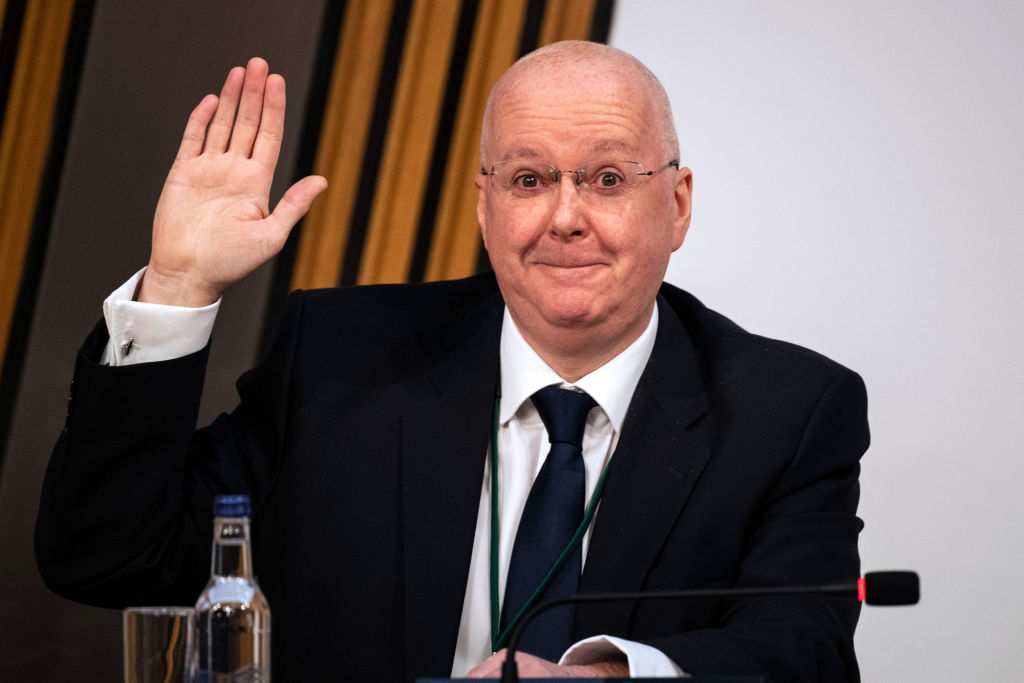
It is in this spirit that John Swinney, Scottish First Minister and SNP leader, is resisting calls for a parliamentary inquiry into the SNP finances scandal. Peter Murrell, former chief executive of the Scottish Nationalists and estranged husband of Nicola Sturgeon, recently pleaded guilty to the embezzlement of £400,000 in party funds, which he spent on £2,000 pepper grinders, £4,000 pens, and most famously a £125,000 camper van.
Holyrood has been failing for at least two decades now and in those two decades Westminster has maintained its mission of ‘devolve and forget’
Holyrood’s opposition parties, which exist more in theory than in practice, want the Scottish Parliament to hold an inquiry into how Murrell got away with it for so long and whether anyone inside the SNP harboured suspicions but declined to act upon them. The idea of MSPs investigating anything more complex than long division is hard to take seriously.
Remember Murder She Wrote’s Amos Tupper, the bumbling small-town sheriff so dim-witted that he needed a local mystery novelist to solve all his cases? He was Sherlock Holmes compared to the average MSP. Now in its 27th year, and somehow becoming more mediocre by the year, Holyrood is an institution painfully unequal to the task being demanded of it.
Even if enough capable members could be found for a committee of inquiry there still couldn’t be an independent review because Holyrood largely operates on bloc voting. Unlike Westminster, where party leaders and whips must coax and cajole MPs into toeing the line on this legislation or that, Holyrood largely lacks a parliamentary tradition. MSPs, especially those from the SNP and the Greens, almost never rebel from the party line, and the vilification dealt out to the few who do keeps the number of dissenters vanishingly low.
Anyone wondering how a Holyrood inquiry into SNP finances might go need only consult the 2021 Salmond inquiry, in which the Nationalists dragged their feet on handing over evidence, the Crown Office demanded the committee delete documents from its website, and every SNP member voted to find their leader Nicola Sturgeon had not intentionally misled parliament.
That the Scottish Parliament is neither capable of nor willing to conduct a robust, independent inquiry does not mean that Westminster should volunteer to take on the task. The Scottish Affairs Committee is reportedly eager to do so, and Nationalists are pretending to be concerned about bias given the panel is made up of mostly non-separatist politicians. Of course, the SNP isn’t really concerned about bias. It is trying to work the ref and the crowd in case there is a Westminster probe. In accusing a hypothetical investigation of bias, the Nationalists ensure any potential findings that reflect poorly on them will already be discredited.
There is another reason why the House of Commons has no business setting up an investigation. The Scottish Parliament is a creature of Westminster legislation. It is a devolved, not a separate, institution, and has been as evidence has mounted over the years of its fundamental flaws. Not least its supineness to the executive, its habit of passing unlawful legislation, its disregard for the parameters of the devolution settlement and its stubborn failure on most major policy outcomes.
Holyrood has been failing for at least two decades now and in those two decades Westminster has maintained its mission of ‘devolve and forget’ – handing ever more powers to an institution which demonstrably does not work. In that sense, Westminster has been the co-author of Holyrood’s many scandals, from ferry procurement to drugs deaths to the educational attainment gap to the Scottish Parliament’s capture by the Scottish government-funded gender lobby.
Westminster is the sovereign parliament, the guardian of the legislation it passes, and its response to the abject failure of its devolution experiment has ranged from indifference to enablement. The House of Commons might boast a little more intellectual rigour, political independence and parliamentary self-respect than Holyrood, but any inquiry into SNP embezzlement that doesn’t examine Westminster’s role in designing the political fiefdom which handed the Nationalists maximum power with minimum oversight would be a self-serving waste of time.
While these two parliaments were neglecting their duties, much of the heavy lifting on scrutiny was being done by the blogger Stuart Campbell, author of the Wings over Scotland website. A Scottish nationalist, Campbell has nonetheless done more to hold the SNP and the Scottish government to account, on financial probity, gender policy, and constitutional strategy, than an apathetic House of Commons. Work that ought to have been done by MPs and MSPs was left instead to bloggers, former civil servants, freedom of information activists, and others who toiled away for years to get answers for no other reason than their belief in transparency.
I would trust them to preside over a public inquiry before I would trust the midwit partisans of Holyrood or the absentee landlords of Westminster.




Comments