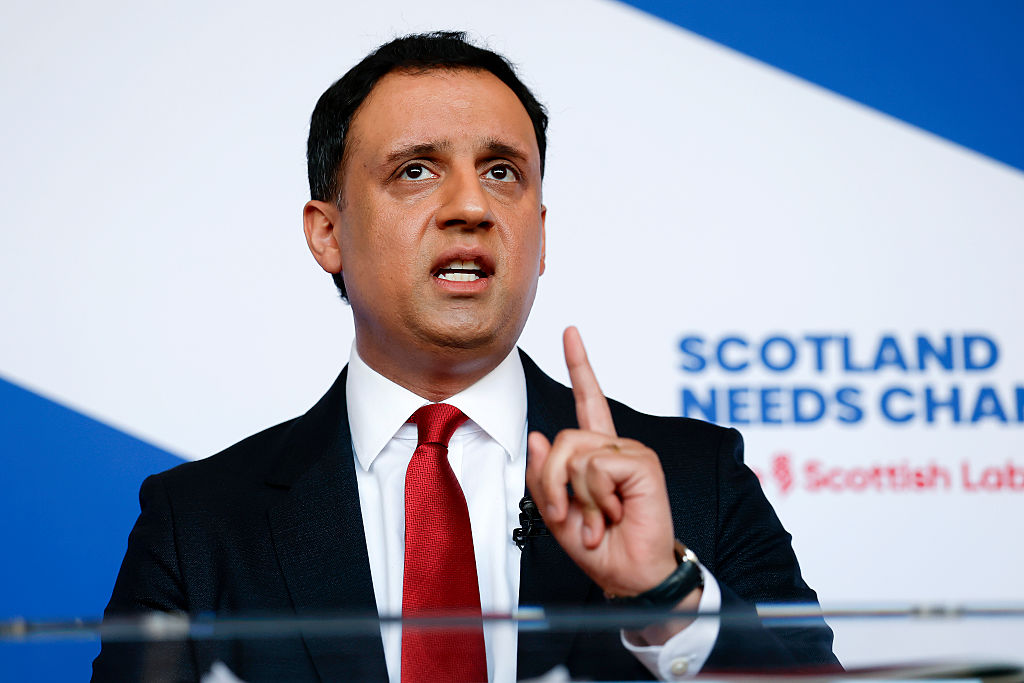
The leadership of the Scottish Labour party isn’t worth the price of a cold cup of tea. Anas Sarwar has confirmed this by jumping ship to a seat in the Lords and a billeting in Andy Burnham’s new government, reportedly as a business minister. The appointment – no, let’s be candid: the promotion – will involve Sarwar quitting as Scottish Labour leader and giving up his seat at Holyrood.
I doubt either will prompt from him much in the way of farewell tears. Westminster is always where he has wanted to be because Westminster is where the power is. His decade at Holyrood was preceded by five years as MP for Glasgow Central, a seat he inherited from his father Chaudhry Mohammad Sarwar, who renounced his British citizenship, returned to Pakistan and was elected governor of Punjab. Sarwar junior was chucked out by the voters in the 2015 SNP landslide.
His time in the Scottish parliament has been unfulfilling. Elected Labour leader in 2021, Sarwar failed to turn turbulence within the SNP to his advantage, and while it is the case that Keir Starmer dragged down the fortunes of Labour’s Scottish branch ahead of May’s devolved elections, the unpalatable truth is that Sarwar would have been in no position to oust the SNP had things gone differently inside No. 10.
Scottish Labour dropped to just 17 seats, tied with Reform, and its new generation of MPs elected in 2024 appear doomed come the next general election. Starmer has to take his share of the blame, but Sarwar’s portion is much larger. He didn’t get it done and now he’s turning tail. Even those of us well-disposed towards him and his campaigns – he exposed a cover-up of child deaths at the SNP’s flagship Glasgow hospital, for example – must admit that his legacy at Holyrood is essentially non-existent.
Sarwar was the first Labour figure of any standing to call for Starmer to resign, and the peerage and government job are his reward for that, his ticket out of the dead end that is Holyrood politics. The brightest minds in Scottish Labour spent a generation fighting to have a devolved parliament; this generation are fighting to have absolutely nothing to do with it. It’s difficult to blame them for preferring a career at Westminster; devolution has proved to be little more than a job creation scheme for the dull, the dogmatic, and the deranged. Holyrood is the Parthenon of inadequacy, the Forum Romanum of mediocrity, a sixth-form common room with tax-raising powers.
Which is why options for replacing Sarwar are limited. Three names to look out for are Jackie Baillie, Daniel Johnson, and Michael Marra. Baillie should have got the job years ago and the party would likely be in ruder health if she had. The Dumbarton MSP is Machiavelli’s Mammy, a legendarily ruthless political schemer, but after decades at the top of Scottish Labour politics she would be vulnerable to any push for a fresh face.
That desire could be met by Edinburgh Southern MSP Daniel Johnson, a pro-business moderate who is well-regarded within Labour and wider political circles but little-known to the general public. Another option would be Michael Marra, a fierce Dundonian with rhetorical flair and more intellectual heft than most MSPs. His forensic mind and keen eye for detail could come in handy against an SNP government prone to error and allergic to scrutiny.
But when the leadership of this party is worth so little that the incumbent deems a sub-cabinet posting in a deeply unpopular government the better career option, it’s a wonder why anyone would want to follow in his footsteps.
 Stephen Daisley
Is it any wonder Anas Sarwar is fleeing Holyrood?





Comments