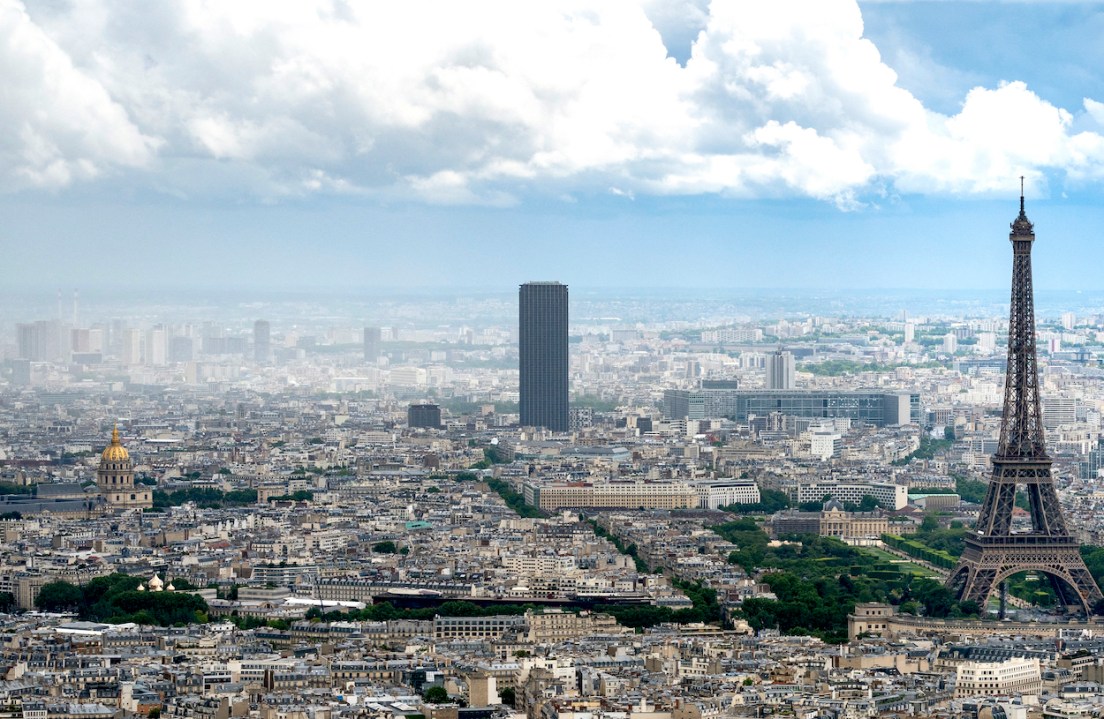
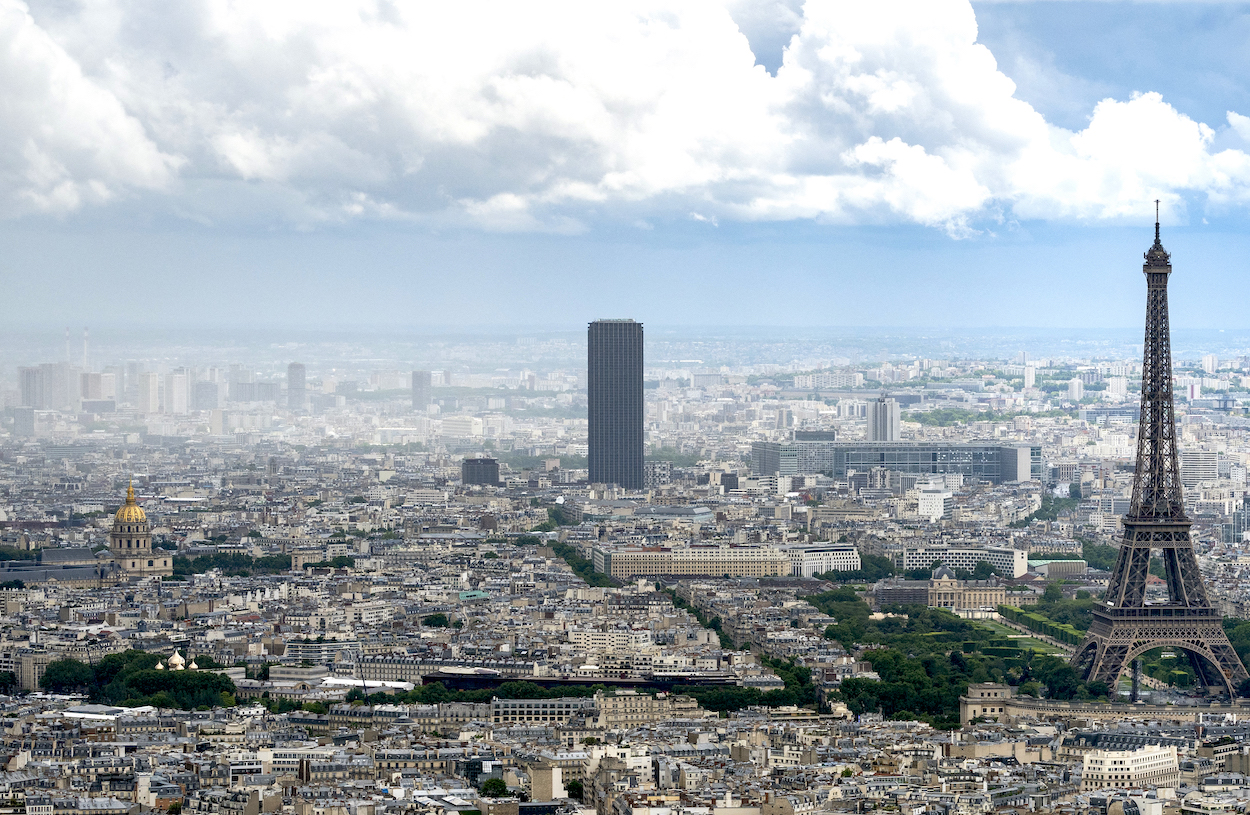
Parisians were recently treated to the impromptu spectacle of a shirtless 26-year-old man scaling bare-handed the 59-story Montparnasse office tower.
For many in the French capital, news reports of the vertiginous feat were another reminder – if they needed one – of how much they loathed the chocolate-brown skyscraper looming incongruously over the burnished boulevards of the Left Bank.
The spiderman exploit was not witnessed by anyone inside the 210-meter skyscraper. The Montparnasse tower was empty. The city’s most unloved building has been vacant since March. More than a half-century after its inauguration, it’s awaiting a long-overdue facelift. The wait may be long.

The Montparnasse is despised by Parisians as an eyesore, but it has also failed functionally. The glass-and-steel skyscraper, constructed in 1973, is disconnected from its urban environment – it coldly shuns Parisians. The underground shopping concourses have been virtually deserted for decades, with many boutiques boarded up and defaced with graffiti. The surrounding residential tower blocks are bleak and desolate.
Nearly a decade ago, bold plans were announced to give the tower complex a makeover. It was to be transformed into a translucent, eco-friendly structure covered in vegetation with terraced gardens and a rooftop greenhouse. The renovation – featuring a luxury hotel, student housing, and recreational spaces – was supposed to be completed by 2023. Three years later, the project is still stalled. The tower’s multiple owners – one is billionaire Xavier Niel whose media holdings include the left-leaning newspaper Le Monde – are fighting in court over the commercial impact of the proposed overhaul.
Some believe the Montparnasse tower should be demolished. Many wonder how its construction was ever approved in the first place.
Parisians have long taken pride in the visual harmony of the city’s low-rise urban design. In the mid-19th century, Baron Haussmann ambitiously transformed the French capital by creating wide boulevards lined with Lutetian limestone facades with signature black wrought-iron balconies. A strict height limit of six stories was imposed with a careful eye to pleasing aesthetics.
Since Haussmann, Parisians have been fussy about architecture. The city eschewed skyscrapers, regarded as gleaming symbols of Anglo-Saxon capitalism. Neither did Paris succumb to the postmodern eccentricities of London’s patchwork of oddly shaped towers with funny names— Shard, Gherkin, Cheesegrater, Walkie Talkie. Parisians had the good sense to relegate office towers to a commercial zone, La Défense, beyond the city’s periphery.
Even the iconic Eiffel Tower, made of puddled iron, didn’t escape the contempt of Parisians when it first appeared in 1889. It was resented as a grotesque intrusion on the city’s Belle Époque grandeur. A petition was circulated to have it dismantled, warning that foreigners visiting Paris would wonder what happened to the renowned good taste of the French.
By the 1920s, however, the modern age announced by the Eiffel Tower had triumphed. Architects came forward with bold futurist designs for the French capital. Franco-Swiss architect Le Corbusier proposed a forest of 60-story skyscrapers stretching across the Right Bank. Fortunately, the French government rejected Le Corbusier’s plan. But the modernist ethos prevailed in the longer term. Following World War Two, Le Corbusier’s rationalist approach to urban design appealed to France’s new ruling elite of technocrats.
In the 1960s, the modernists found a champion in Georges Pompidou, an ex-banker who was Charles de Gaulle’s prime minister before succeeding him as president of the Fifth Republic. Pompidou embraced modernism in all its aspects. He championed the supersonic Concorde jet. He constructed automobile expressways along the banks of the Seine. He commissioned a modern art gallery – an outlandish inside-out structure that looked like a pile of plumbing – that bore his name. Above all, Pompidou was an ardent admirer of the skyscraper.
“The modern architecture of the big city leads to the tower,” declared Pompidou. “The French prejudice, and particularly that of Parisians, against height is, to my eyes, completely retrograde.”
Pompidou needed little convincing to green-light the Montparnasse tower. The project brought together a group of Corbusier-inspired architects and an American property tycoon, Wylie Tuttle. An entire district around the Montparnasse railway station was razed to make room for the tower and modernist residential blocks. Parisians watched, horrified, as the skyscraper rose over the legendary Montparnasse district once frequented by Picasso, Modigliani, Man Ray and Jean-Paul Sartre. When it was completed, the reaction was so hostile that the Paris council quickly imposed a prohibition on constructions higher than 37 meters, or 12 stories.
Several of the building’s owners are fighting the proposed makeover in court
More than a half century later, everyone agrees that something must be done with the skyscraper that Parisians hate. For the tower’s critics, the choice of architect to oversee the facelift is hardly comforting. Renzo Piano’s credentials include the Shard in London. The Italian architect was also behind the Centre Pompidou, which like the Montparnasse tower has been closed for extensive renovations. Piano promises to reconnect the tower’s cement-block base with the surrounding area by creating pedestrian promenades and a leafy square. Still, his solution is largely cosmetic. What’s more, several of the building’s owners are fighting it in court.
Some believe the tower should be dismantled and replaced with an urban park surrounded by human-scale housing in harmony with the Left Bank ambiance. It would cost an estimated €1 billion ($1.15 billion) to demolish the structure and indemnify its owners, compared with roughly €750 million ($864 million) for the planned facelift keeping the tower intact.
Meanwhile, after the city council voted to remove height restrictions, another controversial tower is going up nearby on the southwest edge of Paris. It’s a 42-story glass pyramid that looks like a crystalline Tower of Babel. The “Triangle Tower,” as it’s called, was tirelessly promoted by the socialist-controlled Paris city council as an eco-friendly structure featuring a 120-room hotel, shopping boutiques, a nursery for 60 children, a cultural center and a sky bar like the one atop London’s Shard.
In London, the Wandsworth council has just rejected a plan to construct a 29-story tower near Battersea bridge. Lobbying by Mick Jagger, who lives in the area, apparently helped defeat the project. Wandsworth council cited “excessive height and scale” as the reason for turning down the plan. London, it appears, has learned from past mistakes, while Paris is indulging in yet another architectural folly.
The Montparnasse tower meanwhile stands forlornly on the Left Bank, vacant and unloved, its future uncertain.





Comments