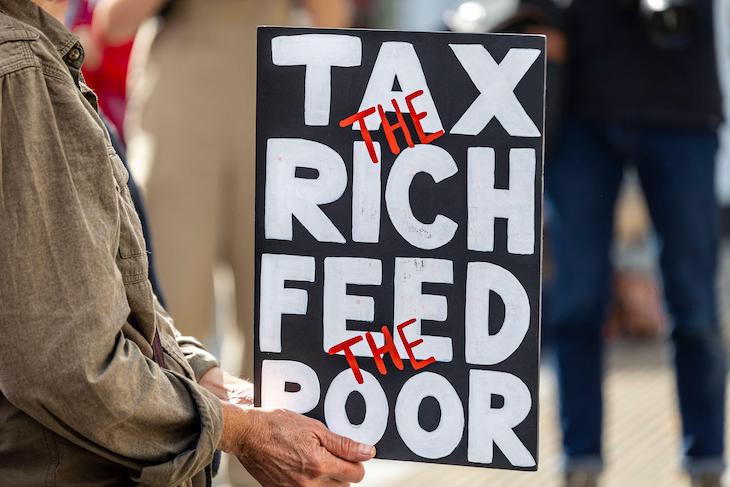
Labour used to be able to rely on the support of union members. Not any longer. Reform and Labour are tied at 28 per cent among union members, according to polling by JL Partners. The survey reveals that Keir Starmer’s party has suffered a 20 percentage point drop since 2024. Reform actually beat Labour among members of two of the biggest unions: Unite, by 36 per cent to 30 per cent, and the GMB, by 31 per cent to 22 per cent. Union leaders said it proves “the working class have abandoned” Starmer’s party.
Nigel Farage now ranks as the most favourably viewed party leader among union members, as well as the most popular choice for prime minister
Nigel Farage now ranks as the most favourably viewed party leader among union members, as well as the most popular choice for prime minister. Plenty of justification then for the claim he made this week that “Labour is no longer the party of the patriotic working class. That mantle now belongs to Reform”.
His party will lean into this theme further. We will hear more from Farage about being on the side of alarm clock Britain. Reform’s blend of cultural conservatism, anti-establishment sentiment, and national pride appeal to working people, as they should – even before economic policy enters the equation.
For Labour, the collapse in union support is grim. As Tom Lubbock, co-founder of JL Partners told me, “This is the workers abandoning the party that was built to represent it. The union bosses were pretty close to the mark in their explanations. Winter fuel allowance, welfare, cost of living. In the poll, 62 per cent said Labour had lost touch with working class people.” Mass immigration, which exacerbates the sense of unfairness about welfare, and Net Zero, which worsens the cost of living crisis through its impact on energy prices, surely loom large in the background too.
Two years on from Labour’s landslide victory, Starmer’s government has somehow managed to both scare away the rich and do nothing for the poor. It is working people after all that bear the brunt of the rising tax burden caused by increased employer National Insurance contributions and the freezing of tax thresholds. We learnt earlier this week, courtesy of the Peter Mandelson files release, of the Welfare Secretary Pat McFadden’s despair that “Every meeting I have is: ‘Who can we tax in order to pay benefits to others?”. It is a line that will come to haunt Labour as much as Chief Secretary to the Treasury Liam Byrne’s “I’m afraid there is no money” note to his successor in 2010.
On one level, this polling, reported in the Times, should not come as a surprise. We have long known the old tribal party loyalties, and indeed the left/right spectrum, are dead. We should also remember, as The Spectator’s James Heale has pointed out, that there has long been some diversity in the political leanings of union members. One in three trade unionists voted for Margaret Thatcher in 1979. Four in ten Unite members voted for Boris Johnson in 2019. But this does feel as if it represents a key milestone in the re-alignment of British politics. We may not be about to see the unions formally disaffiliating from the Labour party, but we are seeing one of the oldest institutional alliances in British politics being ripped asunder.
The emotional impact of this on the Labour movement should at least be significant. What are Labour MPs in it for if not to be champions of organised labour, on the side of the Clydeside shipworker and the Teesside steelworker? But, in truth, the newest crop of Labour MPs don’t seem much to care. They have become the party of the lanyard class; not for labourers, but for bureaucrats. And as I wrote last week, these bureaucrats’ biggest union is engaged in ever more hysterical attempts to portray Reform voters as a bunch of racists.
When running for the Labour leadership, Keir Starmer recited the obligatory Labour catechisms: “I’m Keir Starmer and I’m a proud trade unionist…I’ve been working with trade unions all my life, starting with legal observing on the Wapping picket line, [and] acting for the National Union of Mineworkers trying to stop the pits being closed.” But it has never appeared convincing. The only union that has ever had a claim on his heart is the European Union.
There is an irony in the Prime Minister’s current predicament. If Andy Burnham wins in Makerfield on 18 June, he is odds-on to replace Starmer as PM. The only thing likely to save Starmer is Reform triumphing in the by-election, depriving the king of the North from entering No 10. In that event, Starmer may limp on. But either way, his legacy may end up being the Labour leader who finally lost the working class.
For a man who reportedly owes his first name to Keir Hardie, one would have thought that a painful blow. But that Keir toiled in the Lanarkshire coal mines; our Keir toiled in Doughty Street Chambers. For all the ‘son of a toolmaker’ schtick, the working class have never seen Starmer as having their back. That, in large part, will be the reason we see the back of him.





Comments