
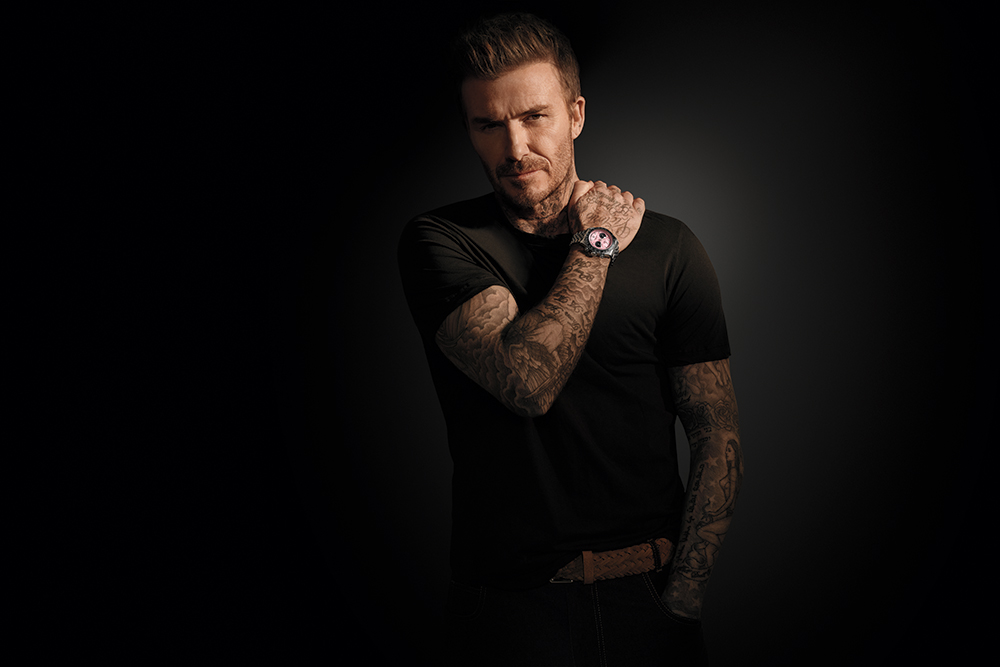
The FIFA World Cup is coming to the United States (Thursday, June 11 to Sunday, July 19, 2026), which means, for a few weeks, the country will submit to calling the Beautiful Game football. It already does so more often than it admits, and the insistence on “soccer” now feels faintly performative.
The US came late to the game, but Major League Soccer now draws average crowds of more than 22,000 a match, placing it alongside established European leagues. Its broadcast deal with Apple – 10 years and $2.5 billion – suggests confidence. The arrival of Lionel Messi at Inter Miami CF in 2023 did not create interest so much as accelerate it. Watchmaking, as it tends to, has followed the audience.
For a time, the relationship between watches and football was organized around a single idea: control the biggest stage. Hublot’s partnership with FIFA placed it at the center of the World Cup for more than a decade. Referees wore the watches, substitution boards echoed their design, and timekeeping became part of the broadcast.
Although Hublot has now stepped away from FIFA, it has not turned its back on football. Rather than focus on a single moment every four years, attention has spread – and so have the brands involved. The Union of European Football Associations (UEFA) now carries much of the institutional weight. The UEFA European Championship offers the same level of attention, without ignoring everything in between.
Newer entrants are choosing different stages. In 2025, Vanguart became the official timing partner of the Ballon d’Or, reflecting how influence is no longer tied to one governing body but spread across platforms. Norqain has taken a more direct route, returning this year as timekeeper of Soccer Aid for UNICEF, using a charity match to build visibility in the UK while maintaining ties to the Swiss national teams across the men’s and women’s game.
Timekeeping in football is no longer about the clock. It is about influence
At club level, the story fragments further. IWC Schaffhausen approached football first through individuals, notably Zinédine Zidane, whose 2010 Ingenieur edition predates the current wave of partnerships. The brand later moved into club football with Tottenham Hotspur FC in 2018. Hublot went further with Juventus FC from 2012, producing a run of Big Bang models that made no effort to hide their allegiance, while Jacob & Co.’s work with FC Barcelona dispenses with all subtlety.
Not every brand has followed that route. TAG Heuer’s relationship with Manchester United FC (2016-2021) was closer to the traditional model: visibility and continuity. Christopher Ward’s partnership with Everton FC is more direct, producing watches that read as symbols of affiliation. The US has taken a different approach. Tudor’s link with Inter Miami CF has helped to produce one of the standout watches of recent years: a pink-dial chronograph that was a global hit and has remained in demand since. If Europe leans on history, then America trades on immediacy.
The same divide appears with individuals. Breitling’s pairing with Erling Haaland works because it does not attempt to change who he is. Hublot’s long relationship with José Mourinho follows a similar logic. Earlier, Hublot relied on legacy with Pelé and Diego Maradona giving the brand a foothold when it needed one. Now it works with those shaping the present, including Kylian Mbappé. At the more conspicuous end, Jacob & Co. and Cristiano Ronaldo are closely aligned.
More revealing are the choices made without contracts. Manchester City manager Pep Guardiola does not need an ambassadorial agreement. His rotation of timepieces from Patek Philippe to A. Lange & Söhne, Rolex, and Richard Mille suggests a collector’s instinct rather than display. David Beckham sits between the two worlds, formally tied to Tudor but long established as a collector. Inside dressing rooms, watches move quickly. They are bought, exchanged, noticed, and imitated. Trends emerge there before they reach the brands. Football’s mass appeal explains why. It cuts across the men’s game, the women’s game, and the children watching and playing now who will become the next generation of buyers.
The watches that stick tend to be those tied directly to that world. The Hublot Big Bang Juventus, the Jacob & Co. Epic X Chrono Messi, the TAG Heuer Carrera Manchester United, or the Tudor Black Bay Chrono “Pink” linked to Inter Miami all work because they are specific to a moment, a club, or a player. Occasionally, something sits outside even that system. When Messi was reported to have given Donald Trump a pink Tudor, it did not feel like marketing. It read like something unscripted – even if it wasn’t.
The US brings this into focus. It is one of the few places where football is still expanding commercially, and where sport, entertainment, and fashion overlap easily. For watch brands, that is an opportunity, but also a test. The old model of one tournament, one partner, one message no longer holds. In its place is a network of tournaments, clubs, players, and collectors, each carrying a different kind of authority. Timekeeping in football is no longer about the clock. It is about influence, who sets it, and who others choose to follow.
Miami heat
Bucherer has chosen Miami for its latest exclusive with independent watchmaker H. Moser & Cie., a decision that says as much about the market as it does about the watch. Bucherer, the world’s largest watch and jewelry seller following its acquisition of Tourneau, has become an increasingly active partner, shaping limited editions rather than simply distributing them.
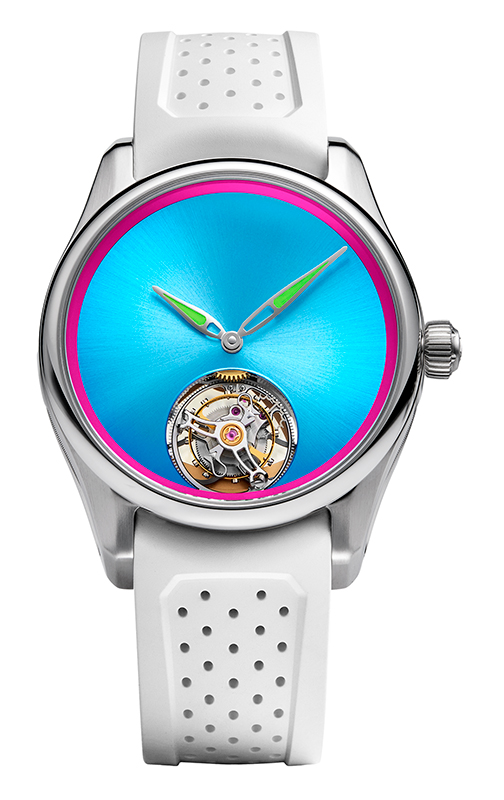
Moser’s contribution is consistent with its usual approach: a proprietary double hairspring for stability, an automatic caliber with three days of power, and a case rated to 12 ATM. The mechanics are standard for the brand, but the presentation is not. Like the city that inspired it, the Pioneer Tourbillon Miami, limited to 28 pieces, is not subtle and features a blue fumé dial, a vivid pink flange, and a flying tourbillon at six o’clock, plus a rubber strap built for heat and movement.
Since acquiring Tourneau, Bucherer has established a serious American footprint. The US is actively shaping global product development, and Miami reflects the less-formal way that watches are being worn in the US today. In that context, a watch like this feels less like an outlier and more like a direct response to market demands.





Comments