When Juliet said of Romeo that ‘a rose by any other name would smell as sweet’, she spoke a common truth. We identify and love flowers by and for their scent.
But you will struggle to find many scented flowers for sale in Britain. This is largely because in the 1950s, the UK’s home-grown flower business was flattened by the Dutch government. Huge investment in its domestic flower industry saw the first air-freighted blooms arrive in this country, followed by the ‘Flying Dutchman’ lorries in the 1980s. Today the average Briton spends £28 a year on flowers, up from £8 in 1984, yet 86 per cent of these are imported, most via the Netherlands from Ecuador, Kenya and Ethiopia. These flowers are bred to survive transport and are scent-free because the biological effort required to smell sweet shortens vase life.
Now a home-grown flower movement is fighting back. Next week at the Chelsea Flower Show, the first miniature UK flower farm will be installed in the Grand Pavilion by Flowers from the Farm, a network of more than 1,000 UK growers from Cornwall to the Isle of Skye. The question, though, is whether – in a world that’s seen UK food price inflation of 38.6 per cent in five years, fertilisers caught in the Strait of Hormuz and wild weather devastating harvests – the organisation’s quest for farmers to grow flowers instead of food is misplaced.
Not according to former president of the National Farmers’ Union, Minette Batters, who has a pick-your-own flower enterprise on her Wiltshire farm and cited British flower-growing on page one of her (December) Farm Profitability Review. With farmers questioning ‘viability, let alone profitability’, Batters believes a model enabling diversification offers a route to stability – and not just for farmers. As a whole, ‘the environmental horticulture sector brings in £38 billion to our GDP’, she says. ‘We should be growing so much more – flowers, bulbs, trees, shrubs. There’s huge value to our economy and to meeting the environmental requirements we’ve set down in legislation. We need to empower that to happen.’
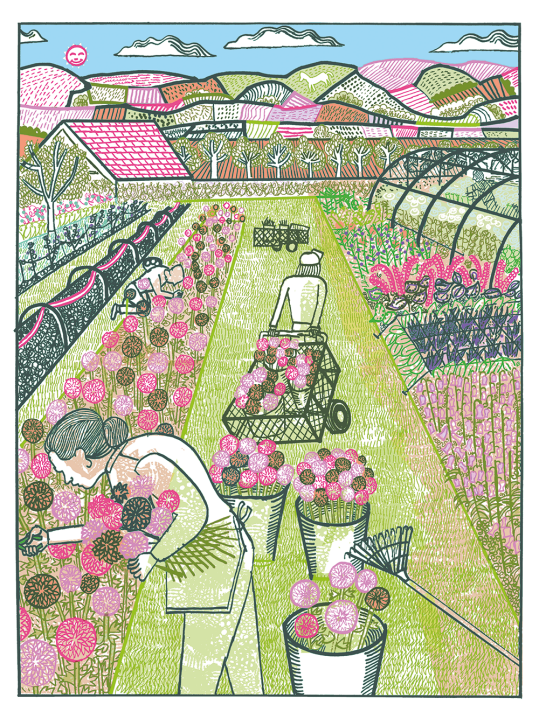
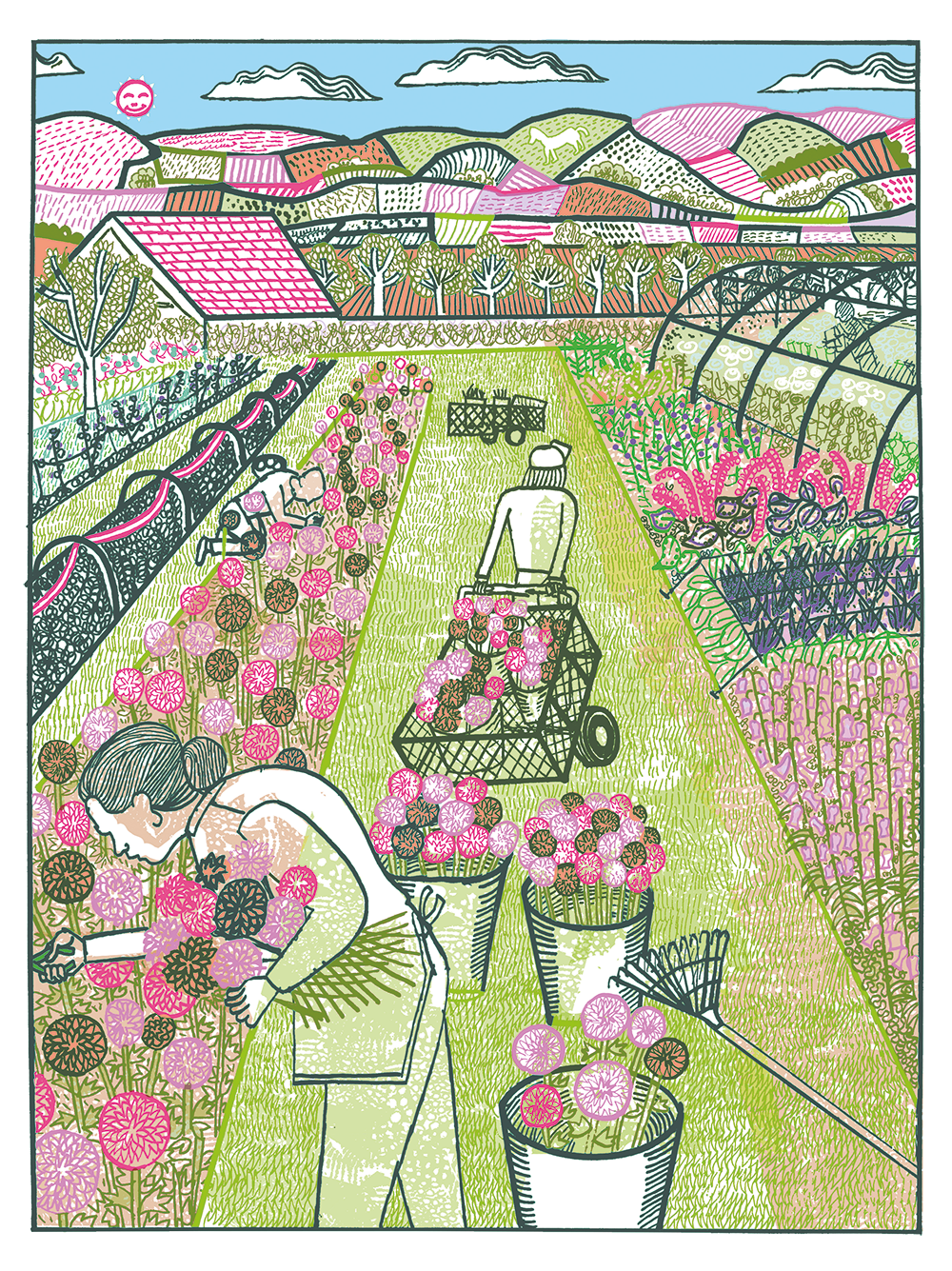
Georgie Newbery, one of the flower farmers behind the Chelsea installation, grows 50,000 stems per season on 3.5 acres in Somerset. From event florists offering only British blooms on their websites to Cissy Bullock’s Stem Union Hub poised to open a British-only stall at Covent Garden flower market, Newbery thinks the industry is at a tipping point: ‘The supply is the issue, not the demand.’
Integrating cut flowers into an existing farming system, says Newbery, is not only possible, but lucrative. Cut flowers are harvested by hand before the combine enters a field, so the harvest incompatibility that can bedevil grain intercropping (when flowers are grown within a crop) doesn’t arise. An in-field strip sown with annuals is worth ‘between 80p and £1 a stem’ and flowering shrubs for wholesale foliage fetch ‘pounds per stem’. Crops such as crab apples deliver all year: spring blossom for which ‘posh wedding florists in London will pay £3 to £4 a stem’, followed by autumn fruit and winter foliage ‘as natural Christmas decorations’. Newbery turns over £36,000 a hectare. The government’s Sustainable Farming Incentive payments for wildflower strips pay £592 to £798 per hectare. The gap speaks for itself.
A new generation is catching on. Ben Andrews, whose family have farmed 450 acres at Broadward Hall in Herefordshire for generations, has incorporated cutting sunflowers between his lettuce and cabbage crops, selling them at the farm gate and through the organic supplier Abel & Cole. The flowers are drilled and weeds hoed with his existing machinery, dramatically cutting labour costs, something that proved prohibitive with other blooms.
First-generation farmer Poppy Royds started Dusky Slug Flowers on a quarter of an acre in East Sussex this year, growing 20,000 stems across a mix of varieties. She is already supplying Natoora stores in London, as well as florists and private clients. She aims to double her numbers by next year. ‘There’s huge potential,’ says Royds. ‘People are desperate for wild beauty without the negative environmental impact.’
Royds’s point is that the case for growing British flowers, as opposed to importing the scent-free ones, is about more than money or air miles. A flower’s scent is not decorative. Its chemical cocktail of volatile organic compounds (VOCs) evolved over millions of years to guide pollinators. Flowers grown in the sterile, fertiliser-dependent soils of industrial glasshouses lack access to the diverse soil microbiome that enables this. Modern hybrids bred to hold their shape also lose the open-petal structures pollinators need to get at the nectar. In a country where insect numbers have fallen by 60 per cent in two decades, importing scentless flowers rather than growing perfumed ones is an own goal extending well beyond the bouquet.
‘There’s no reason we can’t be more like the French and have corridors of lavender within a field’
The Biodiversity Net Gain (BNG) market, launched in England in February 2024, rewards those who restore rather than degrade, following legislation requiring developers to offset habitat destruction by 10 per cent over 30 years. But Defra’s interpretation restricted this to non-food-producing land, effectively requiring farmers to close the gate and rewild for three decades. Batters considers the policy economically illiterate. ‘This binary approach of one or the other is in the wrong direction,’ she says. ‘We should be expanding BNG: bringing in flowers, food-producing crops, food-producing trees. This delivers on what is now a legislative requirement. It’s a win-win.’ Flower-growing is about integration not competition, she says: ‘There’s no reason why we can’t be more like the French and have corridors of lavender within a field.’
Meanwhile, the farm-to-plate food business Wildfarmed – whose standards require in-field flowers alongside grain production – has produced peer-reviewed research recording 79 per cent higher insect biomass in its fields than in conventionally farmed one. (It is working with the Food and Environment Agency to use this and other data to calculate a price for farmed-field BNG.)
Newbery is frustrated by one remaining obstacle: Defra’s failure to grant flower producers a Standard Industrial Classification code. Without it, their economic contribution cannot be properly counted or funded. ‘We just don’t exist as a sector,’ she laments.
That may be about to change. With Chelsea providing the showcase and private finance about to support farmed-field BNG, the scales – as Newbery puts it – are starting to tip. If she’s right, tourists driving through the countryside in the summer may be treated to views of more than golden wheat. And if they open their windows, they also may find themselves agreeing with the Bard.





Comments