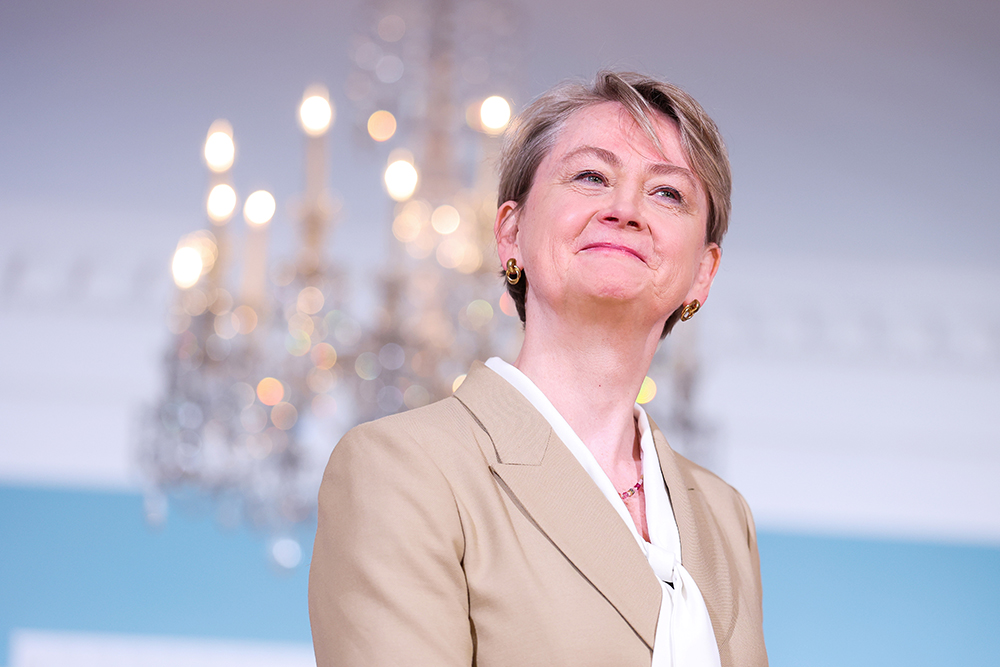
Bet on Yvette
Sir: Were Angela Rayner, Ed Miliband, Andy Burnham or Wes Streeting to succeed Sir Keir (‘After Starmer’, 2 May) as prime minister without first becoming a holder of one of the other three Great Offices of State, this would mark the first time in more than a century that a current or previous holder has not become prime minister in the middle of a parliament when the occasion arose.
On the basis of this very strong tradition, the real contenders are David Lammy, Shabana Mahmood, Yvette Cooper and Rachel Reeves. Of these, the only credible potential candidate appears to be Cooper, who could run as a ‘safe pair of hands’ to stop the frontrunners, should sufficient Labour MPs want her to do so. Cooper also has more experience of office than most, if not all, of her potential rivals. All this may have informed her opposition to Sir Keir’s Iran war initiatives as reported by Tim Shipman, as she might not have wanted to alienate Labour’s rank and file in the event of a contest, although a coronation would be preferable to prevent governmental paralysis. While Cooper looks like an outsider, there are very good reasons for the odds of her succeeding Sir Keir to shorten.
Paul T. Horgan
Newcastle, Co. Down
Lowest division
Sir: Richard Kelly’s letter (2 May) proposes constitutional fixes for Wales’s east-west divide that amount to busywork. The problem is not where lines are drawn but where economic life is lived. North-east Wales orients towards England because opportunity lies there, not in Cardiff.
Referendums or administrative reshuffles risk confusing political theatre with practical change. Voters are not drifting because governance is unclear but because it has yet to anchor prosperity. Until devolution generates a stronger economic pull within Wales itself – through jobs, connectivity and institutions – boundary changes will do little more than formalise the divide they are meant to solve.
Federico Forni
London SW15
Down memory lane
Sir: I was surprised not to see the name of Sir Gerald Barry, the former editor of the late-lamented News Chronicle, as the originator of the concept for the Festival of Britain (Arts, 2 May). I well remember going to the first public concert at which Yehudi Menuhin and his sister Hephzibah played sonatas to an enthusiastic audience. The design of the concert hall was a great talking point, particularly the boxes, which were compared to pulled-out drawers.
Phillip Sober
London W8
Voting rights and wrongs
Sir: Caroline Moorehead’s sobering review of books on Weimar Germany gives it credit for being ‘the first major nation to give women the vote’ (Books, 2 May). In Britain some women had been able to vote in local elections for years, and the 1918 Representation of the People Act, passed while the Great War was at its height and the Weimar Republic not even an embryo, gave the vote for parliamentary elections to all women over 30 and all men over 21. Assuming we counted as a great nation in those days, this is one first that our German friends should not deny us.
Nick Fishwick
Letchworth, Herts
Uncommon knowledge
Sir: Charles Moore’s reflections on the decline in children’s general knowledge reminded me, a teacher of nearly 40 years, of my early days as a young schoolmaster tasked with co-ordinating the annual prep-school Satips general knowledge quiz in our school (Notes, 2 May). Many children – mostly boys, actually – did better than the staff, and when the full results came in we marvelled at the extremely high scores attained by so many, again largely boys from selective and traditional schools. We used to wonder where on earth such young souls gathered their facts and figures.
Then came the internet, so widely predicted to spread knowledge and learning. It would be fascinating to see past and present questions for comparison, and the attainment graph over time. I’m sure Spectator readers somewhere could provide both and it would be illuminating for current pupils to sit a quiz from the past.
David Edwards
Norton sub Hamdon, Somerset
Fine line
Sir: Back in 1987, in The Closing of the American Mind, Allan Bloom made two observations with which, given his re-reading of the 1996 Junior Puffin Quiz Book, Charles Moore would probably agree. One was that ours is the first generation to teach their children less than they themselves know, and another was that the young were also being encouraged to admire things that we despise – like celebrity. As an author who sometimes felt she had met more children who knew her favourite food was toasted cheese than had read her books, I thought Bloom was dead right.
Anne Fine
Newgate, Barnard Castle
Mr Nice Guy is no more
Sir: Rod Liddle is correct about the myth of the special relationship (‘The “special relationship” was always a delusion’, 2 May). During my years in the 1970s and 1980s as a soldier in Germany everything we did was predicated upon the Americans riding to our rescue. We planned all our major exercises around the hope of holding the Russians at bay until the Americans flew in reinforcements. These birds have now come home to roost. It’s time we in Europe grew up: this is no longer 1945.
Michael Wingert
High Wycombe, Buckinghamshire
Horse power
Sir: Charlie Brooks (The Turf, 2 May) knocks Newmarket High Street. But the town itself got a warm report by your contributor Robin Ashenden on 11 December 2023, who had fond memories of growing up there. A profile of Newmarket in The Spectator by William Cook in 2019 glowed with admiration for its ‘special’ quality. Six mornings a week, scores of exercising horses surge up Warren Hill; it is one of England’s most beautiful free shows. In the National Horse Racing Museum behind the high street, there’s a letter on display from Fred Astaire to his trainer in Newmarket, urging him to get ‘a fucking winner’. It’s worth visiting to see that alone.
Brian Emsley
Kennett, Cambs
Pole apart
Sir: The enticing review of the reopened Simpson’s in the Strand, (Food, 2 May) reminded me of an incident in the film, Scott of the Antarctic, put in for light relief against the unimaginable conditions, when Oates rouses Bowers, gasping: ‘Birdie, I’ve had a horrible dream. I dreamed that Simpson’s burnt down.’ Regrettably, now I reside in the North-West Frontier Province and am disabled, Simpson’s is as inaccessible to me as it was for ‘poor old Soldier’.
R.H.W. Cooper
Grasmere, Cumbria
We have received a consignment of Gentleman’s Relish, a pot of which will be sent to the writer of the best letter of that week’s issue. This week’s winner is R.H.W. Cooper.




Comments