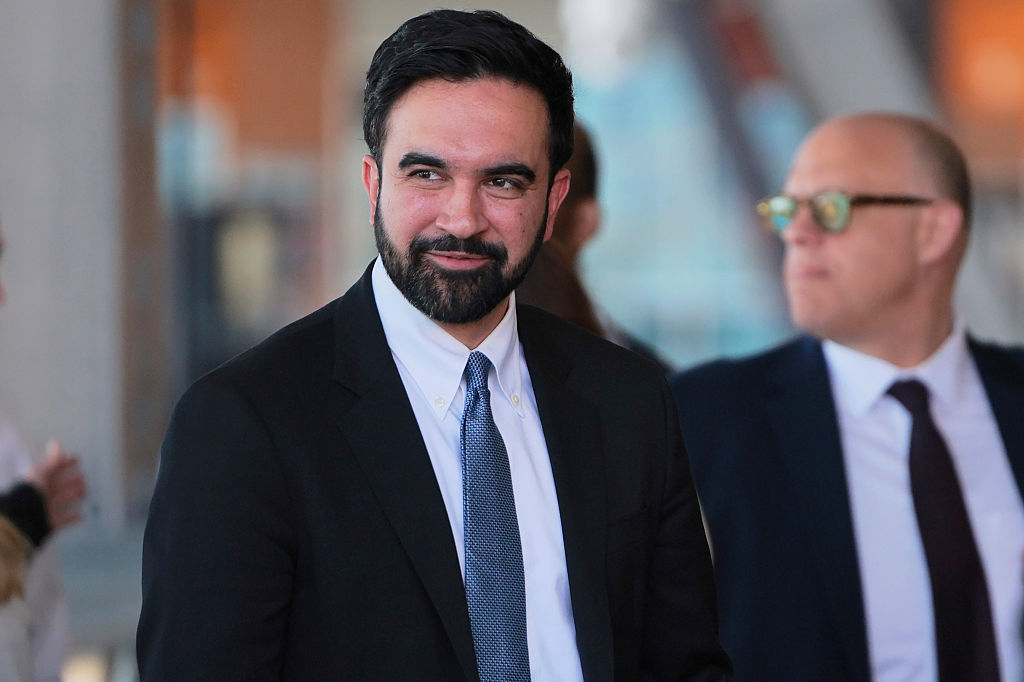
Mayor Zohran Mamdani of New York has faced what others might consider awkward moments in office, as when two Islamists, inspired by ISIS, tried to immolate anti-Muslim protesters outside Gracie Mansion. He passed it off with aplomb by saying the two bomb-carrying individuals were “suspected of coming here to commit an act of terrorism.” In a later statement he acknowledged that the two men had proclaimed “their allegiance to ISIS.”
That counts for boldness on Mamdani’s part. He is considerably more comfortable denouncing Israel, defending the “globalize the intifada” slogan and lamenting anti-Muslim bigotry, than he is in acknowledging New York’s history of terror attacks by Islamists.
It’s therefore possible that when he meets with Charles III and Queen Camilla to lay a wreath at the ceremony for victims of the 9/11 atrocity, the Mayor might spare a few compassionate thoughts for the 19 men who gave their lives so that others might die. But if so, he will be savvy enough to admire them in camera. We New Yorkers are still a bit sore on the subject, and Mohamed Atta and his buddies are not, we think, on the right side of history.
But perhaps Zohran catches our mood. Asked by a reporter about his impending meeting with King Charles, he emphasized that he would be attending the public wreath-laying “alongside a number of other elected officials” to “pay tribute to the more than 3,000 people who were killed in the horrific terror attacks of September 11, and that will be the extent of my meeting with the King.”
So is he meeting the King or just standing somewhere in the King’s proximity? Does seeing the King across the way count? That’s one way to dampen any awkwardness.
The underlying awkwardness has a lot to do with Zohran’s father, Mahmood Mamdani, who has served as the Herbert Lehman professor of Government and a professor of anthropology, political science, and African studies at Columbia University. Mahmood is a prolific scholar who has published more than a dozen books and numerous essays. I will risk an overly terse summary of his work, nearly all of which circles a single theme: everything bad that has happened in modern Africa is the result of outsiders intervening. And high up on the list of these nefarious outsiders is Britain.
The gravamen of this indictment was the instillation of Idi Amin, who seized power in Uganda in 1971 and the following year expelled most of the South Asian Indians in the country. The British had originally recruited 32,000 Indians in the Punjab in 1895-1896 to help build the Uganda Railway. Some stayed and prospered and other Indian immigrants followed.
Mahmood Mamdani was born in Bombay in 1946 but raised by his Muslim family mostly in Uganda. Idi Amin’s expulsion of the Indians from Uganda when he was twenty-six was a blow that has shaped his life ever since. He recounts his experience in his 2025 memoir Slow Poison: Idi Amin, Yoweri Museveni, and the Making of the Ugandan State. The book is worth reading for several reasons, not least of which is the light it sheds on the upbringing of Mahmood’s son Zohran, who seems to have fully absorbed his father’s disdain for Britain and Israel.
Those are the nations that Mahmood chiefly blames for Amin seizing power. The British were unhappy with Milton Obate, who had overthrown his predecessor in 1966 and established a one-party dictatorship, but whose term had been a chaotic lunge into socialism and tribal conflict. Idi Amin, who had served in the British colonial army as an assistant cook in 1946 and seen some action in the British attempt to put down the Mau-Mau rebellion in Kenya in the 1950s and trained in Israel as a paratrooper. Obate named him chief of the army and air force. The British and the Americans mistook Amin as a potential stabilizing force in country that was having a hard time finding its footing in the post-colonial era.
They could not have been more mistaken. Amin emerged as a bizarre and bloodthirsty tyrant who surely deserves his place in post-colonial African history in the highly competitive ranking of monstrous despots. Mahmood, however, does not wish to Amin to be written down as an African phenomenon. In a recent interview on Al Jazeera, Mahmood explains that:
Amin was a state terrorist in the service of the British. When he came to power in Uganda Amin’s worst killings were done in the first year after his coup when his advisors were British and Israelis. And the British and the Israelis had slight disagreement on how they should go about consolidating the coup. And the Israelis were far more compelling in their argument that really you have to kill not just Obate but his entire cohort, all those who comprise his commanders, his military elite, because if you don’t, the reckoning will be around the corner. The worst killings that Amin did he did under the British and the Israelis.
It is no wonder that Mahmood has spent his seeking to fix the blame. How could things have gone so wrong?
Maybe it was British-Israeli Machiavellian thuggery that Mahmood now conjures for Al Jazeera listeners. But in his books Mahmood tends to argue a more devious route to Africa’s woes. In a nutshell: “indirect rule.” This was the British colonial policy of recognizing local indigenous leaders and entrusting them with the responsibility of keeping order, directing public works and raising (modest) taxes. But as Mahmood sees it, indirect rule promoted ethnic division and rivalry and undermined the natural evolution of social unity. Mahmood’s fullest exposition of this thesis is his 2012 book, Define and Rule: Native as Political identity. But the idea is the throughline for his oeuvre, as for instance his 1996 book, Citizen and Subject: Contemporary Africa and the Legacy of Late Colonialism.
I will hand it to Mahmood that “late colonialism” is an ingenious turn of phrase. It pays homage to the Marxist invective of “late capitalism” and mashes it up with rhetoric of “post-colonial theory.” Plainly this man deserved his seat of honor at Columbia University where finding new ways to excoriate the oppressors is academic gold.
Through Mahmood’s eyes, whenever bad things have happened in Africa, Britain is always somehow to blame. When the civil war among native peoples in the Darfur region of Sudan expanded into widespread slaughter by the country’s Arab government, Mahmood hastened to explain that the deep cause was British colonialism, which had “artificially tribalized” the population. This is one of Mahmood’s theses in his 2010 book, Saviors and Survivors: Darfur, Politics, and the War on Terror. It is probably worth noting that Britain granted independence to Sudan in January 1956, and the hostilities in Darfur broke out 47 years later, in February 2003. Before they left, the British planted those seeds of tribal warfare deep, and nearly half a century later they bore fruit.
Why exactly did perfidious Albion do this to Africa? I have recently been studying Mahmood’s works but have not yet deciphered this. Inducing tribal conflict was, for a time a form of divide and conquer that allowed the British to maintain racial despotism. But apparently when they concluded that Empire wasn’t worth the effort, they left the genie of racial despotism behind. Otherwise, Africa would be a thriving and happy place, where the intermingling of Indians from the subcontinent would have simply enhanced the joyous diversity.
He was discouraged, however, by the 1994 Rwandan genocide. His 2001 book, When Victims Become Killers: Colonialism, Nativism, and the Genocide in Rwanda required some trimming of his concept of the inherent benevolence of African peoples. But he succeeded in tracing this disaster too to the legacy of colonialism.
I would not want to portray Mahmood’s antipathy as entirely a matter of his views of European colonialism. He plainly has an abundance of enmity for Israel and the United States as well, whose “colonialism” is mostly metaphoric. And he devoted one whole book, 2004’s Good Muslim, Bad Muslim: America, the Cold War, and the Roots of Terror, to denouncing the American “War on Terrorism,” with nary a word on the British.
What, if anything does this have to do with Zohran’s almost possible meeting with King Charles? Perhaps nothing at all. I would wager that Zohran, growing up in the house Mahmood, has not only a keen understanding of his father’s views but a deep commitment to most of them. We know this from Zohran’s own open disdain for Israel and his denunciations of what he takes as colonialism. Are his grievances against England as raw as his father’s? Hard to say, but as the New York Times points out, “The king was born in Buckingham Palace, and he is the leader of a monarchy that was at one point the world’s largest colonial power.” And Zohran Mamdani might be described as America’s young prince of self-styled “Resistance.” The two would mix as well as vintage wine and Red Bull.
Mahmood speaking on Democracy Now of his son’s electoral victory observed, “Being a minority you are never fully part of society.” Zohran as the happy outsider installed in one of the most inside jobs in the nation may enjoy snubbing the king of England – or vice versa.




Comments