
Copenhagen by Michael Frayn is a problem play. It debuted at the National in 1998 and ran for two years in the West End before transferring to Broadway. Since then, no UK producer has mounted a revival. Something must alarm investors.
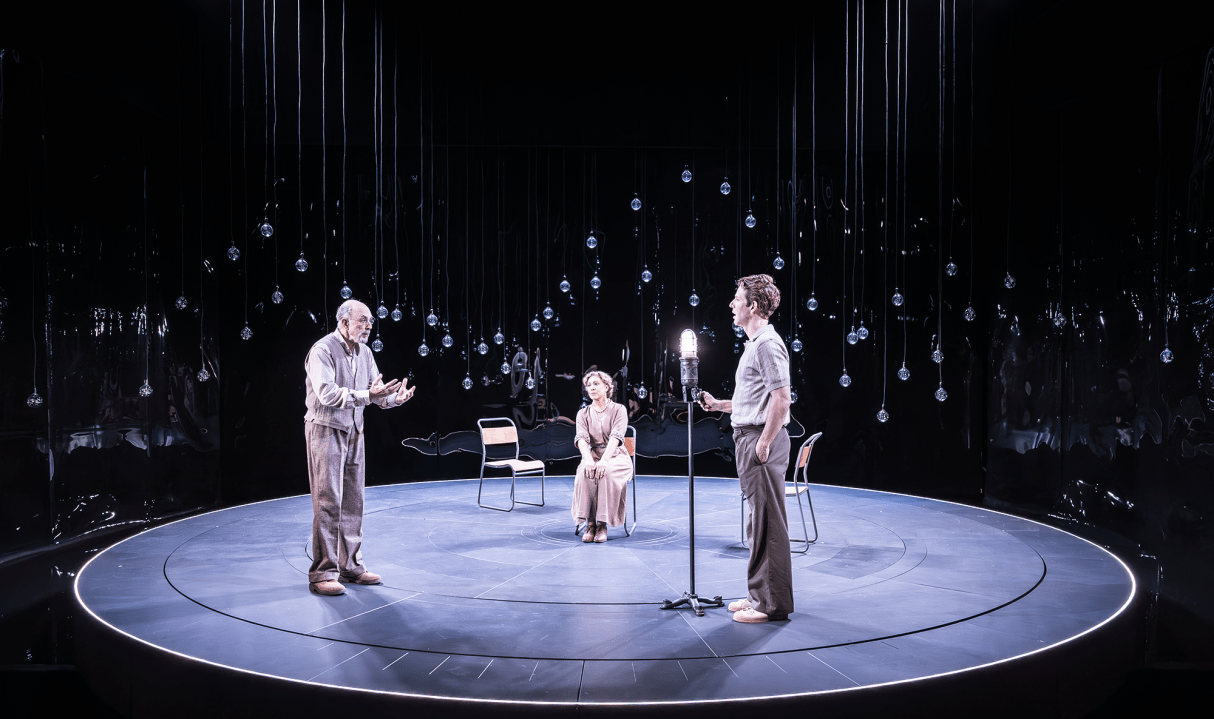
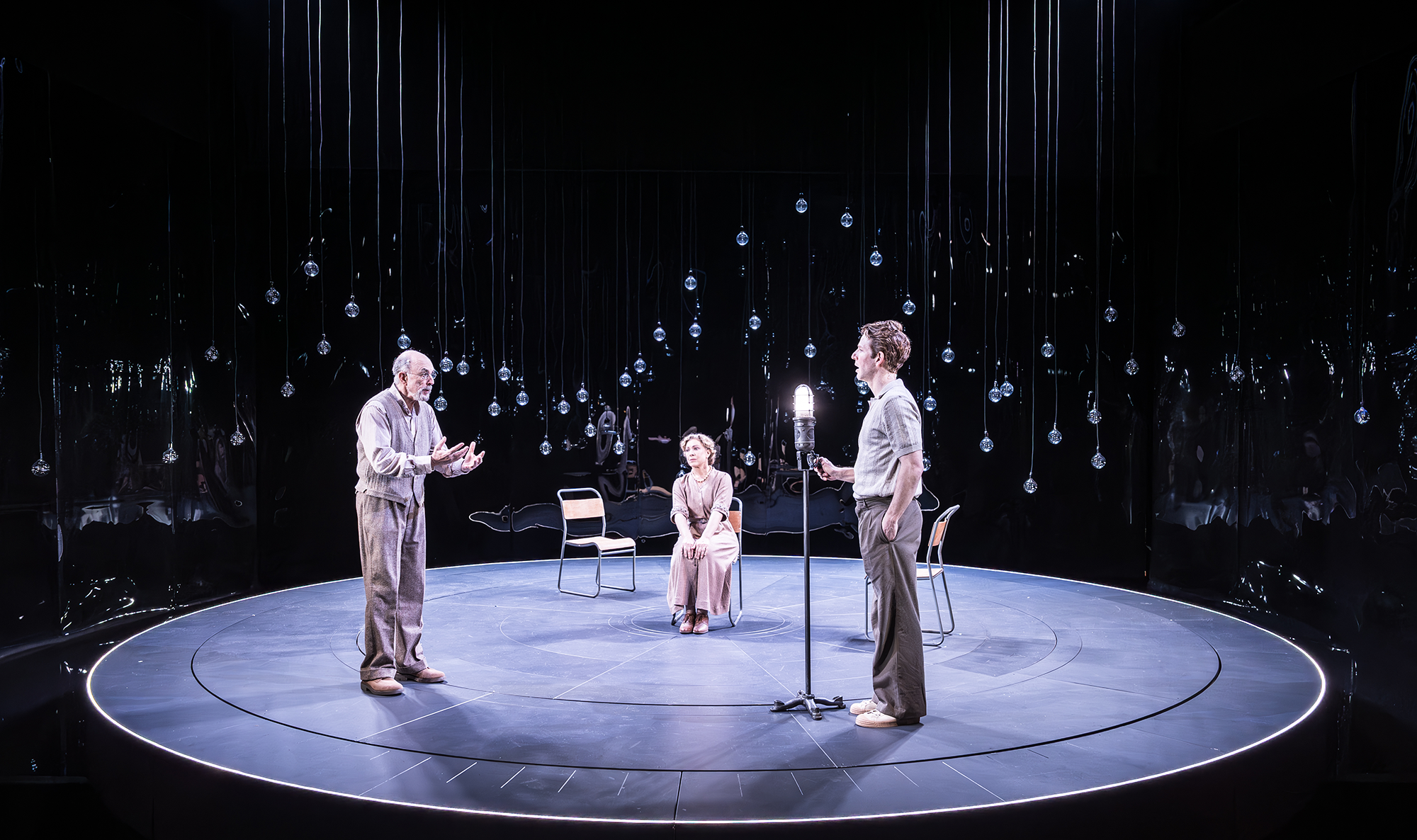
It’s a very chatty show. Three actors with three wooden chairs appear on a plain stage reciting dialogue about a meeting in Denmark in 1941 between the physicist Niels Bohr, his missus, and a family friend, Werner Heisenberg. The discussion focuses on the main developments in atomic science during the 20th century. Mrs Bohr, played by Alex Kingston, is there to offer a female angle on the ruminations of the two mega-nerds. And even before they begin, the characters reveal that they are dead and that their speeches are being conveyed to us from the afterlife. So they have nothing to win or lose from what unfolds on stage. Wow. Only a brave or a crazy dramatist would design an opening like that.

For the first 30 minutes, Mr and Mrs Bohr swap information with Heisenberg that all three of them know already but which the audience must absorb in order to understand everything else. In playwriting, this is a common snag and the author usually solves it by adding a newcomer to the story. That’s why lots of plays start with the arrival of an outsider. Not here.
As the chatter continues, we learn a few bits and bobs about the geeks. Bohr was such an obsessive chatterbox that he once made a colleague sick by rabbiting away at him all night. This aspect of his character is successfully captured by Richard Schiff who emphasises Bohr’s passionate nature by smashing his left hand against the palm of his right hand with a karate chop. Whack! It’s not great acting but it stirs the drowsy from their slumbers. Mrs Bohr contributes to the seminar by shrieking ‘Poor cat!’ when Schrödinger’s allegory about a dying cat is mentioned. Damien Molony plays Heisenberg with an Irish accent which adds a layer of romantic whimsy to his inert but verbose character.
The play’s supporters claim that it presents the intricacies of particle physics in terms that laymen can grasp. Here’s an example. A chain reaction is likened to an avalanche: first a trickle then a cascade. Well, so what? Every scientific theory can be translated into child-like images and basic language so that experts from different fields are able to communicate with each other. Our mental picture of an atom as a cluster of neutrons and protons being circled by a whizzing electron is itself a simplified caricature.
Director Michael Longhurst does his best to make the chitchat watchable. The actors perform on a circular platform surrounded by a moat of water with things floating in it. Clouds of dry ice are released intermittently and they steal across the brackish pond towards the occupants of Row A. This isn’t the only excitement. The stage has a hidden gearing mechanism that allows the playing area to rotate like a microwave turntable. Round and round it goes, sometimes faster, sometimes slower. Those who enjoy watching their jacket potatoes being heated up will appreciate this aspect of the production.
The story focuses on Bohr’s suspicion that Heisenberg passed nuclear secrets to the Nazis. And here lies the play’s essential fault. We in the audience know that Hitler failed to acquire the bomb and so the anxieties suffered by the characters are not shared by us. The stakes are non-existent. Nothing matters. And even if it did, the characters are dead. So why would a playgoer choose to sit through this 175-minute ordeal? It’s like a half-marathon. You do it to signal your membership of the elite and to enjoy a nanosecond of pleasure when the torture ends.
Rowling In It is a play about a play about J.K. Rowling. In 2024, Laura Kay Bailey was cast as the Harry Potter author in an Edinburgh fringe show written by Joshua Kaplan. The play, named Terf, took a sceptical look at Rowling’s support of women who want female-only changing rooms. Bailey may have disappointed Kaplan by portraying Rowling as a witty, elegant and forceful character who seemed a lot more rational and attractive than her critics.
In this show, she delivers a fantastic array of comic impersonations. And it turns out that she’s not a Brit. She’s from Texas. The lazy and disorganised Kaplan is presented as an attention-seeking pseud who annoyed the cast by constantly tinkering with the script. And he refused to start rehearsals until mid-afternoon: ‘I do my best work at night.’ Anyone with experience of mounting a show at Edinburgh will love this 60-minute monologue. Bailey wisely avoids making any provocative utterances about the trans debate. But it’s not hard to guess which side she’s on.






Comments