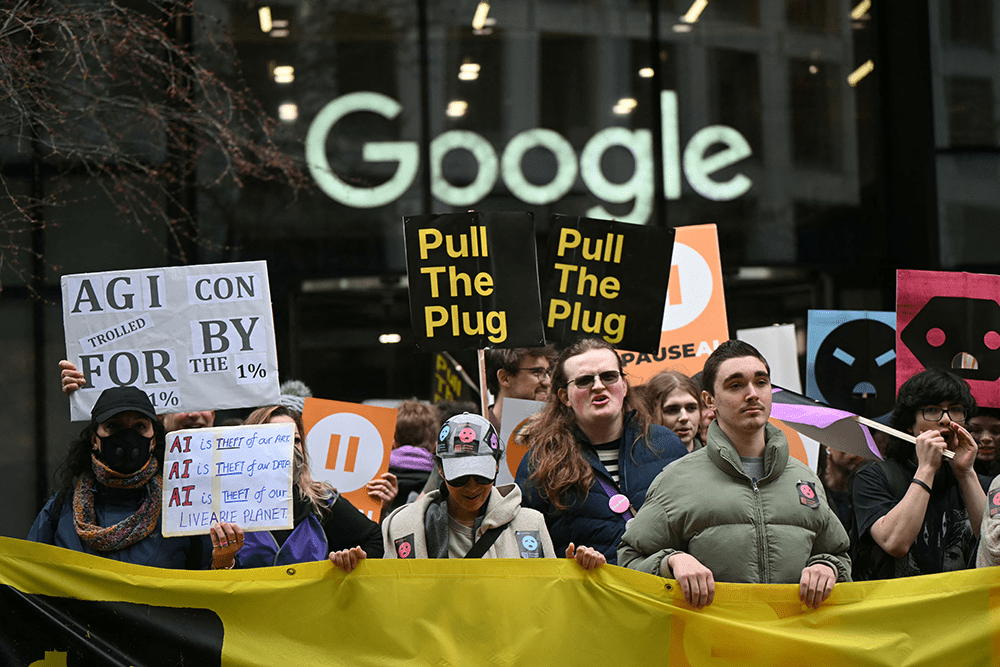


Automation is about to take over the world, apparently. But the fightback has begun. On a cold, blowy day a few weeks ago, I joined a stop-the-bots demonstration that marched through the Knowledge Quarter of King’s Cross where Facebook and Google have their headquarters. A group of 100 activists gathered on Pentonville Road for a warm-up rally addressed by a charismatic young woman in a leather skirt. ‘Can we trust the tech bros with our data?’ she cried into the mic. ‘No! Do we need regulation now? Yes we do!’ She congratulated us for ‘making history by joining the largest anti-robot march ever’. And she promised us a hot meal afterwards. ‘Who doesn’t like free food? No one. Am I right?’ The crowd didn’t reply. ‘I said,’ she repeated, ‘who doesn’t like free food?’ A few reluctant voices answered: ‘No one!’
The march began. We walked into a bus lane, deliberately, and sauntered down the hill towards King’s Cross. Bringing up the rear was a cycle-rickshaw carrying the loud-speakers. We immediately blocked a number 73 bus that slowed to a crawl behind us. Near Euston Road, we caused a larger snarl-up and halted three lanes of traffic. An ambulance, with lights flashing and sirens blaring, spent a few minutes trapped in our bottleneck but no one cared.
Our leader ordered us to turn left into York Way and we spread out across the northbound lane, blocking more vehicles. She yelled out a rhyming slogan: ‘It’s not too late to regulate.’ After several repeats, she told us to help: ‘Guys? When I say, “It’s not too late”, you say, “To regulate”, OK?’ We got the message. ‘It’s not too late,’ she prompted. ‘To regulate’, we shouted back. Repeating this slogan, we plodded along the prescribed route. We’d been turned into robots by the leader of the anti-robot movement.
Human ingenuity will always surpass the achievements of robots – even in the field of malice
Our arrival at Facebook caused a flurry of excitement among the security staff. Six goons in cheap red uniforms formed a line across the entrance, as if daring us to storm the building. The head of security, a busy little chap in civilian clothes, darted here and there talking on his phone, taking photographs, marshalling his men and peering at us with cold inscrutable eyes. He was having the time of his life.
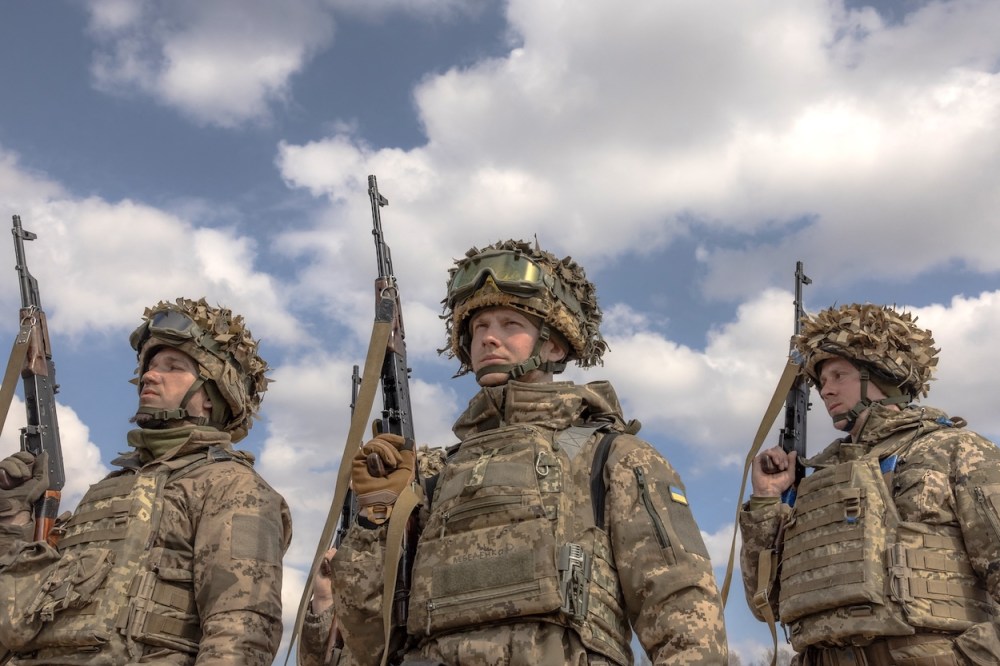
The speeches began. The first activist urged us to pass ‘binding new regulations’ for robots. But he didn’t explain how the laws would be enforced. A pale student, aged about 19, told us that the Pentagon is building winged robots ‘that can kill without human interference’. He sounded thrilled.
A senior lecturer in digital economy spoke about plummeting attention spans and our inability to concentrate on anything for more than five seconds. Her talk was so boring that everyone began chatting among themselves. The march continued. As we trudged through a parade of shops, the 19-year-old began a chant: ‘If they build Big AI, every one of us will die.’ This refrain was echoed enthusiastically by the marchers.
Outside Google DeepMind, we were met by a new squad of henchmen, who ordered us to retreat from the entrance even though we were in a public area. One of them singled me out. ‘Move,’ he said. ‘Where to?’ I asked. He pointed to a spot six inches behind me and I meekly complied. Then, more speeches. An energy guru predicted that AI would exhaust the Earth’s resources. ‘Automation will lead to more fossil fuels and more nuclear power,’ he said. Whistles and boos greeted the words ‘fossil fuels’ and ‘nuclear power’. I felt for a moment as if I’d time-travelled back to the Stone Age and found myself among a tribe of cavemen howling at an eclipse.
To younger activists, the threat of AI sounds terrifying but anyone who recalls the 1970s has heard this story before. A miraculous breakthrough had just been unveiled – the silicon chip – which promised to eradicate most jobs within a few years. Experts told us that by 1999 virtually everyone in Britain would be idle and machines would organise our lives.
Well, it turns out that new technology creates more work than it destroys. Computers can’t even perform a simple task like delivering a weather forecast on TV because viewers prefer to see a friendly familiar face. No robot can supplant the unfathomable complexity of a human being. And our wish to interact with creatures who look and act like us is as strong as our yearning for sleep or food. Even security guards are unlikely to be replaced by robocops – as my brush with the henchman outside Google showed. Only a human being could be so petty as to force a stranger to move six inches away for the sake of ‘security’.
In that vindictive little gesture, I saw a glimmer of hope. Human ingenuity will always surpass the achievements of robots – even in the field of malice. Perhaps especially in the field of malice. The march ended inside a church hall where plates of steamed rice were served to the tired, hungry, miserable activists. I was surprised they bothered eating. Most of them can’t wait to die.





Comments