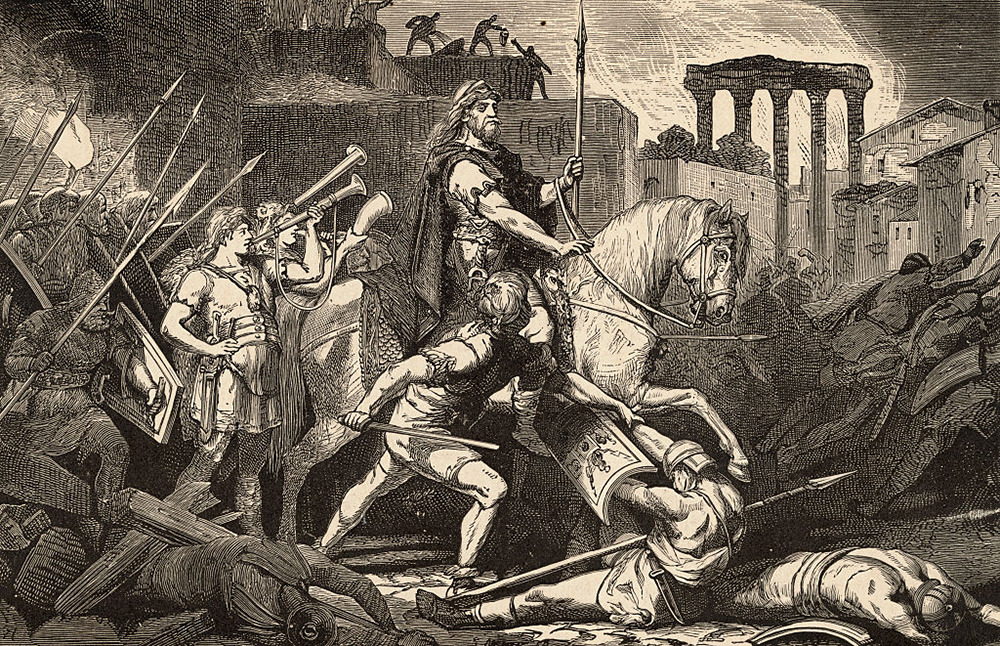


Americans never tire of asking themselves whether their country is turning into Rome. A Latin motto on the Great Seal of the United States proclaims a novus ordo seclorum – a “new order of ages.” But in the poem from which that phrase is adapted, Virgil’s fourth eclogue, the words mean a quite exact replay of past events: there will be, for example, another voyage of the Argo and another Trojan War. Our new order might likewise repeat the history of Rome.
One philosopher who gave a great deal of thought to new orders and Roman history as a template was Niccolò Machiavelli, particularly in his Discourses on the First Ten Books of Titus Livy. An early chapter in that work leaves a reader in little doubt about the parallels Machiavelli would have perceived between America and Rome. The Florentine was writing only some 20 or 25 years after the discovery of the New World and more than two and a half centuries before the United States would be founded. But consider how he characterizes Rome in contrast to two other model republics, ancient Sparta and (relatively) modern Venice.

Republics, including Machiavelli’s own Florence, had a reputation for instability and Rome was no exception. Its history, not least as told by Titus Livy, is a saga of endless conflicts between plebeians and patricians, as well as endless wars with foreign powers. Philosophers from Aristotle onward tried to devise some means, some constitutional arrangement, that could prevent each type of republic – democracy or aristocracy – from degenerating into something worse: mob rule, oligarchy or tyranny. Rome, of course, experienced something of all those corrupt forms of government. Machiavelli asked himself whether that had to happen.
The examples of Sparta and Venice, which survived for centuries without undergoing the kinds of upheavals that befell Rome, seemed to suggest a formula for stability. It was to be found in the right trade and immigration policies. Sparta was effectively isolationist, shunning trade – and all luxury, even the use of metal money – refusing to extend citizenship to foreigners, and, not incidentally, keeping out of wars and entangling alliances as much as possible. “The inhabitants of Sparta were few in number, and therefore could be governed by a few,” Machiavelli writes (in Christian Detmold’s 1882 translation), for “by not permitting strangers to establish themselves in the republic, they had neither opportunity of becoming corrupt, nor of increasing their population to such a degree that the burden of government became difficult to the few who were charged with it.”
The Venetians, on the other hand, were a seafaring people who lived by trade, and their way of life was anything but Spartan. Yet they too kept their citizenship rolls closed and, unlike the Romans, they did not enlist either the lower-class masses or foreigners in their army. The Venetians could avoid doing so because they were a naval power that didn’t engage in land wars.
There are Americans today, especially on the “New Right,” who wish our country would adopt Spartan policies. Others, notably some libertarians, would be happy to see America become Venice, a maritime power protected by its oceans, engaging in long-distance trade while forsaking military commitments on land. Americans, however, tend to be more generous than the Venetians were in offering citizenship to foreigners – and for Machiavelli, that makes all the difference.
Sparta and Venice were exceptionally steady and long-lived republics, but they were not flexible. They were ruined, Machiavelli argues, as soon as circumstances forced them to change their foreign policy, since neither city-state could keep large armies in the field for very long, not without incurring regime change – as we would now say – at home. Whether they lost wars to more powerful opponents or filled the ranks of the armies they needed with the poor, slaves or newcomers, these states were doomed once they were forced to expand.
Rome used the plebeians to fight its never-ending wars, employed foreign auxiliaries as well and kept expanding citizenship to encompass more and more outsiders. For Machiavelli, it made no difference whether Rome’s wars were offensive or defensive, whether they were waged in a spirit of acquisition or out of fear of what some rival might acquire. The effect was the same. Rome expanded, and its expansion created further divisions within the city – over the distribution of spoils and compensation of veterans, for example, as well as the differences resulting from a heterogeneous population. Politicians sought to use one set of factions or another to win power – and to keep it, for fear of being prosecuted by their rivals. Roman politics was tumultuous, marked by bitter hatreds and outbursts of violence. But the city was a superpower.
Those who want to steer America away from the course Rome followed have their work cut out for them
“If a republic be small, it is destroyed by a foreign force; if it be large, it is ruined by an internal imperfection,” Montesquieu wrote in The Spirit of the Laws. The framers of the Constitution designed a large republic and expected it to grow much larger. They didn’t want it to end up like Rome, and despite modern misreadings of Federalist No. 10, they never viewed faction as anything other than an evil, albeit an evil that might supply its own cure, as James Madison hoped. They abhorred political parties even as they built them – they couldn’t escape the internal logic inherent to an expansionist republic. Today even the critics of expansion – the “Spartans” who denounce consumerism and call for tighter, more virtuous communities; the “Venetians” who want trade in place of war; and all the opponents of mass immigration – have the effect of widening political conflict, all the more so because they are against what their countrymen are inclined to take for granted. They make politics more interesting and more intense, not more pacific.
Yet all this just means those who want to steer America away from the course Rome followed into damnation have their work cut out for them. They can’t be discouraged when a large republic acts like a large republic. Virgil’s fourth eclogue promises more than a repetition of the ages – it promises a departure, too. Medieval Christians read it as a prophecy of Christ’s coming. America’s novus ordo seclorum doesn’t bear comparison to that, but if we’re starting a cycle anew, this time we know what happened before, and we can change a few things.





Comments