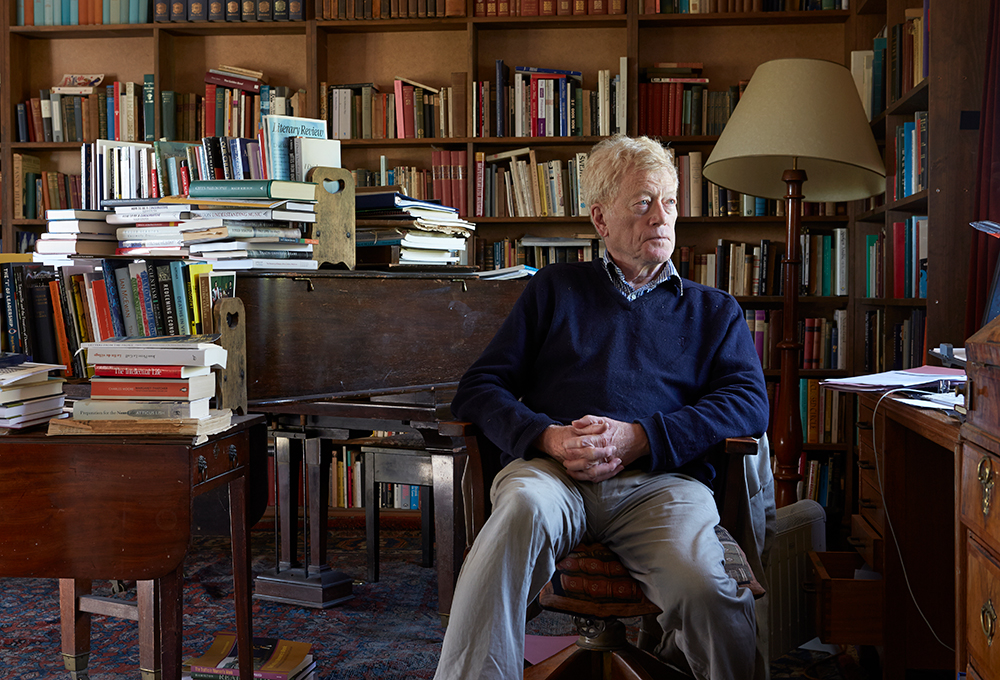
Sir Roger Scruton is remembered by most people as a conservative philosopher. Softly spoken and thoughtful in conversation, he was brave and unconventional in his views. Few things are as unconventional as being a convinced and articulate conservative. It cost him advancement in the academic world. But he was admired, liked and even loved by many. And today his work continues to be influential.
But there was a part of Scruton’s life that is not well-known. It was clandestine. This secret life is currently being commemorated and honoured in an exhibition in Brno, the historic and rather beautiful second city of the Czech Republic. It is a two-and-a-half-hour train journey from Prague unless you are willing to face a direct flight on Ryanair.
Few things are as unconventional as being a convinced and articulate conservative
It all started in 1978 when a Czechoslovak academic called Julius Tomin wrote a letter to four universities asking for lecturers to visit Prague and give talks. Today this request would be unremarkable, but Prague at that time was part of the eastern bloc of communist countries dominated by the Soviet Union. Only ten years before, Soviet tanks had rolled into Prague and crushed an attempt to make the country independent and more democratic. The invitation was not to give talks at a university where the dons kowtowed to the Communist party. It was to give talks at a private home and would be attended by known dissidents. The Czecho-slovak secret service, the StB, would be watching and an informer might well be present. Anyone who came to give a talk might be harassed or arrested. Oxford was the only university to respond.
Scruton was not involved at the beginning. When he was first asked to join the initiative, he said he was too busy. But then he gave one talk and immediately became convinced that it was important work. He committed himself to it.
He came to believe the talks should be done in another way. The ones in Prague were open and liable to be broken up by the secret police. The dissidents present were sometimes arrested and held in prison. Scruton went to Brno and worked there with people who agreed that the talks should be held in secret. He also wanted to reach people who were not outright dissidents but who had normal occupations or were students.
To keep the talks secret, the academics and others who went to Brno had to learn some of the tradecraft of spies. They were instructed to talk to their contacts in parks where the secret service could not have listening devices. They wrote the names of their contacts in code. They avoided taking photographs which might identify their contacts if they were arrested. Computer disks were hidden in luggage and so on. The talks were on subjects like philosophy or the theatre. It is a reflection on just how controlling the communist regimes of eastern Europe were that even a talk on Aristotle or Socrates could be considered subversive. The Communist party wanted to control everything.

Scruton’s own visits to Brno were stopped after an incident. He was talking to two contacts. They were in a park, of course. Suddenly plain-clothes secret agents appeared. Scruton was arrested and told he must leave the country within three hours. His passport and belongings were at the home where he had been staying, so the police drove him there. Meanwhile, Scruton’s two companions raced ahead to the flat (to the extent that it was possible to race in a 26 horsepower East German Trabant). They had a few minutes to burn or flush down the loo papers that might be incriminating. Afterwards Scruton was driven by his friends – still in the Trabant – to the border, followed by three police cars. He was made to trudge across a countryside border and banned from visiting Czechoslovakia again.
But he went on helping to arrange for others to make visits. Meanwhile, the operations of this maverick organisation, called the Jan Hus Educational Foundation, after a 14th-century Czech national hero, expanded. Visits of a similar kind were made to other countries including Poland, Hungary and Romania.
The work included taking across samizdat – publications that were banned in these countries. The works of George Orwell – Animal Farm and Nineteen Eighty-Four – were among those that were highly valued in eastern Europe. A man in Romania once told me that when he read a samizdat copy of Nineteen Eighty-Four, it was a revelation. He said it was as if he were reading about the very society in which he lived. The academics and others who made the trips were sometimes followed or arrested.
What did the talks mean to those who attended? In Brno, I asked one of those who had been there. He said that the most common response given to this question by participants had been that it gave them ‘dignity’. That might seem strange. Why should listening to a talk and taking part in a question-and-answer session provide dignity?
He tried to explain, saying that living in communist Czechoslovakia was ‘humiliating’. The moment you left your home, you were constrained in everything you said and did. You must not step out of line. You lived with your own hypocrisy – saying things you did not believe. Even within the home: if you had children, you had to avoid saying anything against the regime lest it was repeated by them at school. So the talks, given by people who were free to say whatever they thought, were liberating.
Scruton was a prime mover in the whole enterprise but many others – from the left as well as the right – gave varying amounts of their time and support. The trustees and patrons read like a Who’s Who of the notable figures of the time. They included Tom Stoppard, Yehudi Menuhin, Lady Antonia Fraser, Sir Adrian Cadbury and Iris Murdoch.
He was a defender of the best of western civilisation – its architecture, democracy and open debate
In 1986, they mounted a public campaign to help dissidents in Prague called ‘the Jazz Section’ – musicians who were deviating from the musical style and content approved by the communist regime. Some of them had been arrested. In the course of campaigning to help them, the Jan Hus Educational Foundation got the support of various well-known musicians, including Sir Paul McCartney, Sir Elton John and Sir Simon Rattle.
These eastern European talks reached many people who became significant figures after the fall of communism, including Vaclav Havel, who became president of Czechoslovakia, and Petr Fiala who became prime minister of the Czech Republic. One testimony to how much it meant to people is that Scruton received honours from leaders in Poland, Czechoslovakia and Hungary. In Budapest, there are even cafés that are named after him.
The Brno exhibition, which runs until 19 April, includes letters such as one written by Scruton in 1986 to Lord Waldegrave, a junior minister at the time. He explains that he is sending it to Waldegrave’s private address in Kensington because ‘we do not want it to get into any other hands than yours’. Even within the UK, the Jan Hus Educational Foundation was cautious about spreading knowledge of its work. Another exhibit is one of the many reports by British academics who went to Brno. This one relays the information that a contact there ‘is in great need’ of a photocopier to make copies of samizdat publications.
I asked two people who knew Scruton well what motivated him. One said simply: ‘He thought it was the right thing to do.’ The other said it was ‘solidarity’ – solidarity with people who had had freedom taken from them. At a time when many people seem to be ashamed of Britain, it is a gentle pleasure to know that these particular Britons did something good and honourable.
Scruton was a believer in and defender of the best of western civilisation – its historic architecture, democracy and open debate among other things. He was willing to fight for these things. He was opposed, suppressed and cancelled by people in Britain whose views differed from his. But he continued on his line. His memory and legacy will endure far longer than that of any of those who tried to put him down.

James Bartholomew is director of the Museum of Communist Terror. Sir Roger Scruton was a trustee until his death in 2020.



Comments