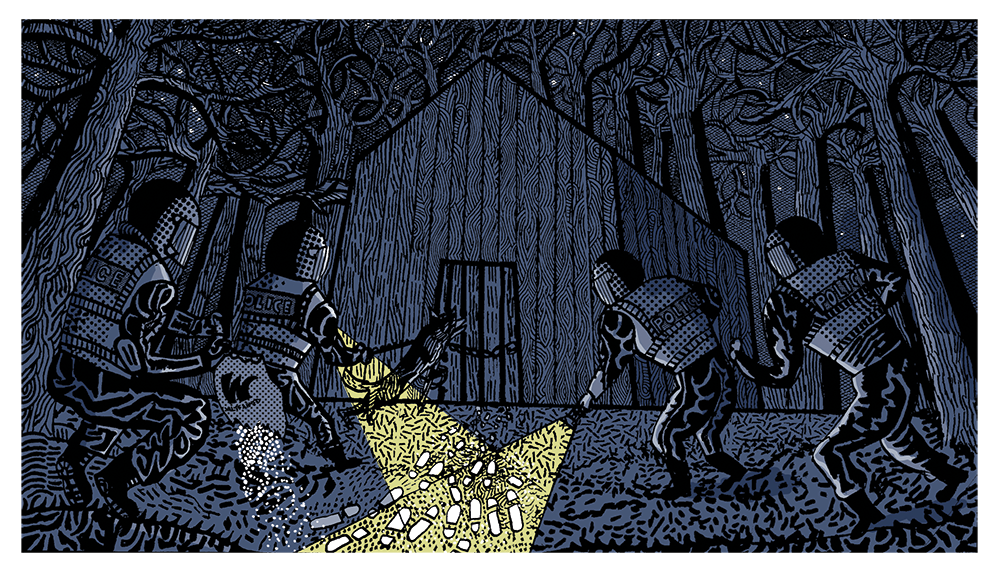
Organised crime has a new focus: high-end food production. The latest victim is Wildfarmed, a UK-based, regenerative flour business co–founded by one half of the band Groove Armada. Last month, 50 tons of its flour were stolen, disguised as a wholesale order for the French supermarket E. Leclerc. In an audacious move, the fraudsters asked for the wording on the bags to be translated into French. Wildfarmed obliged. The 1kg bags – all 50,000 of them – were loaded into containers ready for export. Then they vanished.
Wildfarmed’s disco-ball neon branding makes it a surprising target. But the real question is not how anyone hides a haul of hard-to-miss flour bags, but whether this theft is a bellwether. As our interconnected global food system buckles under record-breaking weather events and price-spiking politics, is food – something we treat as an always-available commodity – becoming so valuable it is now worth stealing?
The flour bags – all 50,000 of them – were loaded into containers ready for export. Then they vanished
The same scam had been used in October 2024 to defraud the high-end cheese merchant Neal’s Yard Dairy. Nearly 1,000 wheels of clothbound cheddar worth around £300,000 were ordered by a buyer posing as a distributor to French supermarkets, and delivered to warehouses in and around London. Neal’s Yard paid all the farmers regardless, some of whom had supplied them for more than 30 years. Patrick Holden, founder of the Sustainable Food Trust – whose farm contributed two and a half tons of Hafod cheddar, its biggest-ever order – chooses to look on the bright side, saying the theft ‘demonstrated high-quality UK foods with a good story are becoming valuable – even to the French’.
The Chapel and Swan Smokehouse in Suffolk was hit shortly afterwards. Since 2004 the artisanal business has supplied fish and meat, traditionally smoked and cured by a small team in a brick kiln in the village of Exning. When an order for £37,000 of smoked salmon came in from a wholesale distributor, it too reasoned it was driven by a growing appreciation of quality.
When a second order was raised before the first had been settled, the director, Chris Swales, became suspicious. He called the French supermarket directly, uncovering the scam. Swales traced the delivery address to what he describes as a ‘really shady’ garage in east London complete with guard dogs and shipping containers. The £28,000 loss was unrecoverable.
Tempting as it is to cast the heists as Wallace and Gromit plotlines or a gift to a marketing team – it’s so good it’s worth stealing – their sophistication and scale point to something graver. A recent government report declared biodiversity loss and ecosystem collapse to be a national security threat, predicting that black markets in scarce food would become a target for serious and organised crime.
The report, compiled by the Joint Intelligence Committee, had been due for release last autumn. Its findings were presented at a Cobra meeting, convened for matters of national emergency, then all went quiet. Ruth Chambers of Green Alliance, the environmental thinktank and charity, forced the report’s release through a Freedom of Information request. After initial refusals, the threat of appeal focused minds. ‘The deadline for that internal review was the day on which the government published the summary version of the report,’ says Chambers.

Released without fanfare on the Defra website, the document’s contents explain the reticence. Ecosystem collapse is now a likely reality not a hypothetical, it states, and presents a direct and escalating threat to UK national security. If biodiversity continues to decline at current rates, every critical ecosystem – from water to soil to pollinators – faces collapse, some within five years. Each one underpins our ability to feed ourselves. The format of the report, says Chambers, suggests a fuller version exists that the government is refusing to publish.
The report highlights something that is little understood by shoppers used to year-round food choice, irrespective of season. Our global food system is so interconnected that poor harvests on the other side of the world won’t just lead to price hikes, but crime spikes.
In the olive-growing areas of Europe, years of erratic weather have brought crop-eroding droughts and disrupted growing cycles, and thousands of trees have been destroyed in record-breaking wildfires. Between 2020 and last year, the price of olive oil in the UK rose by 118 per cent, while in 2024 olive oil fraud more than doubled and 10,500 haulage lorries had goods stolen from them. When Tesco starts security-tagging olive oil, we should all pay attention.
Coffee and cocoa tell a similar story. Poor harvests caused by extreme weather saw chocolate prices rise by 45 per cent from 2022 to 2025 as the cost of raw cocoa tripled, while Arabica beans went up 80 per cent in 2024. Large-scale organised theft of green coffee beans has been reported in producing countries such as Brazil and Vietnam and in importer countries like the US. Meanwhile food giant Pladis has changed the recipe of Penguin and Club biscuits. ‘If you like a lot of chocolate-flavoured coating on your biscuit, join our Club’ doesn’t have quite the same ring to it, but it beats having to lock bars in plastic boxes, as Sainsbury’s did with Cadbury’s Dairy Milk last month in an attempt to prevent thefts .
Even in the UK, with its historically forgiving seasons, the 2024 wheat harvest fell by 20 per cent after the wettest September to May on record. The 2025 harvest was the second-worst on record and modelling for 2024/25 showed that even after government payments, farms made a loss per hectare on average. In an echo of the 2022 Ukraine war – which saw UK fertiliser prices treble in two years – the US-Israeli strikes on Iran have already spiked fertiliser costs. Qatar has halted nitrogen fertiliser production altogether.
Last month, the government finally released long-awaited plans for the Sustainable Farming Incentive (SFI) – the scheme which rewards farmers for adopting nature-friendly farming techniques – which had been pulled without warning in March last year. The headline figure of £2.7 billion bundles nature-friendly farming with landscape recovery schemes such as tree-planting and peatland restoration. One grows food; one does not. Defra says it will reveal the SFI budget in June, shortly before the application window opens. The previous cap was £1.05 billion – a fraction of the £5.9 billion that the RSPB, National Trust and Wildlife Trusts say is needed to meet the government’s own legally binding nature targets.
‘The transition to nature and climate resilient farming has never been more urgent,’ says Vicki Hird of the Wildlife Trusts. ‘It’s vital that the budget for these schemes is considerably increased.’ A look at the government’s allocation of funds amid current ‘build, build, build’ mania suggests they do not agree. The entire two-year SFI fund designed to persuade farmers to grow food in a way which works with, not against, natural systems is less than the £1.6 billion allocated for annual local road maintenance.
Poor harvests on the other side of the world won’t just lead to price hikes, but crime spikes
The scammers targeting award-winning cheddar, smoked salmon and regenerative flour are operating at the premium end. But they foreshadow something wider. Food and drink accounted for 22 per cent of all product thefts in 2024. There was a tenfold increase in food fraud between 2020 and 2024, costing the UK economy up to £2 billion per year. Global food supply-chain thefts rose 79 per cent in 2024. The supply-chain intelligence firm BSI called it ‘a pivotal moment’.
With over half our food imported, there is no comfort in treating Amazon deforestation or African desertification as someone else’s crisis. As Chambers puts it: ‘Biodiversity loss is a global threat and ecosystem degradation is happening everywhere.’
On Wildfarmed flour bags, a QR code allows customers to trace each bag from farm to shelf thanks to its segregated supply chain. It was not enough to stop the £50,000 theft. Traceability of this kind is absent from the vast majority of our shopping – and it won’t be enough on its own. Last year, the number of US farms declaring bankruptcy increased by 55 per cent, and more than a third of UK farms made no profit. We must turn our attention not to the symptom but the cause: both what we eat, and how we grow it, has a value we have never properly assigned.
‘The cost of degraded soils, polluted waterways and declining biodiversity has been measured in the trillions,’ says Wildfarmed’s Cato. ‘Yet our food system prices it at zero. No species survives the death of its ecosystem. We know everything we need to know to grow abundant food in a way that rebuilds nature and resilience.’ The government’s report, read in light of these thefts, makes one thing clear: the time to invest in how our food is grown is before the shelves are empty, not after.
Sarah Langford’s Rooted: How Regenerative Farming Can Save The World is out now.






Comments