
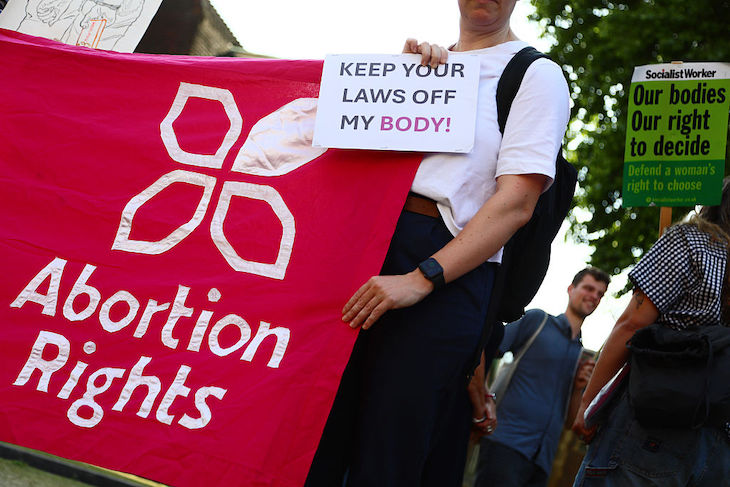
Last week, the body of an 18-day old baby girl was found in Westminster, in desperately sad circumstances. The baby’s mother has since been charged with her murder and stands accused of throwing her daughter out of a third-floor window. Five days later, and a few streets away, the House of Lords voted to approve the Crime and Policing Bill – including the controversial amendment, Clause 208. Proposed by the Labour MP Tonia Antoniazzi, Clause 208 would decriminalise self-administered abortions after the 24-week limit. The new legal position is that whatever a woman does to end her own pregnancy, at whatever stage, is no business of the criminal law. Should a mother decide to abort a full-term or late-term infant at home, the state will, essentially, be indifferent to that.
There are echoes here of the assisted suicide debate; haste, lack of detail
Peers also voted on several proposed amendments to the bill, aimed at modifying its more extreme aspects. One amendment, from Baroness Stroud, would have reinstated in-person appointments before obtaining abortion pills via post – a practice brought in during the pandemic, which was meant to be temporary. Another amendment from Baroness Monckton would have removed Clause 208 altogether. Both were voted down.
The debate invites numerous ethical questions. Why should it be the case that society and a state that are universally horrified at the tragedy of a murdered newborn, should extend none of this concern to a foetus aborted at full-term just 19 days earlier? Will police no longer investigate suspicious deaths of newborn babies, if these are claimed to have been late-term abortions? Crucially, why do so many campaigners assume it will always be a woman’s choice to do this rather than being coerced into it? The bill’s legal indifference, billed as compassion, may prove a gift to those who would abuse women, making it harder to identify and prosecute those responsible for coercing their partners or relatives into late-term abortions. Consider the case of Stuart Worby, jailed in December 2024 after arranging for a friend’s girlfriend to feign pregnancy and acquire abortion pills on his behalf via the pills-by-post scheme so that he could spike a woman’s drink and induce an abortion against her knowledge.

Yesterday morning, the abortion provider BPAS put out a press release, boasting about “modern values” and “strength of support” from the public. In fact, the public was not consulted at all and available polling suggests they reject the logic of Clause 208. Though the public broadly supports the right to an abortion, hardly anyone believes in abortion up to birth – one per cent, according to recent Savanta Comres polling. The same poll found that 60 per cent of respondents and 70 per cent of women believe that the 24-week abortion limit – already very permissive by European standards – should be reduced. There have been no impact assessments, no public consultation, and scarcely any public debate on Antoniazzi’s amendment, which passed the Commons after a mere 46 minutes of backbench debate.
There are echoes here of the assisted suicide debate; haste, lack of detail, arguments resting on emotion and a naive assumption that everyone will behave well – that Parliament shouldn’t also legislate for worst-case scenarios. There is also the familiar linguistic manipulation. “Decriminalisation” softens the impact of a change which will encourage the state to turn a blind eye to possible infanticide, coercion or sex-selective abortion. “Compassion” for the mother involves ignoring the moral status of a potentially viable foetus. Abortions, even late-term ones, are often spoken of as merely “healthcare”, as if they carried the same ethical implications as a hernia or slipped disc.
Baroness Spielman spoke powerfully of the dangers of the slippery slope, the “progressive urge always to find new frontiers at which one can prove one’s superior compassion”. Laws don’t exist only to prohibit or permit; they also express social values and encourage behavioural change. Once a principle has been accepted, extending its logic becomes gradually harder to argue against. Consider how pills by post, supposedly a short-term measure, have become not only permanent but their own argument for further liberalisation.
“We will be told by the same people”, added Spielman, “that it is cruel for a woman in late pregnancy to have to abort on her own, without access to the full range of drugs and clinical procedures and without support, and that all of these things must, therefore, be decriminalised – at which point we will have no abortion law at all.” It will be worth remembering her remarks, if and when progressives deploy these arguments to justify expanding abortion further still.
This week’s vote not only represents a dramatic, unscrutinised shift from the existing legal framework, but in going so much further than the public would like, it risks disturbing a consensus on abortion that was largely settled. Many who generally supported abortion with certain caveats would be aghast at the thought of the state turning a blind eye to the termination of viable, full or near-term pregnancies, and the whole business attracting so little debate. In the years to come, such overreach may be punished.






Comments